
The Archaeological Area of Agrigento, popularly known as the Valley of the Temples (Valle dei Templi), is one of the most sublime expressions of ancient Greek architecture and culture outside of Greece itself. Located on the southern coast of Sicily, it stands as a monumental reminder of the power and wealth of the ancient city of Akragas.
Contrary to its name, the site is actually located on a high ridge overlooking the sea rather than a valley. It encompasses approximately 1,300 hectares, making it one of the largest archaeological parks in the world. The area features a stunning row of Doric temples built from local golden-yellow sandstone.
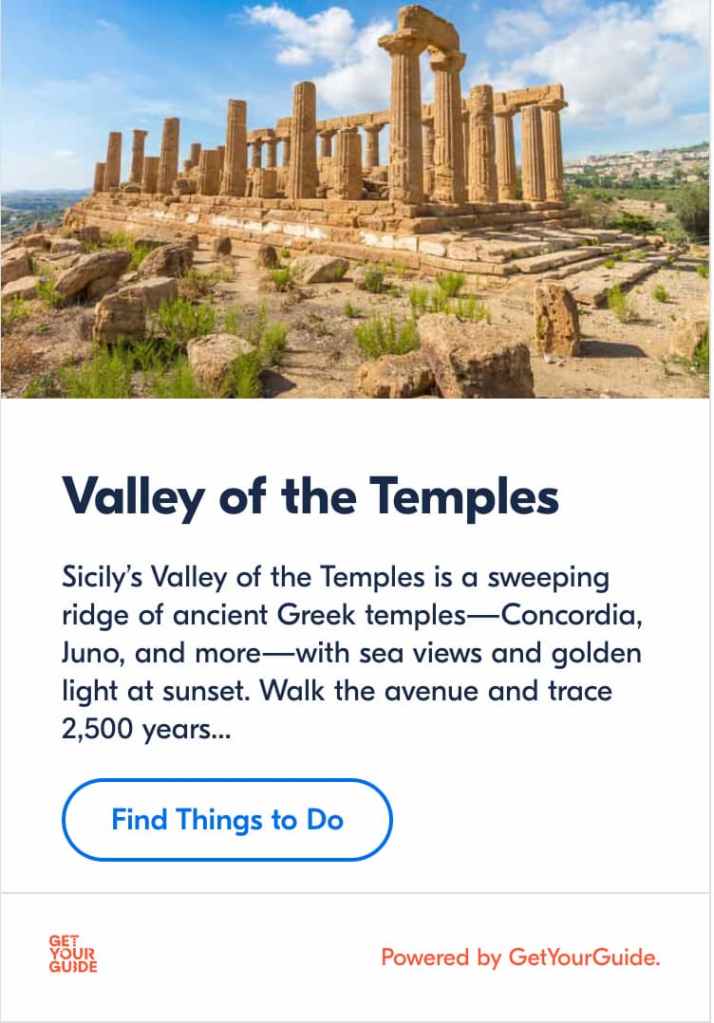
The most complete structure is the Temple of Concordia, which remains one of the best-preserved Greek temples in existence. Other major ruins include the Temple of Juno, the Temple of Heracles (the oldest on the site), and the massive Temple of Olympian Zeus, which was intended to be the largest Doric temple ever built, though it now lies in ruins. The site also includes a complex necropolis, ancient fortifications, and the beautiful Kolymbethra Garden, a lush oasis of citrus and olive trees.
Attraction
Agrigento is a magnet for history enthusiasts and photographers alike for several reasons:
- The “Concordia” Silhouette: The Temple of Concordia’s near-perfect preservation offers a rare, visceral connection to the 5th century BC.
- Golden Hour Spectacle: The sandstone structures absorb the sunlight, turning a deep amber-gold at sunset. The site is also illuminated at night, creating a dramatic skyline visible from the modern city.
- The Telamons: Visitors can see the remains of the Telamons—colossal stone figures that once supported the Temple of Zeus. A massive reconstructed replica lies on the ground, illustrating the sheer scale of ancient Greek ambition.
- Cultural Integration: The site hosts the annual Almond Blossom Festival in spring, blending ancient heritage with Sicilian folklore.

Heritage
Inscribed as a UNESCO World Heritage Site in 1997, Agrigento is recognized for its “Outstanding Universal Value”:
- Criterion (i): The Greek temples of Agrigento constitute one of the most extraordinary ensembles of Greek architecture in the Mediterranean.
- Criterion (ii): It represents a significant exchange of cultural values during the period of Greek colonization, showcasing the peak of the Doric style.
- Criterion (iii): Akragas was one of the greatest cities of the ancient Mediterranean world, and its remains provide exceptional testimony to the social and political organization of the era.
- Criterion (iv): The site is an incomparable example of an ancient city’s integration with its surrounding landscape.
Gateways
While Agrigento has a railway station and many hotels, the primary gateways with commercial airports are Catania or Palermo.
- Commercial Airports: Catania-Fontanarossa Airport (CTA) and Falcone-Borsellino Airport (PMO) in Palermo are the two major hubs.
- Lodging: Both cities offer extensive luxury and boutique lodging. However, for a visit to the temples, many travelers stay overnight in the modern city of Agrigento, which has hundreds of B&Bs and luxury hotels like the Villa Athena, which sits directly inside the park.
- Transit: From either airport, it is a roughly 2 to 2.5-hour drive or a direct train/bus ride to Agrigento.
When
- Spring (March to May): This is the peak experience. The almond trees are in bloom, the weather is mild (15°C to 22°C), and the hills are lush and green.
- Autumn (September to October): The summer heat has faded, but the Mediterranean remains warm enough for a nearby swim.
- Winter (November to February): Crisp and cool; the site is much quieter, though it can be windy.
- Caution: July and August are extremely hot (35°C); if visiting then, only go at sunrise or for a night tour.

Consideration
- Sun Exposure: There is very little shade among the ruins. Hats, sunscreen, and water are non-negotiable.
- Walking Distance: The archaeological path is roughly 2–3 km long. Comfortable walking shoes are essential. There is a shuttle service available for a small fee between the two main entrances (Eastern and Western).
- Combined Tickets: Consider buying a combined ticket that includes the Pietro Griffo Archaeological Museum, which houses the original Telamon and one of Italy’s finest collections of Greek vases.
- Night Tours: During summer, the park often stays open until midnight. This is highly recommended to avoid the heat and see the temples beautifully lit.

Resources
- Parco Valle dei Templi – Official Site: The definitive source for ticket prices, opening hours, and event schedules.
- UNESCO World Heritage – Agrigento: For official maps and the detailed history of the Greek colony.
- Visit Sicily – Official Tourism Portal: A great resource for broader travel planning across the island.
- The Thinking Traveller: A deep-dive cultural guide with high-quality photography and context.
- Viator – Agrigento: A reliable platform for booking skip-the-line tickets and expert-led guided walking tours.
Featured Image
Temple of Concordia (Anna & Michal, Flickr/CC BY-SA 2.0).
In The News
Advertisement


Comment:
 All About World Heritage Sites (...and more)

_Telamon.jpg)
Leave a comment