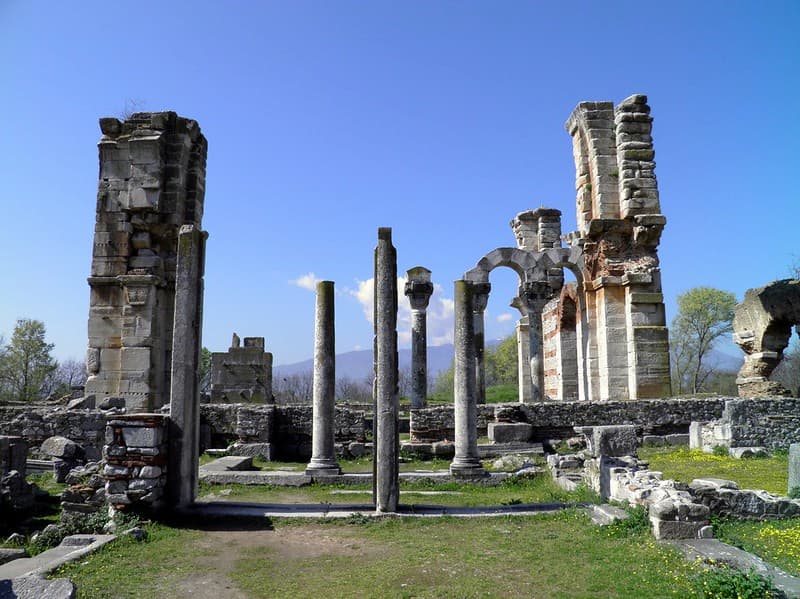
The Archaeological Site of Philippi is a sprawling complex located in the Macedonia region of Greece, offering a profound journey through Hellenistic, Roman, and early Christian history. Established originally as Crenides by Thasian colonists, it was captured and renamed by Philip II of Macedon in 356 BC, serving as a vital strategic outpost. Later, following the pivotal Battle of Philippi in 42 BC, it became a Roman colony and was subsequently reshaped by its significant role in the spread of Christianity, marked by the arrival of the Apostle Paul in 49 AD.
The site is notable for its layers of distinct historical epochs, visible across a wide area.
- The Theatre: A massive Hellenistic theater, later expanded by the Romans, which could hold thousands of spectators and is still used today.
- The Roman Forum: The central hub of Roman Philippi, featuring the remains of public buildings, temples, and shops surrounding a large paved square.
- Early Christian Basilicas: Ruins of several large churches, including Basilica A and Basilica B, illustrate the city’s transformation into a major Christian center.
- The Prison of Paul: A small structure traditionally believed to be the place where the Apostle Paul was imprisoned.
Attraction
Philippi attracts tourists worldwide primarily due to its unique historical significance, blending military, political, and religious milestones.
- Biblical Significance: As the site of the first Christian church established by Paul on European soil, it is a crucial pilgrimage destination.
- Roman History: The location of the decisive battle between Mark Antony/Octavian and Brutus/Cassius makes it a compelling site for Roman history enthusiasts.
- Architectural Diversity: Visitors can explore a remarkable variety of structures ranging from Greek theaters to vast Christian basilicas within a single complex.

Heritage
Inscribed in 2016, Philippi is recognized for its exceptional universal value under Criterion (iii) and (iv):
- Criterion (iii): It bears unique testimony to the layers of history in the region, showcasing the distinct architectural styles and urban planning of the Hellenistic, Roman, and Early Christian periods.
- Criterion (iv): The site is an outstanding example of a fortified Hellenistic city that was later transformed by the Romans into a “small Rome” and subsequently became a pivotal center for the development of early Christianity.
Gateway
- The City: The coastal city of Kavala serves as the perfect gateway to Philippi, located just 15 km (about a 20-minute drive) from the archaeological site.
- Airport: Kavala Airport “Alexander the Great” (IATA: KVA) offers domestic flights from Athens and international charter flights during the summer season.
- Lodging: Kavala provides a wide array of lodging options, from luxury beachfront hotels to cozy boutique guesthouses in its historic Panagia district.
When
- Spring (April to June) and Autumn (September to October): These are the optimal times. The weather is pleasantly warm (15–25°C), ideal for walking around the outdoor ruins.
- Avoid July and August: Peak summer months are often intensely hot (30°C+) and crowded.

Consideration
- Extensive Walking: The site is vast and mostly outdoor, requiring significant walking on uneven terrain. Wear comfortable walking shoes.
- Limited Shade: There is minimal cover from the sun, so bring a hat, sunscreen, and plenty of water.
- Combined Ticket: A single ticket often covers entry to both the archaeological site and the onsite museum.
- Plan for Time: Allow at least 3 hours to thoroughly explore all the major sections of the complex.

Resources
- UNESCO – Archaeological Site of Philippi: Official archive for maps, conservation reports, and detailed history.
- Ministry of Culture – Philippi: Official government site for opening hours, entrance fees, and current alerts.
- Visit Greece – Philippi Guide: Practical tourism info, transport options, and nearby attractions.
- Bible Places – Philippi: Historical and archaeological context from a biblical perspective.
- Viator – Macedonia Tours: For booking guided day trips from Kavala or Thessaloniki, including transport and a knowledgeable guide.
Featured Image
Basilica B (Carole Raddato, Flickr/CC BY-SA 2.0).
In The News
Advertisement


Comment:
 All About World Heritage Sites (...and more)
Leave a comment