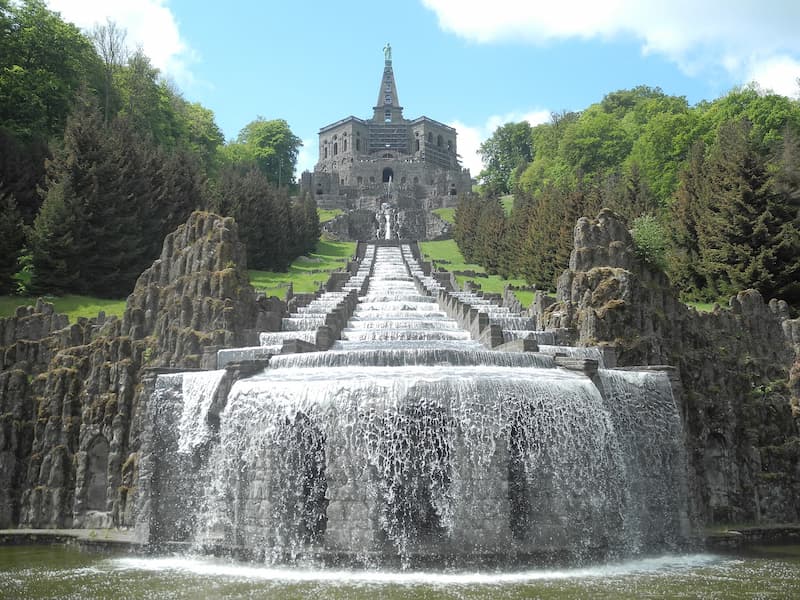
Located in Kassel, Germany, the Bergpark Wilhelmshöhe is a monumental landscape park covering 560 hectares, making it the largest European hillside park. Construction began in 1689 and continued for nearly 150 years, resulting in a dramatic blend of Baroque architectural grandeur and English landscape garden design. The park is crowned by the massive Hercules Monument, from which a complex, pump-free water system cascades downhill, powering various fountains, grottoes, and waterfalls before ending at the Wilhelmshöhe Palace pond.
The park is organized along an east-west axis, descending a height of roughly 315 m. Key features include:
- The Hercules Monument: A copper statue of Hercules atop an octagonal building and pyramid, visible from across the city.
- The Water Features (Wasserspiele): A series of cascades, waterfalls, and basins fed by reservoirs located behind the Hercules monument. Water travels 12 km purely by gravity.
- Löwenburg (Lion’s Castle): A picturesque artificial ruin designed to look like a medieval knight’s castle.
- Wilhelmshöhe Palace: A neoclassical palace at the bottom of the park, now housing an art museum and gallery of Old Masters.
Attraction
Tourists worldwide are drawn to the park for several reasons:
- Natural Water Spectacular: The water features are a unique engineered spectacle, operating without pumps for over 300 years.
- Scale and Beauty: It is an unparalleled combination of massive architecture and scenic landscape, allowing for hours of hiking through different “scenic zones.”
- Art and History: The palace museum houses a prestigious collection, including works by Rembrandt and Dürer.

Heritage
Bergpark Wilhelmshöhe was inscribed by UNESCO in 2013 based on two criteria:
- Criterion (iii): The park is a remarkable testimony to the aesthetics of the Baroque and Romantic periods, demonstrating the power and wealth of the absolutist landgraves of Hesse-Kassel.
- Criterion (iv): The ensemble of water features and architectural settings is unparalleled in garden art, representing the pinnacle of monumental water engineering in the Early Modern era.
Gateway
Kassel is the gateway town, providing necessary infrastructure for tourists.
- Airport: Kassel Airport (KSF) is the closest commercial airport, offering limited regional flights. For international arrivals, Frankfurt Airport (FRA) is the best choice, connected by a direct 1.5-hour train ride to Kassel-Wilhelmshöhe station.
- Lodging: Kassel offers extensive lodging, from luxury hotels near the park entrance (like the Schlosshotel Wilhelmshöhe) to budget options in the city center.
When
- Best Time for Water Features: May 1st to October 3rd. The water features operate only on Wednesdays, Sundays, and public holidays during this period.
- Best Weather: Spring (May-June) and Autumn (September-October) offer pleasant temperatures for walking the steep slopes.

Consideration
- Physical Fitness: The park is extremely steep. Climbing from the palace up to the Hercules monument takes considerable effort; it is best to take a bus to the top and walk down.
- Transportation: The park is car-free. Use the local tram and bus system (lines 4, 12, or 22) to reach the upper or lower entrances.
- Walking Gear: Sturdy walking shoes are essential.
- Entrance Fees: While the park is free, entrance fees apply for the Hercules Monument, the Löwenburg, and the palace museum.

Resources
- UNESCO World Heritage Centre – Bergpark Wilhelmshöhe: Official site detailing the heritage criteria and history.
- Visit Kassel – Official Tourism Portal: Logistics for transportation, schedules for the water features, and map downloads.
- Museumslandschaft Hessen Kassel (MHK): Official site for booking tickets to the Palace, Löwenburg, and Hercules Monument.
- German National Tourist Board: General travel overview and visitor tips.
- GetYourGuide – Kassel Tours: A platform to book guided walking tours of the park and water features.
Featured Image
The Great Cascades (Baummapper, Wikimedia/CC BY-SA 3.0).
In The News
Advertisement

Comment:
 All About World Heritage Sites (...and more)


Leave a comment