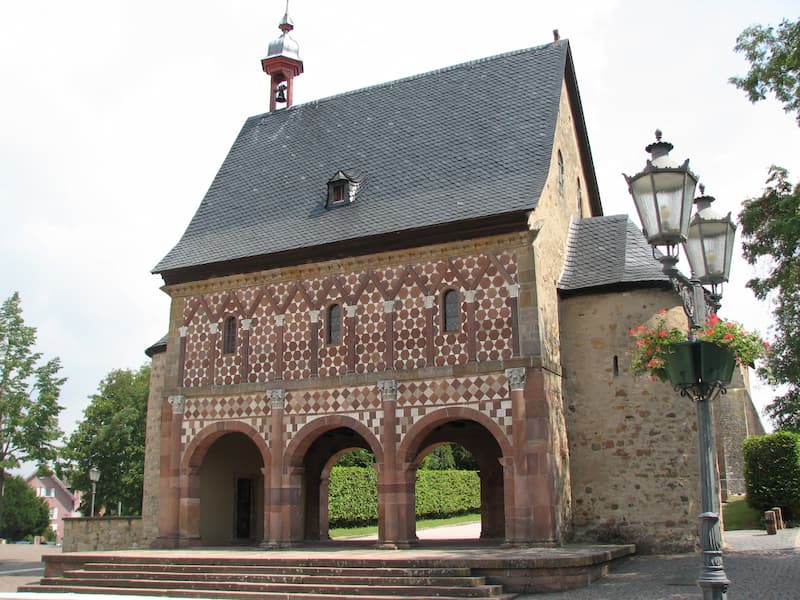
The Abbey and Altenmünster of Lorsch, located in the Hessian town of Lorsch, Germany, is a monumental link to the Carolingian Empire. Founded in 764 CE, it was once one of the most powerful Benedictine abbeys in Europe, serving as a spiritual and political nerve center for the Frankish kings.
The site is composed of several key elements:
- The King’s Hall (Königshalle): This is the crown jewel of the site. It is one of the few Carolingian buildings in the world that remains standing and largely intact. Its distinctive façade, featuring red and white sandstone tiles and triple arches, reflects a “Renaissance” of Roman architectural styles.
- The Church Fragment: A remaining section of the massive Romanesque abbey church that once stood here.
- The Altenmünster: The “Old Monastery” site, located about 500 m away, where the original foundation took place. Today, it is an evocative archaeological park where the footprints of lost buildings are traced in the landscape.
- Lauresham Open-Air Laboratory: A reconstructed 1:1 scale Carolingian manor farm where experimental archaeology brings the 9th-century daily life of serfs and lords to life.
Attraction
Lorsch attracts visitors primarily as a “Time Capsule of Charlemagne.”
- Architectural Rarity: For architects and historians, seeing a structure from the 800s CE that isn’t a ruin is a rare privilege.
- Royal Burial Ground: It was the final resting place for several Carolingian kings, including Louis the German, making it a site of immense dynastic importance.
- Medieval Science: The site is home to the Lorsch Pharmacopoeia, the oldest preserved book of monastic medicine in the West (now part of UNESCO’s Memory of the World).
- Interactive History: The Lauresham laboratory allows families and tourists to see ancient breeds of cattle and traditional crafts in action.

(Ludvig14, Wikimedia/CC BY-SA 4.0).
Heritage
Inscribed in 1991, Lorsch was recognized under two main criteria:
- Criterion (iii): The religious complex, specifically the King’s Hall, is a unique and excellently preserved document of the Carolingian era, including original sculptures and paintings.
- Criterion (iv): The abbey provides definitive architectural evidence of the “awakening of the West” under Charlemagne, serving as a prototype for medieval monastic development across Europe.
Gateway
- City: Frankfurt is the ideal gateway, located just 50 km (approx. 40 minutes) north of Lorsch.
- Airport: Frankfurt Airport (FRA) is one of the world’s busiest international hubs, offering direct flights from nearly every continent.
- Lodging: While Lorsch itself has charming boutique stays like the Hotel Karolinger Hof, Frankfurt offers a massive range of luxury and business hotels. Many travelers visit Lorsch as a day trip from Frankfurt or nearby Heidelberg.
When
- Spring (April to June): The Monastic Herb Garden and peony gardens are in full bloom, and the weather is perfect for walking the “Culture and Nature Axis” between the sites.
- Summer (July to August): Ideal for visiting the Lauresham Open-Air Laboratory, as this is when most live demonstrations and outdoor workshops occur.
- December: The Lorsch Christmas Market, set against the backdrop of the illuminated King’s Hall, is intimate and deeply atmospheric.

Consideration
- Size of the Site: Lorsch is a “slow travel” destination. While the physical buildings are few, the archaeological landscape is large. Allow at least 3–4 hours to walk the circular path.
- Guided Tours: Access to the interior of the King’s Hall is typically restricted to guided tours. It is wise to book these in advance via the official website, especially for English-language requests.
- Experimental Archaeology: Check the schedule for Lauresham before going; it is a research facility, and certain areas may be closed for active experiments on specific weekdays.
- Footwear: You will be walking on grass, gravel, and cobblestones; sturdy walking shoes are essential.

(Immanuel Giel, Wikimedia/CC BY-SA 4.0).
Resources
- Official Lorsch Abbey Website: The definitive source for 2026 tour times, tickets, and accessibility information.
- UNESCO World Heritage Centre – Lorsch: Provides the technical and historical justification for its status.
- Staatliche Schlösser und Gärten Hessen: The state portal for managing Hessian heritage sites, offering regional travel context.
- World Heritage Site – Lorsch Review: A community-driven site providing practical tips from recent travelers.
- Viator – Frankfurt Day Trips: Useful for booking organized transport and guided day tours departing from Frankfurt.
Featured Image
Abbey of Lorsch (Elswhs, Wikimedia/CC BY-SA 3.0).
In The News
Advertisement


Advertisements
Advertisements
Advertisements
Comment:
Advertisements
 All About World Heritage Sites (...and more)
.jpg)


Leave a comment