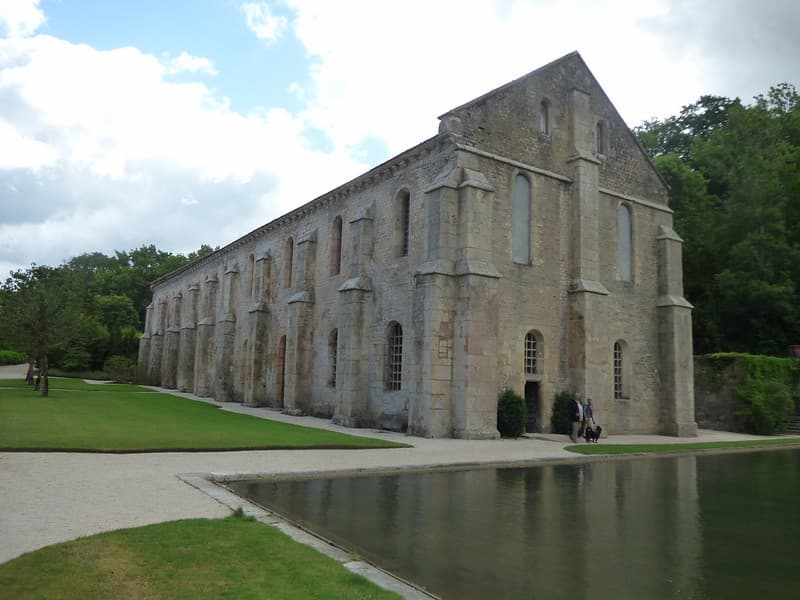
Founded in 1118 by Saint Bernard of Clairvaux, the Cistercian Abbey of Fontenay is one of the oldest and most complete Cistercian abbeys in Europe. Tucked away in a marshy valley in Burgundy, France, it serves as a pristine time capsule of 12th-century monastic life.
The Abbey of Fontenay is the quintessential example of the “Cistercian style”—an architectural philosophy rooted in austerity, manual labor, and prayer. Unlike the ornate Gothic cathedrals of the same era, Fontenay is defined by its monastic minimalism: no stained glass, no statues, and no decorative carvings that might distract a monk from contemplation.
The complex is exceptionally well-preserved and includes:
- The Abbey Church: A massive, cruciform structure with a barrel-vaulted nave.
- The Cloister: The spiritual heart of the abbey, featuring elegant Romanesque arches.
- The Dormitory: A vast hall where monks slept on straw mats, topped by a magnificent 15th-century oak roof.
- The Forge: One of the oldest industrial buildings in Europe, where monks used a hydraulic hammer to process iron.
Attraction
- Total Immersion: Because the abbey was sold and used as a paper mill after the French Revolution, it escaped the “modernization” that ruined many other medieval sites. Visitors feel like they have stepped directly into the year 1150.
- The Gardens: The site features beautifully landscaped formal gardens that have earned the “Jardin Remarquable” (Remarkable Garden) label from the French Ministry of Culture.
- Architectural Purity: For fans of Romanesque architecture, Fontenay is the “Gold Standard.” The interplay of light and shadow on the bare stone creates a serene, almost modern aesthetic.
- Industrial History: The forge provides a rare look at medieval technology, showing that the monks were not just men of prayer but also sophisticated engineers.

Heritage
UNESCO inscribed the Cistercian Abbey of Fontenay in 1981 under Criterion (iv):
- The Cistercian Ideal: It is the best-preserved example of a Cistercian monastic ensemble. It perfectly illustrates the spiritual and communal life of the order, which sought to return to the strict “Rule of Saint Benedict.”
- Architectural Unity: The site demonstrates a rare degree of integrity; almost all the original monastic buildings (church, refectory, dormitory, forge, and bakery) remain standing and in their original configuration.
Gateway
The city of Dijon, the historic capital of the Dukes of Burgundy, is the primary gateway to Fontenay.
- Commercial Airport: Dijon-Bourgogne Airport (DIJ) serves the region, though many international travelers arrive via the high-speed TGV train from Paris (CDG) or Lyon (LYS), both of which are major global hubs.
- Lodging: Dijon offers a wide array of high-quality lodging, from 5-star heritage hotels like the Grand Hôtel La Cloche to charming boutique guesthouses.
- Proximity: From Dijon, the abbey is a 1-hour drive or a short train ride to the town of Montbard, which is just a few kilometers from the abbey gates.
When
- Spring (May–June): This is the peak time for the gardens. The air is crisp, the greenery is lush, and the crowds are manageable.
- Autumn (October): The surrounding forests of the Burgundy countryside turn deep shades of gold and red, providing a stunning natural frame for the pale limestone of the abbey.
- Early Morning: To experience the true silence and “peace” of the abbey, arrive as soon as the gates open at 10:00 AM.

Consideration
- Remote Location: The abbey is located in a secluded valley. While you can take a train to Montbard, you will need a taxi, a local bus, or a 40-minute walk to reach the site. Renting a car is highly recommended for exploring the broader Burgundy region.
- Temperature: Even in summer, the thick stone walls of the church and dormitory keep the interiors quite chilly. Bring a light sweater or jacket.
- Physical Activity: The site is large, and the paths are mostly gravel or grass. Wear sturdy walking shoes.
- Silence and Respect: While not an active monastery today, it is still a place of quiet reflection. Loud groups are discouraged, and certain areas have restricted photography.
- Amenities: There is a small gift shop and a snack bar, but for a full meal, you should plan to eat in the nearby town of Montbard.

Resources
- Official Website of the Abbey of Fontenay – The most accurate source for opening hours, ticket prices, and historical archives.
- UNESCO World Heritage Centre – Detailed maps and the official Statement of Significance for the site.
- Burgundy Tourism (Official) – A comprehensive guide to the region, including food, wine, and other nearby heritage sites.
- The Cistercian Order – Provides the spiritual and historical context of the monks who built Fontenay.
- Trip.com – A robust platform for booking hotels in Dijon or Montbard and securing guided tours of the Burgundy region.
Featured Image
The Abbey Church (Elliott Brown, Flickr/CC BY-SA 2.0).
In The News
Advertisement


Comment:
 All About World Heritage Sites (...and more)
Leave a comment