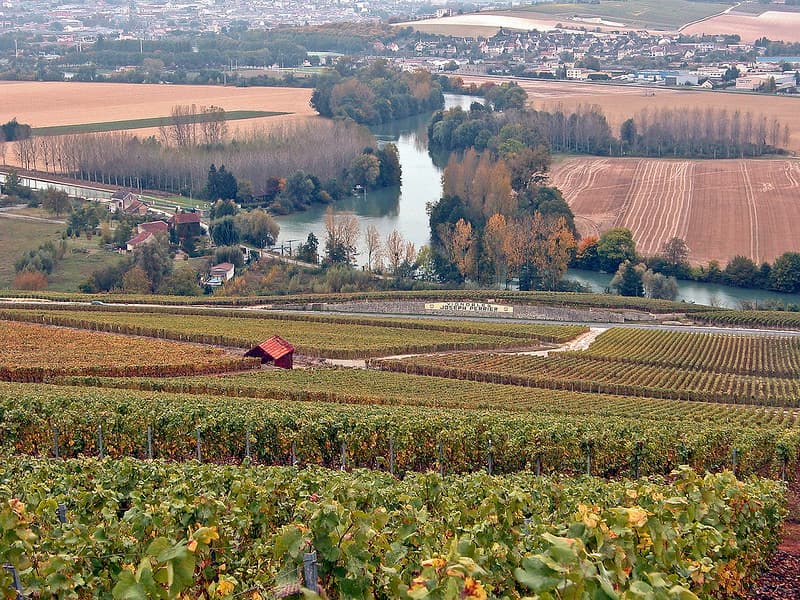
The Champagne Hillsides, Houses and Cellars is a serial UNESCO World Heritage site in northeast France. Unlike a single monument, it is a “cultural landscape” that encompasses the entire technical and social system required to produce, age, and sell one of the world’s most prestigious wines.
The site is composed of three distinct functional clusters located in the Marne department:
- The Historic Hillsides: Centered around the villages of Hautvillers, Aÿ, and Mareuil-sur-Aÿ, these are the most ancient vineyards where the sparkling wine method was pioneered in the 17th century.
- Saint-Nicaise Hill (Reims): This urban area sits atop massive, cathedral-like underground chalk quarries known as crayères. These cool, humid tunnels, some dating back to the Roman era, were repurposed by champagne houses to age millions of bottles at a stable temperature.
- Avenue de Champagne (Épernay): Often called the “most expensive street in the world,” this avenue is lined with the opulent 19th-century mansions of houses like Moët & Chandon and Perrier-Jouët. Beneath the asphalt lies a 110km labyrinth of cellars.
Attraction
Champagne is unique because it is both a place and a universal symbol. Tourists are drawn to:
- The “Crayères” Experience: Descending 20–30 meters underground into the white chalk pits is a sensory experience unlike any other vineyard tour.
- Architectural Grandeur: The “Houses” are not mere offices; they are palaces designed to showcase the prestige of the brand, featuring eclectic styles from Neoclassical to Art Deco.
- Gastronomy: The region offers a high concentration of Michelin-starred restaurants and specialized boutiques (like Maison Fossier for pink biscuits) that pair perfectly with the local bubbly.
- The “Dom Pérignon” Legacy: Visiting the Abbey of Hautvillers allows travelers to stand at the grave of the monk who revolutionized the blending and bottling process.

Heritage
UNESCO recognized the site in 2015 based on its Outstanding Universal Value under three criteria:
- Criterion (iii): It bears witness to a specialized know-how (the Méthode Champenoise) perfected over centuries through social and technical innovation.
- Criterion (iv): It is a complete “agro-industrial system.” The spatial organization—vineyards as the supply basin, cellars as processing sites, and houses as marketing hubs—is perfectly preserved.
- Criterion (vi): The site is the tangible home of a globally recognized symbol of celebration, reconciliation, and the French “Art de Vivre.”
Gateway
The city of Reims is the ideal gateway.
- Commercial Airport: While Reims has a small airfield (Prunay), the practical commercial gateway is Paris-Charles de Gaulle (CDG). It is connected directly to the Champagne-Ardenne TGV station in just 30–45 minutes by high-speed train.
- Lodging: Reims offers a vast range of options, from the ultra-luxurious Domaine Les Crayères to modern business hotels and charming boutique apartments near the Gothic cathedral.
When
- Late Spring (May to June): The vineyards are lush and green, the weather is mild (14°C to 21°C), and the “Flâneries Musicales” (open-air concerts) take place in Reims.
- Harvest Season (September): This is the most exciting time. The region buzzes with activity as thousands of pickers arrive. Note that some small producers may be too busy for tours during the peak weeks.
- December: While cold, Reims hosts one of France’s most beautiful Christmas markets in the shadow of its cathedral, often featuring light shows projected onto the facade.

Consideration
- Reservations are Mandatory: You cannot simply walk into the major champagne houses (like Veuve Clicquot or Taittinger) for a tour. Bookings often fill up weeks or months in advance.
- Dress for the Cellars: Regardless of the temperature outside, the underground cellars remain a constant, damp 10°C to 12°C (50°F to 54°F). Always bring a sweater or jacket.
- Comfortable Footwear: You will be walking on uneven cobblestones and descending dozens of stone steps into the caves. Leave the heels for dinner.
- The “Champagne” Rule: Remember that legally, it is only “Champagne” if it comes from this specific region. Referring to other sparkling wines as such is a faux pas here!

(Julien Maury, Flickr/CC0 1.0).
Resources
- UNESCO World Heritage Centre – The official scientific dossier and maps of the serial site.
- Champagne Patrimoine Mondial – The official site of the mission managing the heritage status.
- Comité Champagne – The interprofessional organization providing deep technical and historical context.
- Reims Tourism Office – Practical guides for city transport, lodging, and cathedral visits.
- Viator – A platform to book guided cellar tours and full-day vineyard excursions from Reims.
Featured Image
Hautvillers (Jean Weber, Flickr/CC BY 2.0).
In The News
Advertisement



Advertisements
Advertisements
Advertisements
Advertisements
Comment:
 All About World Heritage Sites (...and more)

Leave a comment