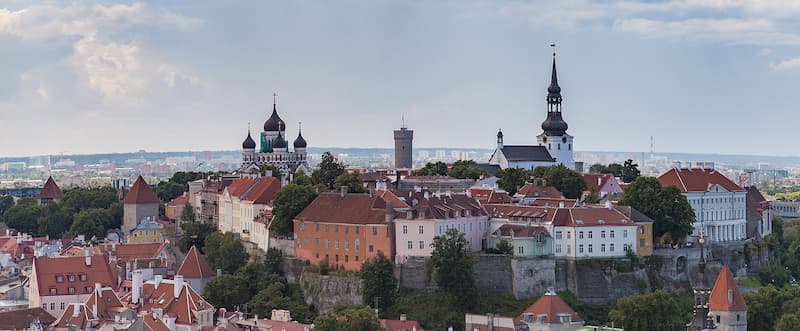
The Historic Centre (Old Town) of Tallinn, the capital of Estonia, is one of the most exceptionally preserved medieval trading cities in Northern Europe. Emerging as a prominent hub of the Hanseatic League between the 13th and 16th centuries, it remains a “living museum” where ancient cobblestone streets, Gothic spires, and a nearly complete defensive wall define the skyline of the Baltic coast.
Tallinn’s Old Town is divided into two distinct sections: Toompea (Upper Town) and the Lower Town. Toompea, perched on a limestone hill, has historically served as the seat of power, housing the medieval Toompea Castle and the 13th-century Dome Church. The Lower Town was the bustling domain of merchants and artisans, centered around the Raekoja Plats (Town Hall Square). The site is characterized by its original radial street network, narrow winding alleys, and remarkably intact 14th-century town walls, which still feature 26 original watchtowers.
Attraction
Tallinn attracts tourists worldwide by offering an authentic medieval atmosphere that feels untouched by time.
- The Christmas Fairytale: Tallinn’s Christmas Market, held in the Town Hall Square, is frequently voted the most beautiful in Europe, transforming the square into a snow-dusted wonderland.
- The Skyline and Viewpoints: The red-tiled roofs and dramatic church steeples are best viewed from the Kohtuotsa and Patkuli platforms, providing some of the most photographed vistas in the Baltics.
- Modern Medieval Fusion: Visitors can dine at themed restaurants like Olde Hansa, which replicates 15th-century dining, or explore hidden artisan workshops in St. Catherine’s Passage, where glassblowers and weavers work in ancient vaulted rooms.

Heritage
Tallinn was inscribed on the UNESCO World Heritage List in 1997 based on its “Outstanding Universal Value”:
- Criterion (ii): It was a powerful outpost of the Hanseatic League, acting as a crucible where the cultures of Northern and Eastern Europe intermingled through trade and religion.
- Criterion (iv): It is an outstanding example of a medieval Northern European trading city that has preserved its urban fabric—including the street layout, property boundaries, and defensive structures—to a degree that is rare in modern Europe.
Gateway
The city of Tallinn itself serves as the perfect gateway.
- Commercial Airport: Tallinn Lennart Meri Airport (TLL) is located just 4 km from the Old Town. It is consistently ranked as one of Europe’s “coziest” airports and offers direct flights to most major European hubs.
- Lodging: The city offers a vast array of accommodations. For a full experience, travelers often stay in boutique hotels within the Old Town walls (such as Hotel Telegraaf or The Three Sisters), though modern high-rise hotels like those in the Rotermann Quarter are just a short walk away.
When
- Summer (June to August): The “White Nights” provide nearly 19 hours of daylight, perfect for photography and outdoor festivals.
- Winter (December): Despite temperatures averaging below freezing (0°C to -5°C), this is a magical time to experience the world-famous Christmas market.
- Shoulder season (May and September): These months offer mild weather and significantly fewer crowds than the summer peak.

Consideration
- Comfortable Footwear: The Old Town is entirely pedestrian-friendly but dominated by uneven, historic cobblestones. Sturdy, flat shoes are a necessity.
- A Tale of Two Towns: Remember that Toompea (Upper) and the Lower Town were historically separate entities. Take the time to explore both; they are connected by the scenic “Long Leg” and “Short Leg” streets.
- Digital Convenience: Estonia is one of the most digitally advanced nations. Expect high-speed Wi-Fi everywhere and a largely cashless economy—even the smallest market stalls usually accept contactless payments.
- The “Lübeck Law”: Much of the town’s history is tied to German trade laws; hiring a local guide for a walking tour is highly recommended to understand the unique social hierarchy that built the city.

Resources
- Visit Tallinn – Official City Guide: The most comprehensive resource for events, the “Tallinn Card,” and neighborhood guides.
- UNESCO World Heritage – Tallinn: The official dossier detailing the architectural and historical significance of the site.
- Visit Estonia: The national tourism board’s portal for broader travel context in Estonia.
- Old Town Tallinn Management: Information on the ongoing conservation efforts and heritage laws protecting the site.
- GetYourGuide – Tallinn Old Town Tours: A reliable platform to book guided historical walks, food tours, or day trips to nearby national parks.
Featured Image
Tallinn skyline (Diego Delso, Wikivoyage/CC BY-SA 3.0).
In The News
Advertisement

Comment:
16 responses to “Historic Centre (Old Town) of Tallinn”
-
Its medieval markets, multicoloured gabled houses, impressive medieval fortifications, outdoor cafe-lined Town Hall Square and post-Soviet era ‘almost anything goes’ atmosphere make this city a real charmer. Estonians have spared their Old Town from either garish or drab modern architecture, making this Hanseatic League town a lustrous gem in a league of its own.
LikeLike
-
Tallinn was my favorite city on this tour. There’s something surreal about walking through a town that has existed since the 13th century. It’s as if you’ve stepped through a portal and are getting a glimpse at the ancient life of man.
Old Town is one of the best preserved medieval cities in Europe, and is a UNESCO World Heritage Site. We did the self guided tour outlined in Rick Steve’s guidebook, and walked along ancient streets filled with history, browsed merchant shops, toured grandiose churches, and lunched at the touristy but fun Olde Hansa restaurant. Olde Hansa stages period themed musical performances and all of the staff dress in medieval costumes.
LikeLike
-
Walking along twisting cobblestone lanes, passing colourful gabled houses, quaint courtyards with grand churches and gothic spires, I often felt as though I was in a fairytale. This illusion continued when we visited Old Hansa, a huge medieval restaurant (www.oldehansa.com) designed to transport diners back to the glory days of the Hanseatic League and built in the style of a rich merchant’s home. Our personal serving boy washed our hands and seated us in our Saxon Chamber. Our meal began with appetisers of pickled cucumbers, berries and quail eggs. Dishes of spelt, lentils and turnips laced with ginger arrived with wild boar, rabbit and bear. Drinks ran to cinnamon, dark honey and herb-flavoured beers.
In Rotermanni courtyard, I found the Kalev Chocolate Shop and Master’s Chamber (www.kalev.eu). Marzipan is an Estonian speciality.
On the eastern side, we found the harbour, the Tallinn Song Festival Grounds at Maajamae Castle and the former Soviet TV Tower. A few minutes walk away is Kadriorg Palace, which was built by Russian Emperor Peter the Great.
Then the bus whisked us on to Kalamaja, one of the oldest neighbourhoods in Tallinn, once the town’s main fishing harbour. We lunched at the fashionable F Block on Telliskivi, a factory converted into a busy, cheap restaurant, before discovering Balti Jaama Turg market.
LikeLike
-
Stepping off the Helsinki-Tallinn ferry in early evening we wandered the town at twilight, shuffling through its snowy streets as the glow from street lights warmed our path. We paused for window shopping. From the omnipresent goods crafted out of local amber to quirky boutiques, there were plenty of great shops in Tallinn’s old town, showing off the fact that Helsinki isn’t the only design-forward city in the Nordic region.
At Revel Denim Guild, a creative studio, denim store and milliners, we found timeless styles with contemporary cuts made of natural fibres. The company has been trading since 2012 and is, if you’ll pardon the pun, at the cutting edge of Tallinn’s fashion scene, revealing a northern cool, I’d yet to discover.
Again, the architecture lover in me was taken by everything from the bulbous domes of church roofs, to the stately neoclassical buildings and decorative doors, which I yearned to get a look behind. But I wouldn’t be dining with the locals in this city. Instead I headed back to my hotel, the Savoy Boutique Hotel, for dinner at its restaurant, Mekk.
LikeLike
-
After a short bus ride from the harbor, we explored the Old Town starting from a 15th-century watch tower and fortress, making old Tallinn a walled city. You could also see that it is a land of fairy tales, as statues of faceless robed creatures stand like sentinels in certain places.
A Christmas market in Europe evokes images of the storybooks I read as a child — snow-covered gabled rooftops, Gothic Towers, giant fir trees, snowmen with colorful mufflers and people wearing mittens and boots to church. Walking into Tallinn’s Christmas market was like walking into an ancient past that one only read about, and a near past that one enjoyed imagining as one’s mother told stories from a fairytale book.
Part of my childlike wonder at being in Estonia came from being in a land I had never been to. A new country, a new culture, but with the old familiar traditions of a universal Christian celebration like Christmas, and wonders that I had only imagined and dreamed about.
LikeLike
-
After arriving seven hours late, I strolled back to the Old Town to explore. And what a joy it was.
My first stop was walled Toompea, perched on a hill, which is home to the impressive Alexander Nevsky Orthodox Cathedral, Estonia’s parliament and some fine viewpoints. Next I headed back downhill to the busy Town Hall Square and had a pleasant lunch in the Baltic sunshine at one of the many restaurants, though bear in mind their prime location is reflected in the price.
LikeLike
-
Being my third time in Tallinn, I admire its old-town setting seeing that it is a charming little city, one of the best preserved medieval cities I have ever laid eyes upon in my travels throughout western and eastern Europe. Taking a walk through the narrow-cobbled streets, one could actually feel lost in time, and with just the right imagination, you can transport yourself to Tolkien’s ‘Middle Earth’ as you gaze upon the old Kiek in the Kok tower and walk by the ancient city walls, which stand as majestic as they did in the 13th and 14th centuries. Tallinn isn’t just about history, however. Club Hollywood is a fave among the locals, while The Bar With No Name is a hit among the tourists. When I was there last in 2009, the sounds of Brick & Lace and Sean Paul made me feel quite at home.
LikeLike
-
One of my favourite destinations, my most recent visit was in summertime, when the medieval Old Town with its fairy-tale red-tiled roofs and multi-coloured buildings was also ablaze with geranium-decorated flower-boxes and market stalls selling rainbows of blooms and vibrant artwork. There were rows of bright linens and woollens, too, but it was warm enough for my friend and me to wander the cobblestone streets in short sleeves, stopping occasionally at an al fresco café or bar for a cappuccino or craft beer.
LikeLike
-
It is a chilly day – Tallinn is a touch further north than Stockholm and has a distinct Scandi feel – but we soon warm up, zipping through beautiful cobbled streets, taking photos and asking questions of strangers. Our tour takes us up a winding staircase and into a tower guarded by Old Thomas, a key figure in the city’s history and amusingly portrayed by a member of the local tourist board. He tells us that the walls around the Old Town used to separate rich from poor, before his character struck a blow for equality during a hunting trip.
A few (inaccurate) goes on his cross-bow and a glug of the local spirit later, we meander over to the stunning Alexander Nevsky Cathedral, where Old Thomas is immortalised on a weather vane, and then on to the famous confectionary shop, Kalev. Here we rest our legs while decorating postcard-sized slabs of one of the local specialities: marzipan. The result makes for a memorable souvenir – although a glance at our handiwork is a ringing endorsement for the skills of the professionals.
LikeLike
-
I took a fascinating walking tour from an abandoned Soviet concert venue, Linnahall, to an abandoned Soviet prison, Patarei, on the sea, plus visited a massive graffiti wall in the Telliskivi Creative City, a hip area in a renovated 19th-century railway factory complex.
LikeLike
-
One Eastern European city you’re sure to fall in love with. This photogenic spot is a joy to explore with sights to stumble upon around every corner like the Town Hall Square, the Estonian Open-Air Museum and the Great Guild Hall.
LikeLike
-
The Old Town is pedestrianised (bring comfortable shoes for the cobbled streets) and everything is within easy walking distance. Don’t miss a stroll along the city ramparts and a trip up St Olaf’s Church tower for views of the red roofs of Tallinn. In an eerie echo of recent history, the tower was used as a radio tower and surveillance point by the KGB. Estonia has worked hard to shake off its Soviet past but there are still plenty of reminders for those who wish to look for them.
LikeLike
-
Tallinn is a city of wonderful views, one of the best being from the 400ft tower of the city’s main landmark, St Olaf’s Church. In the 16th century it was the tallest building in the world, boasting a tower 520ft high. Unfortunately it attracted lightning bolts as well as world records, and it was burned to the ground three times. The views are also superb from Toompea Hill, home to the castle, and the onion domes of Alexander Nevsky Cathedral, the city’s most extravagantly decorated Russian Orthodox church. For a different vista, take a lunch cruise and see Tallinn from the sea. We arrived in the city by boat from Helsinki, and it was a lovely way to see the medieval skyline for the first time.
LikeLike
-
Two aspects of the city enthralled me: the Museum of Occupation (okupatsioon.ee) and the antique shops around the Old Town. In the museum you can watch videos of the Nazi and Soviet invasions and occupations. There are numerous displays of uniforms and weapons. You can also experience the terror of being put into a tiny NKVD prison cell and find out what it was like to be a political prisoner in those times.
In Tallinn the antique shops are unlike those in the UK. They contain masses of things from the Eastern Front of the Second World War and from the Soviet occupation of Estonia. You can see or buy revolvers, rifles, machine guns and even small artillery pieces. Uniforms, hats, caps, jackets of soldiers, officers, SS daggers, revolvers, Soviet army and navy tunics are all there in abundance, plus lots of other fascinating objects.
LikeLike
-
Tallinn is a very beautiful city,but can be a bit chilly in winter when we went. Tried the train Tallinn – Moscow and it was a great experience actually!
LikeLike
-
One of the main reasons that I wanted to visit Tallin was because of its beautifully-preserved medieval city: the entire walled Old Town. The second reason was to experience my first European Christmas market. Another fun fact about Tallinn: it has more startups per capita than any other European city, and Skype was invented here! It didn’t disappoint: I loved wandering around the ancient cobblestone streets, drinking glogi under the Christmas tree in the town square, and eating all of the delicious food. One thing I will say upfront: although it was so festive during the holiday season, I would 100% recommend visiting in summer or shoulder seasons over winter. I was dying to experience the 24 hours of daylight and enjoy all of the lush forests that surrounds the city, but then again, no surprises that I’d rather not be somewhere cold, ha! Just another reason to go back…
LikeLike

 All About World Heritage Sites (...and more)


Leave a comment