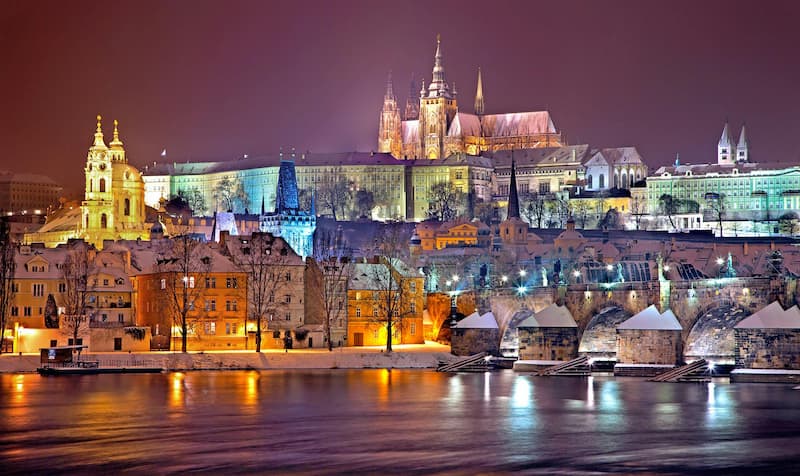
The Historic Centre of Prague is a breathtaking testament to over a thousand years of architectural evolution, remarkably preserved as a “living museum” in the heart of the Czech Republic.
The designated area encompasses several historic districts: Hradčany (the Castle District), Malá Strana (Lesser Town), Staré Město (Old Town), and Nové Město (New Town). It is characterized by its dramatic skyline of “a hundred spires,” medieval winding lanes, and grand open squares. Key landmarks include the sprawling Prague Castle, the Gothic St. Vitus Cathedral, and the iconic Charles Bridge, which connects the two banks of the Vltava River with its gallery of Baroque statues.
Attraction
Prague is a magnetic destination because it offers a dense, walkable concentration of history:
- The Astronomical Clock: A 15th-century masterpiece in Old Town Square that draws crowds every hour for its mechanical procession of the Apostles.
- Atmospheric Contrast: Travelers can move from the intimate, narrow alleys of the Jewish Quarter (Josefov) to the monumental scale of Wenceslas Square.
- Carioca Culture: Beyond history, Prague is world-renowned for its beer culture, vibrant jazz clubs, and “black light” theaters.

Heritage
Inscribed in 1992, the site is a UNESCO World Heritage treasure for its Outstanding Universal Value:
- Criterion (ii): Prague played a critical role in the political and cultural evolution of Central Europe, serving as a model for urban development in the region.
- Criterion (iv): It is a supreme architectural ensemble where Romanesque, Gothic, Renaissance, Baroque, and Art Nouveau styles coexist in a unified urban fabric.
- Criterion (vi): The city is an intellectual center, inextricably linked with names like Charles IV, Mozart, and Franz Kafka.
Gateway
The city of Prague itself is the primary gateway.
- Commercial Airport: Václav Havel Airport Prague (PRG) is the main international hub, located about 17 km from the center.
- Lodging: Options are vast, ranging from historic palaces in Malá Strana (like the Alchymist Grand Hotel) to modern boutique stays in the New Town.
When
- Spring (April to May) & Autumn (September to October): These are the “shoulder seasons” offering mild temperatures (13°C to 18°C) and manageable crowds.
- Winter (December): Despite the cold, the city is magical during the Christmas Markets, often ranked among the best in the world.
- Early Mornings: Regardless of the month, visiting Charles Bridge at sunrise is the only way to experience its majesty without the daytime crowds.

Consideration
- Currency: While in the EU, the Czech Republic uses the Czech Koruna (CZK). While cards are widely accepted, small cafes and markets often require cash.
- Footwear: Prague’s streets are almost entirely cobblestones. High heels or thin-soled shoes can be treacherous; sturdy, comfortable walking shoes are essential.
- Validation: If using public transport (trams or the metro), you must validate your ticket in the yellow machines before boarding to avoid heavy fines.
- Safety: Prague is very safe, but pickpocketing is common in high-traffic areas like the Astronomical Clock during the hourly show.

Resources
- UNESCO World Heritage – Prague: Detailed historical dossier and protected zone maps.
- Prague.eu – Official Tourism Portal: Comprehensive guides on events, transport, and museum hours.
- Prague Castle for Visitors: The official site for the castle complex, essential for checking security entrance times.
- Honest Guide (YouTube): A popular local-led resource for avoiding tourist traps and finding hidden gems.
- GetYourGuide – Prague Tours: A reliable platform for booking guided walking tours, river cruises, and skip-the-line castle tickets.
Featured Image
Prague Castle (Julius Silver, Pexels/Free To Use).
In The News
Advertisement


Comment:
7 responses to “Historic Centre of Prague”
-
The capital of the Czech Republic, Prague is considered one of the most beautiful cities in Europe. It is bisected by the Vltava River with its two main districts, the Stare Mesto (Old Town) and Nove Mesto (New Town), on the right bank. However, the best way to get your bearings in a new city is by elevation, so start on the left bank, at Petrín Hill. Take the funicular to the top and spend the morning taking in historical sights such as the Hunger Wall, Strahov Monastery, the Memorial to the Victims of Communism, and Štefánik’s Observatory. Don’t leave without ascending the 299 steps to the summit of the Petrin Lookout Tower, or Petřínská rozhledn, which is Prague’s Eiffel Tower. It will reward you with sweeping views across the city and its magical spires.
LikeLike
-
The jewel in the crown of Prague is not a big structure – it’s the astronomical clock (or Prague Orloj). Every hour, the animated figures around it start to move which ignites thousands of clicks from the tourists that wait patiently for this moment!
LikeLike
-
If you visit Prague its worth exploring the local historical architecture. For me walking through the streets of historical Prague, is like walking through a gallery of all major European architectural styles, spanning a thousand years of architectural history in enchanting colors and shapes and, it is interesting to discover how these splendid buildings shaped the history of the Czech Republic and in contrast, how history shaped the designs of many of these buildings and what they came to symbolize in an historical context.
In the historical center of Prague you can walk past the Municipal House, the Art Nouveau jewel of Prague, that is covered in floral motives, guilded wroth iron curved around beautifully shaded stain glass.
And continue through the Gothic and neo-Gothic styled powder tower going to the Celetna street , covered with Baroque palaces with Gothic interiors and Renaissance courts yards. On the way you encounter the unique Cubist house at the Black Madonna with its straight angular lines, then continues on to the medieval Ungelt compound with its Renaissance palace, past the heavily Baroque St.James Church and into the Old town Square with its legendary Astronomical clock. Which is followed by the Art Nouveau Jewish Quarters with its ancient synagogues.
LikeLike
-
We spent three days in Prague in 2015 and found the city enchanting. The Charles Bridge at sunrise is a must. A climb to the top of the tower at the Old Town end of the bridge has the best vantage point in the city.
LikeLike
-
Wenceslas Square is one of my favorite places to just walk around in Prague. I absolutely love the upside down statue of Saint Wenceslas!
LikeLike
-
We are standing on Charles Bridge. It is an absolutely beautiful landmark. It is really cool to see it after reading about it before I came. It is even beautiful at night, because it is all lit up. And it is not as busy as I thought it would be, which is fabulous.
LikeLike
-
Right at the beginning of Charles Bridge and squeezed between the Vltava River and Hradčany is the Malá Strana neighbourhood. Cobbled streets, hidden gardens, antique churches, and elegant squares—the Mala Strana neighbourhood is unquestionably the city’s most alluring district.
LikeLike

 All About World Heritage Sites (...and more)


Leave a comment