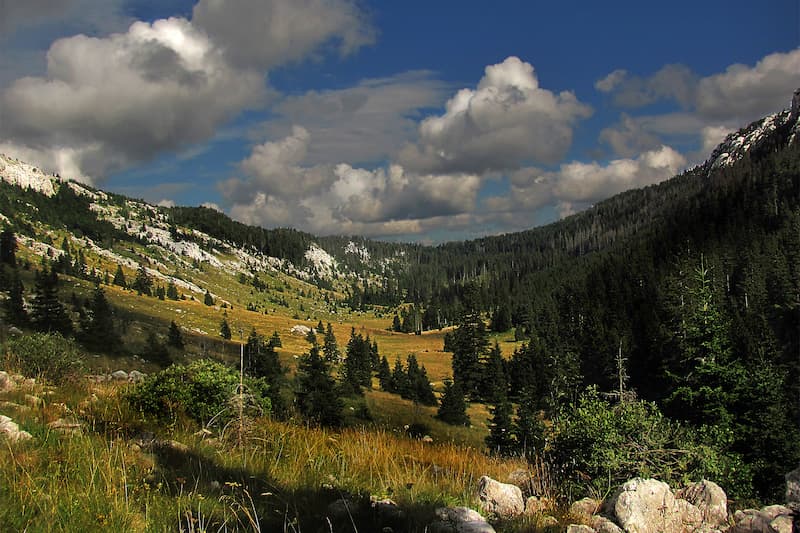
The Ancient and Primeval Beech Forests of the Carpathians and Other Regions of Europe in Croatia represent a rare, untouched wilderness of European beech (Fagus sylvatica). This transnational site in Croatia is composed of three specific areas: the strict reserves of Hajdučki and Rožanski Kukovi in Northern Velebit National Park, and the Suva Draga-Klimenta and Oglavinovac-Javornik sections within Paklenica National Park. These forests are “primeval” because they have remained virtually unaltered by human intervention since the last Ice Age, showcasing massive, centuries-old trees and a complex, self-sustaining ecosystem that thrives amidst dramatic limestone “karst” formations.
Attraction
While much of the world’s forests are managed or replanted, Al-Ahsa’s counterpart in Croatia—the Beech Forests—attracts travelers through its raw, prehistoric atmosphere:
- The “Vertical” Landscape: In Northern Velebit, the beech trees grow around the Kukovi, gigantic rock towers that look like something out of a fantasy novel.
- Hiking Paradise: The Premužić Trail offers one of the most famous high-altitude walks in Europe, providing views of the Adriatic Sea on one side and the UNESCO forest on the other.
- Endangered Wildlife: It is one of the few places in Europe where the “big three” predators—brown bears, wolves, and lynxes—still roam freely.

(Star Droid 5000, Wikimedia/CC BY-SA 4.0).
Heritage
Inscribed as part of an extension in 2017, the site is recognized under Criterion (ix): It is an outstanding example of the post-glacial expansion of the European beech.
The site demonstrates how a single tree species was able to re-colonize an entire continent from small “refuges” in the south (like the Dinaric Alps in Croatia) over just a few thousand years—a process of biological evolution that is still active today.
Gateway
- The City: Zadar is the most convenient gateway city for both Paklenica and Northern Velebit.
- Airport: Zadar Airport (ZAD) is a commercial hub with many budget and international connections.
- Lodging: Zadar offers everything from the Heritage Hotel Bastion to modern apartments.
- Alternative: Zagreb is a better gateway for Northern Velebit specifically, but Zadar is closer to the coastal entrance of Paklenica.
When
- Late Spring (May to June): The forest is at its most vibrant green, and the mountain air is fresh without being freezing.
- Autumn (October): The peak of visual beauty; the beech leaves turn a brilliant fiery orange and gold, contrasting against the white limestone.
- Note: High mountain trails are often blocked by snow from November through April.

Consideration
- Physical Intensity: These are mountain forests. Reaching the UNESCO-designated zones requires significant hiking (often 3–6 hours) on rocky, uneven terrain.
- Strict Protection: These are “Strict Reserves.” In Hajdučki and Rožanski Kukovi, you must stay on the marked trails. Diverging from the path is illegal and dangerous due to deep vertical pits in the rock.
- Weather Shifts: Velebit is notorious for the Bura—a powerful, cold wind that can appear suddenly. Always check the DHMZ (Croatian Met Service) before heading out.
- Limited Facilities: Unlike more “manicured” parks, there are no snack bars or shops deep in these forests. You must carry all your water and food.

(Leonardo Dj, Wikimedia/CC BY-SA 3.0).
Resources
- UNESCO World Heritage Centre – Beech Forests: For the full list of all 94 components across Europe.
- Northern Velebit National Park Official Site: Essential for trail maps and current weather alerts for the Kukovi region.
- Paklenica National Park Official Site: Details on the specific UNESCO beech forest sections within the canyon.
- European Beech Forests Official Portal: A pan-European site dedicated to the history and science of these forests.
- Booking.com – Zadar Accommodation: Use this to find base-camp lodging in Zadar or Starigrad-Paklenica.
Featured Image
Northern Velebit National Park (Gorga, Wikipedia/CC BY-SA 3.0).
In The News
Advertisement

Comment:
 All About World Heritage Sites (...and more)


Leave a comment