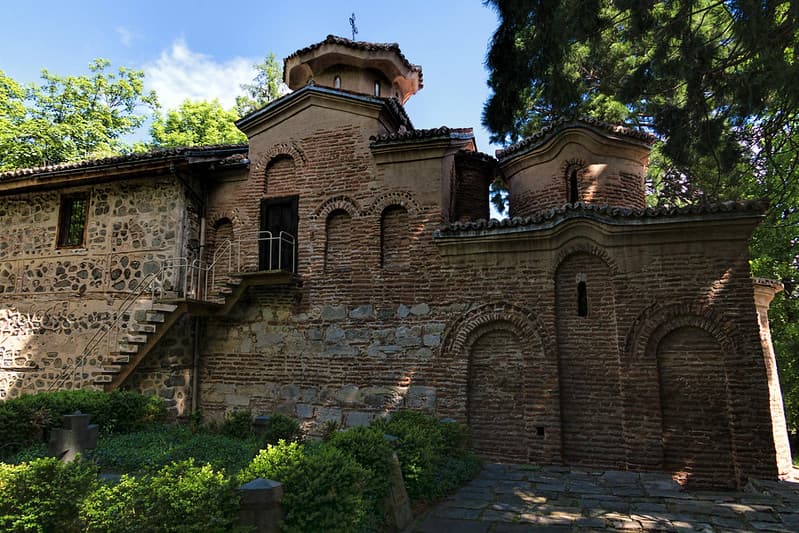
The Boyana Church (St. Nicholas and St. Panteleimon) is a medieval Bulgarian Orthodox church located on the outskirts of Sofia, at the foot of Vitosha Mountain. It is famous for its exceptionally well-preserved frescoes, which are considered among the finest examples of Eastern European medieval art.
The site consists of three distinct buildings constructed in three different stages:
- The Eastern Church (10th/11th Century): The oldest section, a small cross-domed structure.
- The Second Church (13th Century): Added by Sebastocrator Kaloyan and his wife Desislava in 1259. This two-story “tomb-church” contains the world-renowned frescoes.
- The Third Church (19th Century): An addition built with local donations during the Bulgarian National Revival.
The interior is famous for its second layer of wall paintings from 1259, which feature over 240 human figures rendered with a psychological depth and realism that many historians view as a precursor to the Italian Renaissance.
Attraction
Tourists are drawn to Boyana for its artistic realism. Unlike the rigid, stylized figures typical of most Byzantine-era art, the “Boyana Master” (an anonymous artist) depicted figures with unique emotions and realistic facial features. Highlights include:
- Donor Portraits: Strikingly lifelike depictions of Sebastocrator Kaloyan and Desislava.
- Historical Figures: Ancient portraits of Tsar Constantine Tikh and Tsaritsa Irene.
- The Vitosha Setting: The church is set within a peaceful, gated park that offers a cool retreat from the city.

(InterAct-Bulgaria, Wikimedia/CC BY-SA 4.0).
Heritage
Inscribed in 1979, the church meets Criteria (ii) and (iii):
- Criterion (ii): It reflects the high level of Bulgarian monumental painting during the Middle Ages and contributed significantly to the development of Eastern European art.
- Criterion (iii): It is a perfectly preserved example of a medieval architectural and artistic ensemble, showing the transition from Byzantine canons to a more humanistic approach to art.
Gateway
Sofia is the primary gateway.
- Airport: Sofia Airport (SOF) is the main international commercial hub.
- Lodging: As the capital, Sofia offers thousands of options, from the luxurious InterContinental Sofia and Grand Hotel Sofia to cozy boutiques in the city center.
- Access: You can reach the church from central Sofia in about 20 minutes by taxi or via public transport (Bus 63 or 64).
When
- Spring (May to June) and Autumn (September to October): The weather is mild, and the surrounding park is at its most beautiful.
- Weekdays: The site is small and can only accommodate 8–10 people at a time inside the church; visiting midweek helps avoid the large weekend tour groups.

Consideration
- Visit Limits: To protect the frescoes, visitors are limited to 10–15 minutes inside the church.
- No Photography: Photography is strictly prohibited inside to prevent damage to the delicate wall paintings.
- Temperature Control: The church is air-conditioned to maintain a constant environment for the art; it can feel chilly even in summer.
- Combined Tickets: You can purchase a combined ticket that includes entry to the National History Museum, located nearby.

Resources
- Official Boyana Church Website: The best source for ticket prices, reservations, and history.
- UNESCO – Boyana Church: Official World Heritage documentation and detailed criteria.
- National Museum of History (Bulgaria): The parent organization of the church, providing info on combined visits.
- Visit Sofia: The official tourist portal for the city of Sofia.
- Viator – Boyana Church Tours: A platform to book guided tours that often combine Boyana Church with Rila Monastery.
Featured Image
Boyana Church (Dan Lundberg, Flickr/BY-SA 2.0).
In The News
Advertisement


Comment:
 All About World Heritage Sites (...and more)

Leave a comment