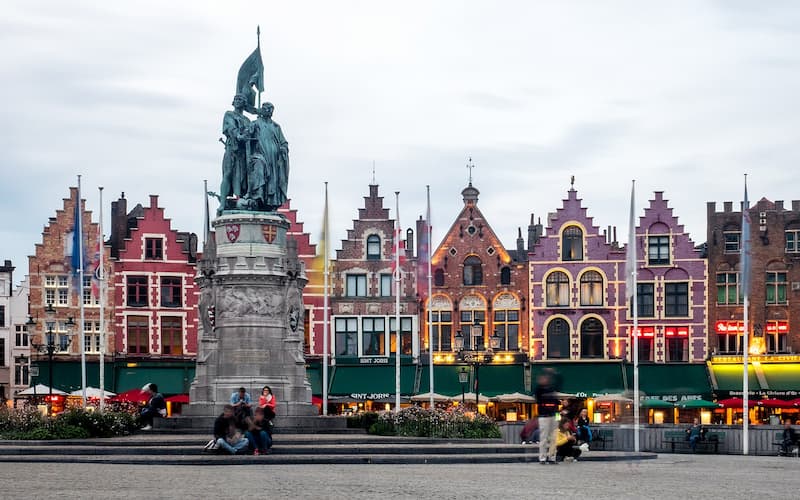
The Historic Centre of Brugge (Bruges) is a breathtaking testament to the “Golden Age” of medieval Europe. Often called the “Venice of the North” due to its intricate network of scenic canals, this Belgian city remains one of the most commercially and culturally significant sites in Northern Europe, where the past is not just preserved but lived.
Bruges is an oval-shaped historic settlement in the Flemish Region of Belgium. It is defined by its Brick Gothic architecture, characterized by tall, stepped-gabled houses and massive religious structures. The heart of the city is the Markt (Market Square), dominated by the 83-meter tall Belfry, while the Burg Square showcases the 14th-century City Hall. Winding throughout the city are the reien (canals), which served as the mercantile arteries for the Hanseatic League and now offer a reflective backdrop to the city’s stone bridges and weeping willows.
Attraction
Bruges attracts millions of visitors who seek a “fairytale” atmosphere. Key highlights include:
- The Belfry of Bruges: A 13th-century tower where visitors can climb 366 steps for a panoramic view of the West Flanders landscape.
- Artistic Treasures: The Church of Our Lady houses Michelangelo’s Madonna and Child, the only sculpture by the master to leave Italy during his lifetime.
- Gastronomy: Bruges is a world capital for chocolate (with over 50 artisan shops), Belgian waffles, and world-class breweries like De Halve Maan, which famously features an underground beer pipeline.
- Canal Cruises: Boat tours offer a unique perspective of hidden gardens and medieval facades that are invisible from the street.

Heritage
Inscribed in 2000, UNESCO recognizes the city for three primary reasons:
- Architectural Ensemble: It is an outstanding example of a medieval settlement that has maintained its historic fabric—including its original street patterns and canal systems—over centuries.
- Cultural Influence: During the 15th century, Bruges was the cradle of the Flemish Primitives. Revolutionary artists like Jan van Eyck and Hans Memling lived here, developing a style of painting that influenced all of Europe.
- Brick Gothic Landmark: The city is a masterpiece of Gothic brick construction, a style unique to Northern Europe and the Baltic regions.
Gateway
While Bruges has a small nearby airport (Ostend-Bruges), Brussels is the practical international gateway.
- Commercial Airport: Brussels Airport (BRU) is a major global hub with direct flights from across the world.
- Lodging: Brussels offers thousands of lodging options, from the high-end hotels near the Grand Place to business stays in the European Quarter.
- Seamless Access: A direct train runs from Brussels Airport to Bruges every hour, taking approximately 90 minutes. Alternatively, it is a roughly 1-hour drive via the E40 motorway.
When
- Spring (April to May): This is the “Goldilocks” period. The weather is mild, the trees along the canals are blossoming, and the crowds are thinner than in mid-summer.
- Summer (June to August): The liveliest time, featuring outdoor festivals and warm weather (18°C to 22°C), though the city can become extremely crowded.
- Winter (December): Despite the chill, the Bruges Christmas Market and “Winter Glow” festival turn the city into a sparkling, festive wonderland.

Consideration
- The “Monday” Rule: Many museums and local shops in Bruges are closed on Mondays. Plan your itinerary accordingly.
- Footwear: The entire historic center is paved with authentic, uneven medieval cobblestones. Wear sturdy walking shoes; high heels are highly impractical here.
- Tourist Taxes: Most hotels and guesthouses charge a mandatory city tax (approx. €2–4 per person/night) not always included in the initial booking price.
- Language: Bruges is in the Dutch-speaking part of Belgium. While locals are exceptionally fluent in English and French, a simple “Dank u” (Thank you) goes a long way.
- Day-Tripper Crowds: Between 11:00 AM and 4:00 PM, the city center is flooded with day-trippers. To experience the true “silent Bruges,” plan your walks for the early morning or late evening.

Resources
- Visit Bruges – Official Website: The primary source for official walking routes, museum tickets, and mobility info.
- UNESCO World Heritage – Bruges: Detailed historical background and the official maps of the protected zone.
- Visit Flanders: The regional tourism board’s guide, excellent for combining Bruges with other Flemish cities like Ghent.
- Legends Tours Bruges: A highly-rated site for booking specialized history and “Dark Side” night tours.
- Booking.com: The most comprehensive platform for securing heritage stays in converted 17th-century townhouses.
Featured Image
Bruges Markt, or Market Square (Ajay Suresh, Flickr/CC BY 2.0).
In The News
Advertisement

Comment:
8 responses to “Historic Centre of Brugge”
-
Bruges is extremely popular with day trip visitors from the surrounding cities, especially at weekends, so we recommend staying at least one night to truly experience its magic. We love the Hotel Acacia, located next to the main square, with its resident parrot, Coco, who greets guests upon arrival at the hotel! Beautiful in every season, Bruges is extra special during the winter when it is home to one of the best Christmas markets in Europe and the Old Town transforms into a festive wonderland complete with a Christmas village in the town square. Packed with everything festive from delicious food to mulled wine, unique chocolate souvenirs and ice skating under the shadow of the Belfry Tower, the Bruges Christmas market is definitely one not to miss. Evenings spent wandering through the twinkling Old Town eating, drinking and skating are some of our most magical memories. Don’t forget, it can get chilly in between all those mulled wines and hot chocolates – winter in Europe requires wrapping up warmly and we always pack a cosy warm scarf to keep the cold winter air at bay!
LikeLike
-
Visitors to Bruges feel like they’ve stepped way back in time. In fact, the city is a UNESCO World Heritage Centre because of its unique architecture and history. We absolutely loved wandering up and down the city streets and looking inside the old churches. The whole family also sat down to have a traditional Flemish meal. I had a dish of creamy chicken and potatoes (waterzoii). Others opted for seafood appetizers, stew and apple tarts for dessert.
LikeLike
-
Bruges has been described as a medieval fairy tale, little Amsterdam, medieval New York, Venice of the North… the list goes on. And while I can see the resemblance with Amsterdam, Bruges is medieval in a way Amsterdam just isn’t. It really is like nowhere else: the narrow houses with tall, pointed gables, the spiked turrets… Gothic! And on the other hand, colourful: ruby reds, pale blues, deep oranges, sunny yellows, soft pinks. One of my fave spots in Bruges is Minnewaterpark with Love Lake and Lovers’ Bridge.
LikeLike
-
Some things to see I like are Grand Place; Place du Bourg; the palace of the dukes of Burgundy, and the Maison-Dieu from the 14C. The town has numerous museums and have been to a few; some of the ones I like are the Belfort or bell tower at a height of 83 meters and a structure of 47 bells. the gate of Gentpoort one of the four gates of the medieval town; the city hall (stadhuis) from 1376. The windmill of Koelewei from 1765 now near the gate of Damme since 1996; museum of arts and popular traditions housed in 8 maison dieu of the 17C; , Museum Groeninge; Flemish paintings from the 15C to our days; Palace of the franks de Bruges (Paleis van het Brugse Vrije) there were a council managing the region around the town and now houses the archives and in the renaissance room there is a monumental chimney of the 16C. And the Gruuthusemuseum is a museum of applied arts in Bruges, located in the medieval Gruuthuse, the house of Louis de Gruuthuse. The collection ranges from the 15-19C.
LikeLike
-
There is so much sight-seeing to do. Bruges is a smorgasbord of medieval buildings; approach from the rail station and the first thing(s) you notice are three lofty spires – the already-mentioned Belfry, the magnificent St Saviour Cathedral, and the biggest and the best… the Welcome Church of our Lady.
LikeLike
-
I wanted a much more engaging journey into Bruges’ history so I went to the Historium located opposite the Belfry. It was cleverly designed and constructed and in a moment I was transported back to medieval Bruges. I walked around the harbour, eavesdropped on conversations, visited ancient bathhouses and laughed at some of the bawdy language. There were recreations and clips taking me through a storyline interwoven with history.
LikeLike
-
Bruges is a small town and completely walkable on foot, but it’s also very bike-friendly (with no hills to navigate) and you can rent great city bikes to amble about on. For a truly memorable Bruges vista head for the city gates, which are right on the canal with four beautiful windmills dotted around them.
LikeLike
-
We had a great time, the city is fascinating with a lot of little side streets and a lot history. We enjoyed tasting chocolate in some of the many chocolate stores, we also found a great restaurant on a side street so narrow that cars could not use it.
LikeLike

 All About World Heritage Sites (...and more)
Leave a comment