Located in the far southwest of Albania, near the border with Greece, Butrint is a staggering archaeological site that serves as a physical timeline of Mediterranean history. It is situated on a low-lying peninsula surrounded by the lush Butrint National Park, a protected area of 94 square kilometers featuring wetlands, salt marshes, and the beautiful Lake Butrint.
Butrint is not just a collection of ruins; it is an atmospheric “landscape museum” where the stones of ancient Greece, the Roman Empire, the Byzantine era, and the Venetian and Ottoman periods coexist in a dense, green jungle-like setting. Legend even links its founding to the exiles of Troy. Walking through the site, visitors encounter a preserved Greek theater, a Roman forum, one of the world’s largest early Christian baptisteries, and a Venetian castle perched atop an acropolis.
Attraction
Butrint is often called the “Pompeii of Albania,” but with a distinctly wilder, more overgrown feel that makes it feel like a discovery.
- The Layering of Civilizations: Unlike sites dedicated to a single era, Butrint shows a continuous human presence from 50,000 BC to the 19th century. You can see a Greek theater that was later “Romanized,” sitting just a short walk from a Byzantine basilica.
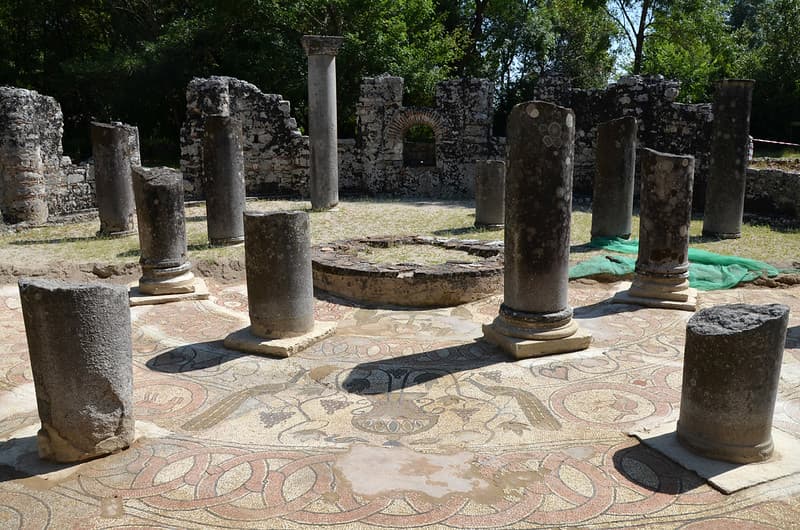
- The Great Baptistery: This 6th-century structure features one of the most intricate and well-preserved mosaic floors in the world, consisting of 69 medallions depicting birds and sea life. (Note: To protect it from the elements, the mosaic is usually covered with sand and only revealed on rare occasions).
- A Natural Oasis: The site is unique because it hasn’t been “sanitized” by aggressive modern development. The ruins are shaded by ancient oak and eucalyptus trees, and the air is filled with the scent of the surrounding lagoon.
- The Venetian Castle & Museum: At the highest point, a rebuilt Venetian-style fortress houses a museum that provides context for the artifacts found on-site, offering panoramic views over the Vivari Channel.

Heritage
Butrint was inscribed as a UNESCO World Heritage Site in 1992 (with later expansions) because it met Criterion (iii): it provides an exceptional testimony to civilizations that have disappeared.
The “Outstanding Universal Value” of Butrint lies in its integrity and authenticity. Because the city was eventually abandoned in the late Middle Ages due to the silting of the port and the spread of malaria, it was “frozen” in time. It escaped the industrial and urban expansion that destroyed the context of many other Mediterranean sites. UNESCO recognizes it as a rare example of the “human-nature interaction,” where the geological changes of the coastline directly influenced the rise and fall of the city.
Gateway
The logistics for reaching Butrint are evolving.
- Primary Albanian Gateway: Tirana. Tirana International Airport (TIA) is the primary operational commercial airport in Albania. Tirana offers extensive lodging, from luxury brands to boutique hotels in the vibrant Blloku district. However, the drive to Butrint is roughly 4 to 5 hours (270 km).
- The Upcoming Gateway: Vlorë. The new Vlorë International Airport (VLO) is scheduled to begin commercial operations in June 2026. Once open, it will reduce the travel time to Butrint to about 2.5 hours, making Vlorë the most convenient domestic gateway for the summer season. Vlorë has a massive inventory of seaside hotels and resorts.
- The Best Foreign Alternative: Corfu, Greece. If you prefer proximity over staying in the same country, fly to Corfu International Airport (CFU). From there, it is a quick 30–70 minute ferry ride to the Albanian city of Sarandë, which is only 20 minutes by bus or car from the Butrint gates.
When
The climate in southern Albania is Mediterranean, meaning hot summers and mild, wet winters.
- Optimal Months: April to June and September to October. These “shoulder seasons” provide the best balance of warm, sunny weather and manageable crowds. The site is particularly beautiful in May when the wildflowers are in bloom.
- Avoiding the Heat: July and August can be intensely hot (often exceeding 35°C), and since the site involves a lot of walking, the heat can be draining. These months also see the highest number of cruise ship day-trippers from Corfu.
- Winter (November–March): While quiet and atmospheric, this is the rainiest period. The site can become muddy, and some of the lower ruins may even experience minor flooding from the lagoon.

Consideration
- Footwear: The paths are uneven, rocky, and can be slippery when wet. Wear sturdy walking shoes or sneakers; flip-flops are not recommended.
- Lack of Signage: While there are some information boards, many are weathered. Hiring a local guide at the entrance or bringing a detailed guidebook is highly recommended to understand what you are looking at.
- Currency: The official currency is the Albanian Lek (ALL). While some shops in nearby Ksamil or Sarandë may accept Euros, the park ticket office and local buses generally require Lek.
- The “Cable Ferry”: To reach the Ali Pasha Fortress across the channel, you can use the iconic, rustic cable ferry. It’s a short, unique experience but requires a small cash payment.
- Mosquitoes: Due to the surrounding wetlands and lagoon, mosquitoes can be prevalent, especially in the late afternoon. Bring repellent.

Resources
- Butrint National Park Official Website: The primary source for official hours, ticket pricing, and conservation news.
- UNESCO World Heritage Centre: For the official academic and historical justification for its protected status.
- Visit Albania: The national tourism agency’s guide to the region, including travel logistics for the Albanian Riviera.
- GetYourGuide An excellent platform for booking guided day trips from Sarandë or Corfu, including transport and entry fees.
- The Butrint Foundation: A UK-based charity that has led much of the modern research and restoration on-site.
Featured Image
The baptistery with its well-preserved mosaic (Carole Raddato, Flickr/CC BY-SA 2.0).
In The News
Advertisement

Comment:
 All About World Heritage Sites (...and more)
Leave a comment