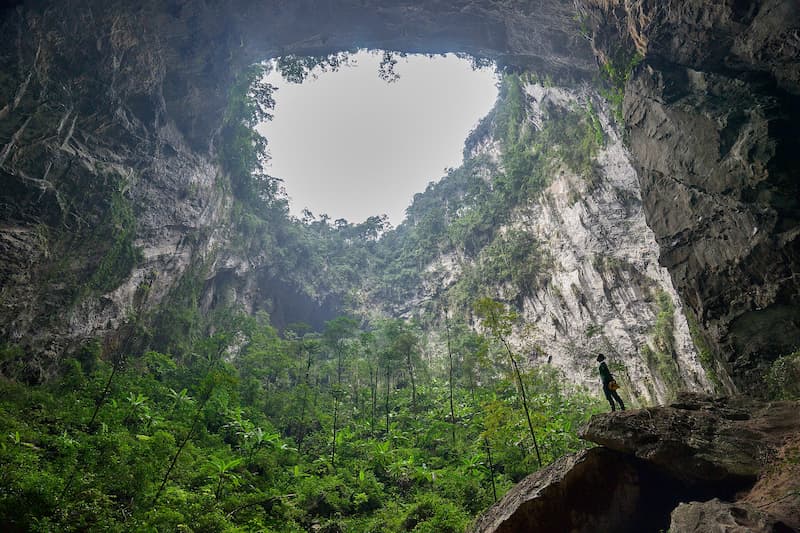
The Phong Nha-Ke Bang National Park and Hin Nam No National Park transboundary property is a colossal limestone karst kingdom straddling the border of Central Viet Nam and the Lao People’s Democratic Republic. Covering over 217,000 hectares, it represents the oldest and most extensive karst landscape in Asia, with a geological history spanning more than 400 million years.
The property is a mosaic of dramatic cliffs, deep sinkholes, and lush tropical forests. It is famous for its subterranean world, housing over 220 km of documented caves and underground rivers. The site features the Son Doong Cave (the world’s largest cave passage by volume) and the Xe Bang Fai Cave (one of the world’s largest active river caves). Above ground, the Annamite Mountain range provides a backdrop for diverse ecosystems ranging from high-altitude dry karst forests to moist lowland evergreens.
Attraction
This site is a premier destination for adventurers and nature lovers due to its scale and variety:
- The “Cave Capital”: It offers everything from family-friendly boardwalk tours of Paradise Cave to grueling multi-day expeditions into Son Doong.
- Adventure Sports: Beyond caving, tourists engage in jungle trekking, ziplining at Dark Cave, and kayaking on the turquoise Son and Chay Rivers.
- Rural Charm: The gateway town of Phong Nha offers a serene atmosphere with scenic cycling routes through rice paddies and local villages.

Heritage
The site was inscribed by UNESCO (originally in 2003 for the Viet Nam side, extended transboundary in 2025) under several criteria:
- Criterion (viii): It provides exceptional evidence of Earth’s history through its ancient karst formations and complex underground river systems.
- Criterion (ix): It showcases ongoing ecological and biological processes, including the evolution of cave-dependent species in isolated subterranean habitats.
- Criterion (x): It is a global biodiversity hotspot, protecting endangered species like the Saola, Red-shanked Douc Langur, and the Large-antlered Muntjac.
Gateway
- Commercial Airport: Dong Hoi Airport (VDH) is the primary gateway, with daily flights from Hanoi and Ho Chi Minh City.
- Lodging: Dong Hoi City offers beachside hotels, while Phong Nha Town (45 km from the airport) is the hub for trekkers, featuring a range of accommodations from social hostels like Central Backpackers to luxury stays like Victory Road Villas.
When
The best time to visit is during the dry season (March to August).
- March to May: The weather is pleasant (22°C to 28°C), perfect for trekking.
- June to August: Very hot (35°C) but ideal for cooling off in the caves and rivers.
- Avoid: September to November, as this is the monsoon season. Many caves are closed due to dangerous flood levels.

Consideration
- Expedition Booking: Tours for major caves like Son Doong sell out months or even a year in advance.
- Physical Fitness: Many tours involve wading through waist-deep water, swimming in caves, and scaling sharp limestone rocks.
- Cash & Connectivity: While ATMs are available in Phong Nha, small vendors and market stalls only accept Vietnamese Dong (VND).
- Leech Protection: If trekking in the jungle, “leech socks” and proper insect repellent are essential.

Resources
- UNESCO World Heritage – Phong Nha-Ke Bang & Hin Nam No: The official source for geological maps and scientific data.
- Phong Nha-Ke Bang Official Website: Managed by the National Park Management Board for official park news.
- Oxalis Adventure: The exclusive operator for Son Doong and a major resource for caving logistics in Viet Nam.
- Vietnam.travel – Phong Nha Guide: The official national tourism portal’s guide to the region.
- Agoda.com – Phong Nha Stays: A reliable platform for booking local homestays and riverside resorts.
Featured Image
Doline in Son Doong Cave (Dave Bunnell, Wikimedia/CC BY-SA 4.0).
In The News
Advertisement


Comment:
3 responses to “Phong Nha-Ke Bang National Park and Hin Nam No National Park *”
-
I feel like a new sky has been opened to us. Some stalagmites remind us of Buddha, the Great Wall of China, and a rong (communal house) of Tay Nguyen (the Central Highlands).
LikeLike
-
The experience over there is otherworldly.
It’s a jungle within a cave.
Misty clouds encircle the scenery and demonstrate evidence of the cave’s own weather system. Other staggering features were the fossil passageways that give proof of the cave’s ancient existence.
When I think of the whole experience I get a sense of pride and achievement that I was capable of going on such an adventure.
To be able to do something you didn’t think you would be able to is exceptionally empowering
LikeLike
-
The Phong Nha-Ke Bang National Park, a UNESCO World Heritage Centre, had been one of my stop in Vietnam. It’s an otherworldly landscape of vertical outcroppings of limestone karst, interspersed with rice paddies that are still dotted with small, circular ponds, craters left by B-52 bombing raids, a place where subterranean rivers flow through one of the largest and most spectacular cave systems in the world.
Deep inside the park, we stopped to walk along a turquoise river that ran between sheer, forested slopes. Assamese macaques crashed around in the trees. An endangered Hatinh langur stood erect on a branch high above us, leaning forward on both hands and looking for all the world like an old man enjoying the scenery. Beautiful.
LikeLike

 All About World Heritage Sites (...and more)


.jpg)
Leave a comment