The Ancient City of Polonnaruwa in Sri Lanka is a breathtaking monument to medieval Sinhalese civilization. After the fall of Anuradhapura in 993 AD, Polonnaruwa rose as the island’s second capital, flourishing between the 11th and 13th centuries. It is celebrated as a “garden city,” where monumental Buddhist and Hindu architecture seamlessly integrates with massive, sophisticated irrigation systems that transformed the arid plains into a fertile kingdom.
Polonnaruwa is a sprawling archaeological park divided into several distinct clusters of ruins:
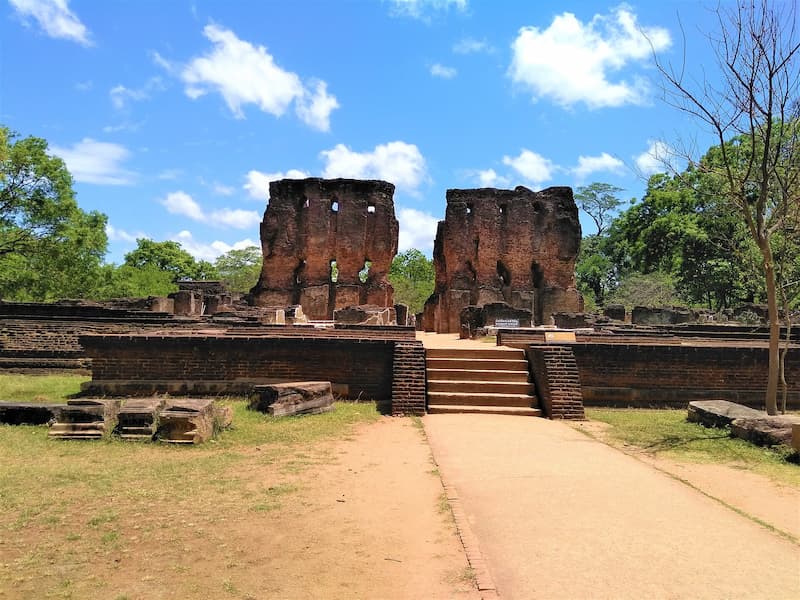
- The Royal Palace Complex: Once a massive seven-story wooden structure (now reduced to thick brick walls) built by King Parakramabahu I, featuring a royal bath and a grand council chamber with intricately carved elephant friezes.
- The Sacred Quadrangle (Dalada Maluwa): The most concentrated area of ruins, home to the Vatadage—a circular relic house with stunning stone carvings—and the Thuparama, one of the few buildings that still retains its original stone roof.
- Gal Vihara (The Rock Monastery): A pinnacle of Sri Lankan art consisting of four colossal Buddha statues (standing, sitting, and reclining) carved directly into a single granite rock face.
- The Parakrama Samudra: A vast man-made reservoir so large it was nicknamed the “Sea of Parakrama,” reflecting the kingdom’s advanced hydraulic engineering.
Attraction
Travelers are drawn to Polonnaruwa for its extraordinary preservation and accessibility:
- Masterpieces of Sculpture: The serenity and detail of the Gal Vihara Buddhas are considered some of the finest rock carvings in Asia.
- Wildlife Encounters: The ruins are home to large troops of toque macaques (famously featured in Disney’s Monkey Kingdom). Nearby, Minneriya National Park offers the “Elephant Gathering” during the dry season.
- Cycle-Friendly Exploration: Unlike other vast sites, Polonnaruwa’s layout is relatively compact and flat, making it famous for its scenic bicycle tours through the shaded ruins.

Heritage
Inscribed in 1982, Polonnaruwa is protected under Criteria (i), (iii), and (vi):
- Criterion (i): It represents a masterpiece of human creative genius, particularly in its architectural harmony and rock-cut sculptures.
- Criterion (iii): It serves as an exceptional testimony to the Chola and Sinhalese civilizations that defined medieval Sri Lanka.
- Criterion (vi): The city is fundamentally linked to the history of Buddhism and the protection of the Sacred Tooth Relic of the Buddha.
Gateway
While Polonnaruwa has its own modern town, it lacks a major commercial airport.
- Gateway City: Sigiriya or Dambulla serve as the most convenient hubs.
- Airport: Sigiriya Airport (GIU) is the nearest domestic hub, though most international travelers land at Bandaranaike International Airport (CMB) in Colombo and take a 4.5-hour private transfer or bus.
- Lodging: Sigiriya offers diverse options, from luxury eco-resorts like Jetwing Vil Uyana to budget-friendly guesthouses.
When
- Dry Season (May to September): The best time for exploring ruins without rain. This period also coincides with the spectacular elephant gathering in nearby parks.
- Winter (December to March): Temperatures are slightly cooler and pleasant for outdoor walking, though occasional rains may occur.
- Time of Day: Arrive at 7:00 AM to beat the midday tropical heat and see the monuments in soft, golden morning light.

Consideration
- Entry Fee: The ticket for foreign visitors is approx. $25 USD (approx. 7,500 LKR). Tickets must be purchased at the Archaeological Museum before entering the main site.
- Dress Code: As these are sacred sites, you must cover your shoulders and knees. You will also be required to remove your shoes and hat when entering temple platforms; socks are recommended to protect your feet from scorching sun-heated stones.
- Transportation: Rent a bicycle (approx. 500–1,000 LKR) for the best experience. If the heat is too intense, hire a tuk-tuk for the day to shuttle you between the ruin clusters.
- Sun Protection: Most of the site is open and exposed. Bring plenty of water, sunscreen, and a wide-brimmed hat.

(David Stanley, Flickr/CC BY 2.0).
Resources
- UNESCO World Heritage – Polonnaruwa: The official global dossier for the site’s history and values.
- Central Cultural Fund – Sri Lanka: The official government body managing the site (check for ticket updates).
- Visit Sri Lanka – Cultural Triangle: The national tourism board’s guide to the region.
- Lonely Planet – Polonnaruwa Guide: Excellent for practical logistical tips and local restaurant reviews.
- Agoda – Polonnaruwa Stays: Use this to find well-rated hotels and eco-lodges near the ancient city boundaries.
Featured Image
The Royal Palace Complex (Nahid Sultan, Wikimedia/CC BY-SA 4.0).
In The News
Advertisement

Comment:
 All About World Heritage Sites (...and more)
.jpg)
Leave a comment