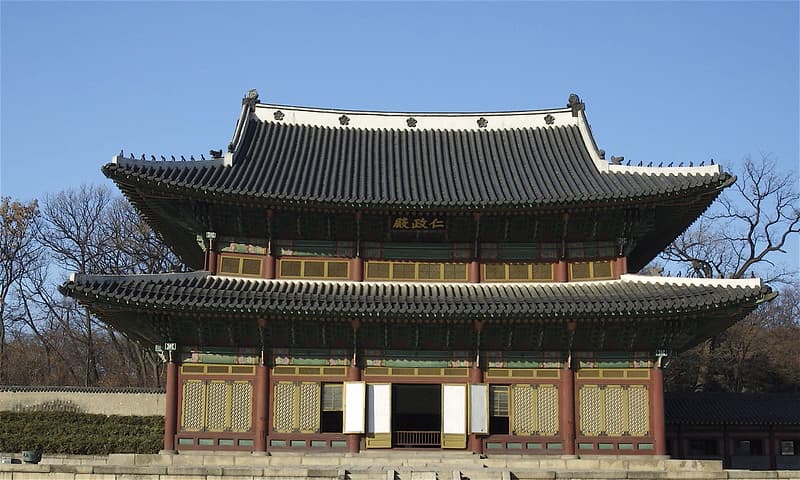
Nestled at the foot of Mount Baegaksan in the heart of Seoul, the Changdeokgung Palace Complex (Palace of Illustrious Virtue) is widely regarded as the most beautiful and quintessential of Korea’s five royal palaces. Built in 1405 during the Joseon Dynasty, it served as the principal residence for many kings and remains a masterpiece of traditional East Asian architecture.
Changdeokgung was originally constructed as a “secondary palace” to the main Gyeongbokgung Palace. However, it quickly became the favored residence of the Joseon royals because its design prioritized comfort and harmony over the rigid, symmetrical formality of Gyeongbokgung.
The complex spans 58 hectares and is divided into three main areas:
- Administrative Area: Featuring the Injeongjeon Hall (Throne Hall), where official ceremonies and foreign receptions took place.
- Residential Area: The private quarters of the King and Queen, including Daejojeon Hall.
- The Secret Garden (Huwon): Occupying 60% of the complex, this rear garden is a masterpiece of Korean landscape gardening, featuring pavilions, lotus ponds, and over 56,000 specimens of trees, some over 300 years old.
Attraction
Changdeokgung attracts visitors from around the world for its distinctive aesthetic and serene atmosphere:
- The Huwon (Secret Garden): Unlike Western or Chinese gardens that impose order on nature, the Huwon was designed to look as natural as possible. Visitors are drawn to the tranquility of Buyongji Pond and the tiny, elegant pavilions tucked into the hillsides.
- Dancheong Art: The buildings are adorned with dancheong, the traditional Korean decorative coloring in five basic colors (blue, red, yellow, white, and black). The intricate patterns on the eaves and ceilings are a major draw for photography and art enthusiasts.
- Royal Living: As the most well-preserved palace, it offers a tangible glimpse into 500 years of Joseon history, allowing tourists to walk through the same halls used by kings until the early 20th century.

Heritage
UNESCO inscribed Changdeokgung in 1997, citing its Outstanding Universal Value. It met the following criteria:
- Criterion (ii): The palace had a significant influence on the development of Korean architecture, landscape planning, and garden design for centuries.
- Criterion (iii): It is an exceptional testimony to Confucian and Pungsu (geomancy) principles. While Gyeongbokgung followed a strict North-South axis, Changdeokgung was built to follow the natural contours of the land, illustrating the Joseon belief in living in harmony with nature.
- Criterion (iv): It is an outstanding example of East Asian palace architecture, uniquely integrated with its natural mountain setting rather than imposing itself upon it.
Gateway
The city of Seoul serves as the primary gateway to the site.
- Commercial Airport: Incheon International Airport (ICN) is the primary global gateway, located about an hour from the palace. Gimpo International Airport (GMP) also serves domestic and regional flights.
- Lodging: Seoul offers an exhaustive range of options. For the most immersive experience, many travelers stay in Bukchon Hanok Village (adjacent to the palace) in traditional Korean guest houses, or in luxury hotels in the Jongno or Myeongdong districts.
When
- Autumn (October to November): This is the absolute best time. The Secret Garden transforms into a sea of crimson, gold, and orange. The “Moonlight Tour” programs are also held during this season, allowing for rare nighttime visits.
- Spring (April to May): The palace grounds are filled with blooming cherry blossoms, plums, and azaleas. The weather is mild, making the extensive walking tours comfortable.
- Winter (January to February): If you catch a snowfall, the palace becomes a quiet, monochromatic wonderland—perfect for those who want to avoid the crowds.

Consideration
- Huwon (Secret Garden) Booking: You cannot enter the Secret Garden freely. Access is strictly limited to guided tours with a set number of tickets. It is highly recommended to book online in advance, as same-day tickets sell out within minutes during peak seasons.
- Closed on Mondays: Unlike many other sites, Changdeokgung is closed every Monday. Plan your itinerary accordingly.
- The “Hanbok” Benefit: Visitors wearing a full Hanbok (traditional Korean dress) receive free admission to the main palace grounds (though the Secret Garden tour still requires a separate ticket).
- Extensive Walking: The palace and garden are massive. Wear comfortable walking shoes; the garden trails include some steep inclines and unpaved paths.
- Respect the Space: Many areas are fragile. Climbing on stone platforms or touching the painted wood of the buildings is prohibited.

(Ethan Doyle White, Wikimedia/CC BY-SA 4.0).
Resources
- Royal Palaces and Tombs Center (Official) – The official government site for the most accurate ticketing, hours, and reservation information.
- UNESCO World Heritage Centre – For detailed historical and architectural significance and official protection documents.
- Visit Korea (KTO) – The official tourism site of the Republic of Korea, providing travel logistics and nearby attraction guides.
- World Heritage Travel – A comprehensive travel guide with historical context.
- Time Travel Turtle – A detailed blog post offering practical visitor tips and a walkthrough of the “Secret Garden” experience.
Featured Image
Injeongjeon Hall (Enrique Dans, Flickr/CC BY 2.0).
In The News
Advertisement

Comment:
One response to “Changdeokgung Palace Complex”
-
When you arrive here, be sure to check out Huwon (the Secret Garden), which is totally idyllic.
LikeLike

 All About World Heritage Sites (...and more)
Leave a comment