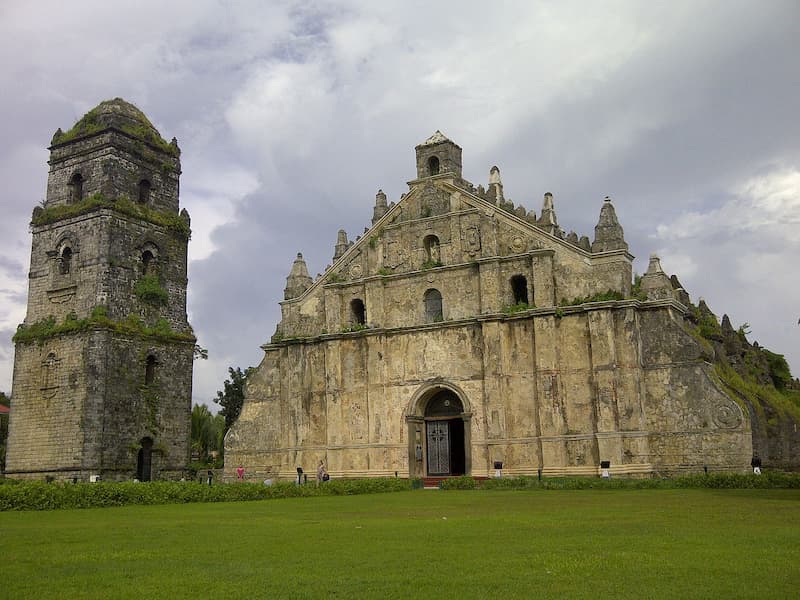
The “Baroque Churches of the Philippines” is a serial UNESCO World Heritage site consisting of four distinct Roman Catholic churches constructed between the 16th and 18th centuries during the Spanish colonial period. They are located in separate areas of the Philippine archipelago: the San Agustin Church in Manila, the Paoay Church in Ilocos Norte, the Santa Maria Church in Ilocos Sur, and the Miagao Church in Iloilo. These churches represent a unique fusion of European Baroque architectural design with local materials and decorative motifs, adapted to the specific geological and climatic conditions of the Philippines.
These churches established a new style of building known as “Earthquake Baroque,” characterized by a squat, monumental, and massive appearance.
- San Agustin Church (Manila): The oldest stone church in the Philippines, featuring intricately carved doors and spectacular trompe-l’œil ceiling murals.
- Paoay Church (Ilocos Norte): Famous for its 24 massive buttresses extending from the side walls and a separate coral stone bell tower.
- Santa Maria Church (Ilocos Sur): Situated atop a hill and enclosed by a defensive wall, showcasing brickwork construction.
- Miagao Church (Iloilo): Distinguished by its fortress-like structure and a highly ornate façade featuring a stylized depiction of St. Christopher in a tropical setting.
Attraction
Tourists are drawn to these sites for their historical significance and unique architecture:
- Architectural Fusion: The integration of Chinese, Latin American, and Philippine indigenous art into European designs is visually captivating.
- Historical Insight: They provide a tangible connection to 300 years of Spanish colonial history and the spread of Christianity in Asia.
- Resilience: These structures have survived centuries of earthquakes, typhoons, and wars, embodying the resilience of Filipino culture.

Heritage
The churches were inscribed on the UNESCO World Heritage List in 1993 based on two criteria:
- Criterion (ii): They represent a style of building and design adapted to the physical conditions of the Philippines, influencing later church architecture in the region.
- Criterion (iv): They are outstanding examples of the Philippine interpretation of the Baroque style, fusing European construction with local decorative motifs.
Gateway
Because the churches are scattered, multiple gateway cities are necessary.
- For Manila: Ninoy Aquino International Airport (MNL) is the main gateway, with extensive lodging in the Makati or Intramuros areas.
- For Ilocos Churches (Paoay/Santa Maria): Laoag International Airport (LAO) is the closest, with numerous hotels available in Laoag City.
- For Miagao Church: Iloilo International Airport (ILO) serves the area, with lodging available in Iloilo City.
When
The best time to visit is during the dry season, from December to May. Specifically, visiting during the Christmas season or during local town fiestas (festivals) offers a vibrant cultural experience. Holy Week (usually March or April) is profoundly significant but exceptionally crowded.

Consideration
- Modest Dress Code: As active places of worship, visitors must dress modestly (covering shoulders and knees).
- Respectful Behavior: Keep noise levels to a minimum, especially if a mass is in progress.
- Weather: It can be very hot, so plan visits for early morning or late afternoon.
- Transportation: Renting a car or hiring a private driver is the most efficient way to travel between the scattered churches in Ilocos and Iloilo.

Resources
- UNESCO World Heritage Centre: The official site providing historical context and conservation details.
- Department of Tourism – Philippines: Provides up-to-date travel advice and logistics.
- Visit Philippines: A comprehensive guide covering the history and cultural significance of the churches.
- Guide to the Philippines: Offers structured tours and travel packages to these heritage sites.
- National Commission for Culture and the Arts: Provides in-depth architectural and historical analysis of Philippine heritage sites.
Featured Image
Paoay Church (Wowieology, Wikimedia/CC BY-SA 3.0).
In The News
Advertisement


Comment:
 All About World Heritage Sites (...and more)
Leave a comment