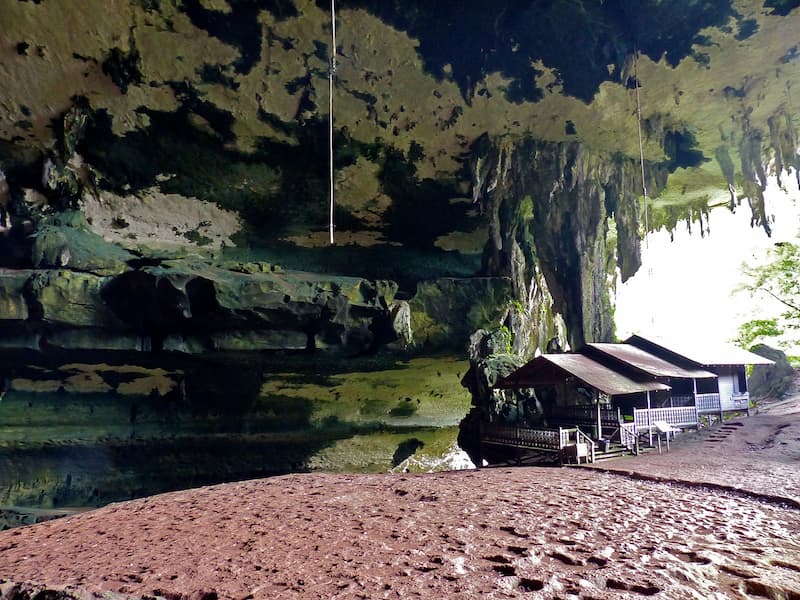
The Archaeological Heritage of Niah National Park’s Caves Complex is Malaysia’s newest addition to the UNESCO World Heritage list, inscribed in July 2024. This site is globally significant, representing some of the oldest evidence of modern human habitation in Southeast Asia and providing a 50,000-year record of human interaction with the tropical rainforest.
Located in the Miri Division of Sarawak on the island of Borneo, the Niah Caves complex consists of massive, interconnected limestone caverns within the Subis Karst. The site is famous for its “Great Cave,” which boasts one of the world’s largest cave entrances, spanning 250 meters wide and 60 meters high.
Inside, the complex holds a wealth of archaeological treasures, including the “Deep Skull” (dated to approximately 40,000–50,000 years ago), ancient rock paintings, and “Death Ships”—unique boat-shaped coffins used for prehistoric burials. The site is also a living ecosystem where the traditional harvest of edible bird’s nests continues to this day.
Attraction
Niah is a pilgrimage site for those interested in the origins of humanity and the raw power of nature.
- The “Deep Skull”: The discovery of this skull in 1958 by Tom Harrisson proved that modern humans (Homo sapiens) reached Southeast Asia far earlier than previously thought.
- The Painted Cave: Visitors can see rare, prehistoric hematite paintings depicting human figures, animals, and “longboats” meant to carry the dead into the afterlife.
- Massive Scale: The sheer size of the caverns is humbling. Walking through the dark, cathedral-like chambers filled with the sound of millions of bats and swiftlets is an otherworldly experience.
- Local Culture: Watching local collectors scale bamboo poles to the cave ceiling to harvest bird’s nests is a daring tradition that has remained unchanged for centuries.

Heritage
UNESCO inscribed the site under two specific cultural criteria:
- Criterion (iii): It provides an exceptional testimony to human development and cultural traditions spanning from the Pleistocene to the Mid-Holocene. It documents the transition from early foraging to settled farming and forest management.
- Criterion (v): It is an outstanding example of early human settlement and land use in a tropical environment, demonstrating how ancient populations adapted to climate change and evolving rainforest ecosystems.
Gateway
Miri is the designated gateway city for Niah National Park.
- Commercial Airport: Miri Airport (MYY) is a major regional hub with frequent flights from Kuala Lumpur, Kuching, Singapore, and Kota Kinabalu.
- Lodging: Miri offers extensive lodging, ranging from 5-star international hotels (like the Pullman or Marriott) to budget-friendly boutique stays.
- Proximity: The park is approximately a 1.5-hour drive (90 km) from Miri city center. Taxis, ride-hailing services (Grab), and rental cars are readily available.
When
The ideal time to visit is during the dry season (March to September).
- Trekking Conditions: During these months, the 3-kilometer boardwalk through the jungle to the cave entrance is less slippery, and the internal cave paths are safer.
- Bat Exodus: Early evening is the best time to witness the “bat exodus,” where millions of bats emerge from the cave to hunt, while swiftlets return for the night.

Consideration
- Physical Stamina: Exploring the main caves involves a 3km walk each way on a wooden boardwalk. While the path is flat, the humidity and occasional steep stairs inside the cave require moderate fitness.
- Equipment: A powerful headlamp or torch is mandatory; your phone light will not be sufficient for the deep, pitch-black chambers. Cotton gloves are also recommended if you plan to touch the guano-covered handrails.
- The Smell: The caves are home to massive colonies of bats. The smell of ammonia (guano) can be very strong.
- River Crossing: Accessing the park requires a very short boat ride across the Niah River at the Park HQ (costing only a few Ringgit).
- Footwear: Wear sturdy trekking shoes with excellent grip, as the boardwalk is often wet and covered in slippery moss or guano.

Resources
For further planning and research, these five websites provide excellent details:
- UNESCO World Heritage Centre: The official technical page detailing why Niah was chosen and its global importance.
- Sarawak Tourism Board: A visitor-friendly guide with local insights and up-to-date travel logistics.
- Sarawak Forestry Corporation: The official management body for the park; check here for permit information and park closures.
- Discover Malaysia-UNESCO: A specialized portal focusing on Malaysia’s heritage sites with high-quality imagery.
- Agoda: A reliable platform to book your gateway accommodation in Miri or find local homestays near Batu Niah.
Featured Image
Great Cave (Bernard DuPont, Flickr/CC BY-SA 2.0).
In The News
Advertisement


Comment:
 All About World Heritage Sites (...and more)
Leave a comment