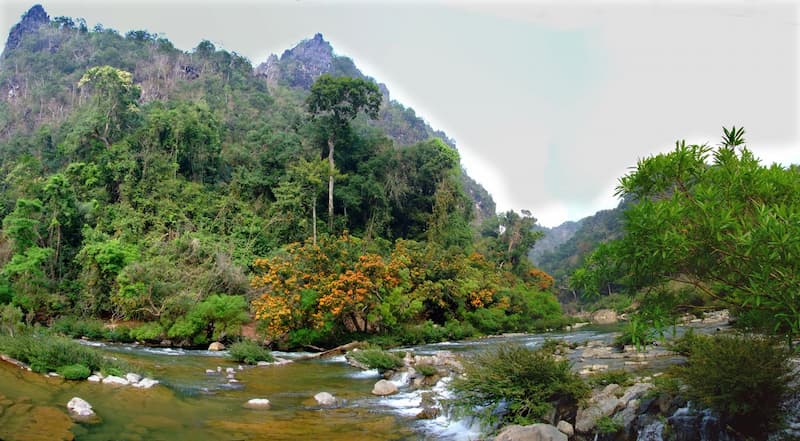
The Phong Nha-Ke Bang and Hin Nam No National Parks transboundary property represents a monumental geological bridge between Viet Nam and the Lao People’s Democratic Republic (Lao PDR). While the Vietnamese side is well-established, the Lao portion, Hin Nam No National Park, offers a raw, frontier experience in the heart of Khammouane Province.
Hin Nam No (meaning “mountain crest, spiky as bamboo shoots”) covers approximately 94,121 hectares of rugged limestone karst. It is the continuation of the same ancient massif found in Viet Nam, created by tectonic uplift and erosion over 400 million years.
The site is dominated by spectacular karst towers, massive sinkholes, and the world-renowned Xe Bang Fai River Cave. This subterranean giant features a 7 km underground river with passages tall enough to “swallow a ten-story building.” Above ground, the park is a sanctuary of primary tropical forest, home to rare primates and biodiversity found nowhere else in Laos.
Attraction
Hin Nam No appeals to travelers seeking “off-the-beaten-path” adventure:
- Tham Khoun Xe (Xe Bang Fai Cave): One of the largest active river caves on Earth. Travelers can kayak or boat through its massive, cathedral-like chambers filled with towering stalactites.
- Wildlife Spotting: It is a prime location to see the Red-shanked Douc Langur, arguably the world’s most colorful primate, and the elusive Lao Rock Rat, a “living fossil.”
- The Ho Chi Minh Trail: History buffs can trek sections of this legendary trail that wind through the park’s rugged valleys.
- Authentic Community Tourism: Unlike highly commercialized sites, Hin Nam No is managed with local villagers who act as guides, offering deep insights into sacred “spirit forests” and cave legends.
Heritage
Inscribed as an extension of the property in 2025, Hin Nam No holds World Heritage status under several UNESCO criteria:
- Criterion (viii): It is part of the oldest and most extensive karst landscape in Asia, providing a unique fossil record of Earth’s geological evolution.
- Criterion (ix): The site’s isolation has allowed for independent evolutionary processes, resulting in high levels of endemism in both flora and subterranean fauna.
- Criterion (x): It protects critical habitats for globally threatened species, forming part of a massive contiguous protected area that is essential for long-term conservation in Southeast Asia.
Gateway
Because Hin Nam No is remote, the primary gateway cities are Thakhek or Vientiane.
- Commercial Airport: Wattay International Airport (VTE) in Vientiane is the main hub. From there, you can fly or take a 5-hour drive to Thakhek. Alternatively, Savannakhet Airport (ZVK) is also a viable option.
- Lodging: Thakhek offers excellent lodging, such as the Inthira Thakhek or Le Bouton d’Or. Closer to the park, travelers stay in basic but authentic village homestays in Ban Na Hin or Muang Boualapha.
When
- Dry Season (November to April): This is the only time to visit if you want to enter the caves. Water levels are low enough for boat passage, and hiking trails are safe.
- Cool Season (November to February): The most comfortable time for trekking, with daytime temperatures around 25°C and cool evenings.
- Note: During the Wet Season (June to October), the Xe Bang Fai River Cave often floods, making it completely inaccessible and turning the dirt access roads into impassable mud.
Consideration
- UXO Safety: This region was heavily bombed during the Second Indochina War. Never stray from established trails and always hire a local village guide who knows the safe routes.
- Physical Fitness: A visit to Xe Bang Fai involves long boat rides and potentially strenuous trekking over sharp “razor” karst.
- Limited Infrastructure: Do not expect luxury at the site. Electricity and Wi-Fi are scarce in the village homestays; bring power banks and a good flashlight.
- Permits: You must check in with the park headquarters or local authorities in Boualapha to arrange official guides and permits.
Resources
- Hin Nam No National Park Official Website: The best source for trail maps, community homestay info, and conservation news.
- UNESCO World Heritage – Transboundary Extension: For the official scientific description of the Lao-Viet Nam transboundary site.
- Ecotourism Laos – Hin Nam No: A government-supported portal with practical logistics for visiting protected areas.
- Tourism Laos Official Guide: The national board’s guide to Khammouane Province and regional festivals.
- EXO Travel – Laos Tours: A reputable regional tour operator that specializes in guided expeditions to Laos’ World Heritage sites.
Featured Image
Xe Bang Fai River (Italian Walrus63, Wikipedia/CC BY-SA 3.0).
In The News
Advertisement


Comment:
 All About World Heritage Sites (...and more)

Leave a comment