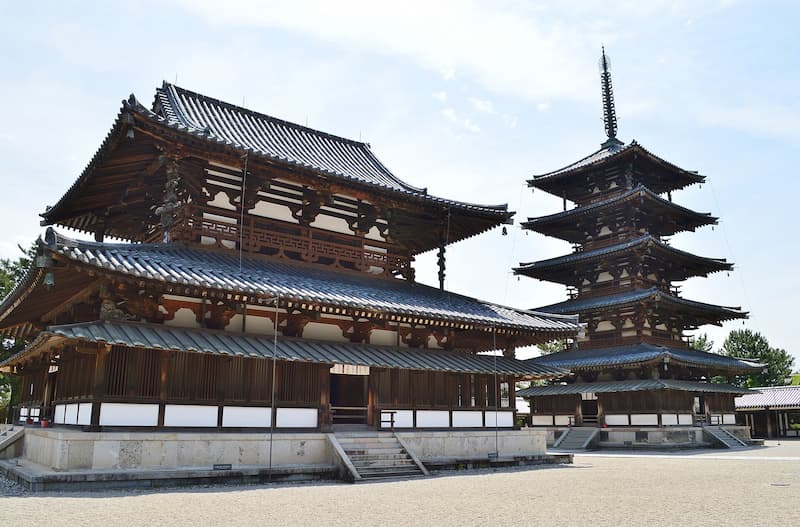
Located in Ikaruga, Nara Prefecture, the Buddhist Monuments in the Horyu-ji Area serve as a majestic portal to 7th-century Japan. This site is not just a collection of temples; it is the cradle of Japanese Buddhism and home to the oldest wooden structures on the planet.
The site consists of 48 Buddhist monuments spread across two primary temple complexes: Horyu-ji and Hokki-ji.
- Horyu-ji (Temple of the Flourishing Law): Founded in 607 by Prince Shotoku, it is divided into the Western Precinct (housing the five-storied pagoda and the Golden Hall) and the Eastern Precinct (centered around the octagonal Hall of Dreams, or Yumedono).
- The Architecture: The buildings utilize a unique “entasis” column style—slightly bulging in the middle—reminiscent of ancient Greek architecture, showing the reach of the Silk Road.
- Hokki-ji: Located nearby, it features a stunning three-storied pagoda completed in 706, surrounded by tranquil rural fields.
Attraction
Tourists are drawn to Horyu-ji for its sheer survival against time:
- World Records: The five-storied pagoda and the Kondo (Golden Hall) are widely recognized as the oldest surviving wooden buildings in the world.
- Artistic Treasures: The temple houses over 2,500 cultural properties, including the Kudara Kannon, a slender, graceful statue that is a masterpiece of East Asian Buddhist art.
- Spiritual Atmosphere: Unlike the crowded temples of central Kyoto, Horyu-ji offers a more spacious, “mini-city” feel with pine-lined avenues and ancient earthen walls.

Heritage
Inscribed in 1993 as Japan’s first UNESCO World Heritage site, it meets Criteria (i), (ii), (iv), and (vi):
- Criterion (i): The monuments are masterpieces of wooden architecture, showing sophisticated design and intricate bracket systems.
- Criterion (ii): They represent the introduction of Buddhism to Japan and the successful adaptation of Chinese and Korean architectural styles into a distinct Japanese aesthetic.
- Criterion (vi): The site is inextricably linked to Prince Shotoku, the regent who laid the religious and political foundations of the Japanese state.
Gateway
While located in the town of Ikaruga, the best gateway for travelers is Nara City or Osaka.
- Airport: Kansai International Airport (KIX) is the primary gateway. From KIX, you can reach JR Horyuji Station in about 60–80 minutes via Tennoji.
- Lodging: Nara City offers high-end options like the JW Marriott Hotel Nara or the historic Nara Hotel. Alternatively, staying near JR Tennoji Station in Osaka provides direct, 25-minute “Yamatoji Line” train access to the site.
- Local Access: From JR Horyuji Station, the temple is a 20-minute walk or a 5-minute bus ride.
When
- Spring (Late March to early April): For cherry blossoms framing the ancient pagodas.
- Autumn (November): The surrounding Ikaruga countryside and the Tatsuta River are famous for vibrant maple leaves.
- Special Openings: The Kuse Kannon in the Hall of Dreams is a “Hidden Buddha” only revealed twice a year: April 11 – May 18 and October 22 – November 22. These are the best times for art enthusiasts.

Consideration
- Walking Distance: The site is vast (nearly 19 hectares). Wear comfortable walking shoes.
- The “All-Inclusive” Ticket: Entry is 2,000 yen, which is pricier than most temples but covers the Western Precinct, the Treasure Gallery, and the Eastern Precinct.
- Combined Trip: Many visitors combine Horyu-ji with Chugu-ji Temple (next door), famous for its “Mona Lisa of the East” statue.
- Bicycle Rental: The area between Horyu-ji and Hokki-ji is perfect for cycling. Rentals are available near the JR station.

Resources
- Horyu-ji Official Website: For the most accurate opening times and religious event schedules.
- UNESCO – Buddhist Monuments in the Horyu-ji Area: Detailed history and heritage criteria.
- Visit Nara – Official Travel Guide: Excellent maps and local dining recommendations in Ikaruga.
- Japan National Tourism Organization (JNTO): Broad travel logistics for the Nara region.
- GetYourGuide – Horyu-ji Tours: Great for booking English-speaking private guides who can explain the complex 1,400-year history.
Featured Image
Horyu-ji Western Precinct, consisting of the Golden Hall and pagoda (Saigen Jiro, Flickr/CC0 1.0).
In The News
Advertisement


Comment:
 All About World Heritage Sites (...and more)

Leave a comment