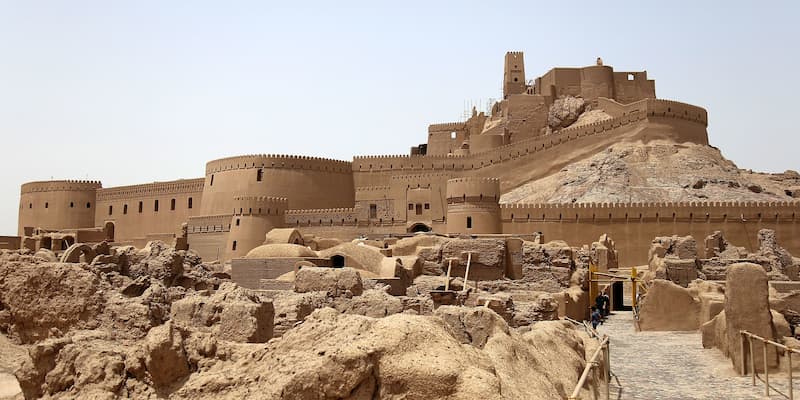
The “Bam and its Cultural Landscape” property is centered around Arg-e Bam, a massive fortress constructed entirely of sun-dried mud bricks (adobe). The site spans approximately 20 hectares and features a tiered structure: the lower city for the common populace and the elevated “Governor’s Quarter” for the ruling elite. Beyond the walls, the cultural landscape includes 67 identified qanats (underground water channels), historic palm groves, and auxiliary forts like Qal’eh Dokhtar. It is a masterclass in vernacular architecture, utilizing the Chineh (mud layer) and Khesht (mud brick) techniques to survive the harsh Lut Desert climate.
Attraction
Bam attracts global visitors for several reasons:
- Scale: It is the largest earthen construction in the world.
- Historical Legacy: As a key stop on the Silk Road, it served as a bustling trade hub for silk and cotton between the 7th and 11th centuries.
- Architectural Ingenuity: The use of “wind catchers” (badgirs) and thick mud walls provides a fascinating look at ancient sustainable cooling.
- Resilience: Watching the “Phoenix-like” rise of the citadel through meticulous restoration is a powerful emotional experience for many travelers.

Heritage
Bam was inscribed as a World Heritage Site in 2004 (and removed from the “In Danger” list in 2013) based on several criteria:
- Criterion (ii): It exhibits an important interchange of human values on developments in adobe architecture.
- Criterion (iii): It is an exceptional testimony to a trading settlement in a desert environment.
- Criterion (iv): It is an outstanding example of a fortified medieval town built in traditional mud-brick techniques.
- Criterion (v): The landscape illustrates the interaction of man and nature through the ancient qanat irrigation system.
Gateway
For travelers, the city of Bam itself serves as the immediate gateway.
- Airport: Bam Airport (BXR) handles regular domestic flights from Tehran.
- Lodging: Options include the Bam Tourist Hotel (near the citadel) and Akbar Guesthouse, which offers a traditional atmosphere.
- Alternative: Kerman (approx. 190 km away) is a larger provincial capital with a major commercial airport (KER) and more diverse luxury lodging. Many tourists fly into Kerman and take a 3-hour taxi or bus to Bam.
When
The ideal windows are Spring (March to May) and Autumn (September to November). During these months, temperatures are temperate (20^C to 28^C), avoiding the 40^C+ scorching heat of the summer and the freezing desert nights of winter. Visiting in late March during Nowruz (Persian New Year) offers a festive atmosphere, though sites can be crowded.

Consideration
- Dress Code: Iran has a modest dress code; women must wear a headscarf (hijab) and loose-fitting clothing in public.
- Currency: International credit cards (Visa/Mastercard) are generally not accepted due to sanctions. You must carry cash (Iranian Rial) or use a local prepaid travel card.
- Safety: While Bam is generally safe for tourists, always check your government’s travel advisories regarding the Kerman province.
- Restoration: Parts of the citadel may still be under active conservation; respect all cordoned-off areas.

Resources
- UNESCO World Heritage Centre: The official source for historical data and heritage criteria.
- Surfiran: A comprehensive guide to the citadel’s history and modern-day visitor tips.
- Persian Walk: Excellent for discovering hidden gems and local cultural experiences in Bam.
- OrientTrips: A logistics-heavy site useful for booking transport and local guides.
- Mah Card: A specialized travel card service for tourists in Iran.
Featured Image
Arg-e Bam (Safa Daneshvar, Wikimedia/CC BY-SA 4.0).
In The News
Advertisement


Comment:
 All About World Heritage Sites (...and more)

Leave a comment