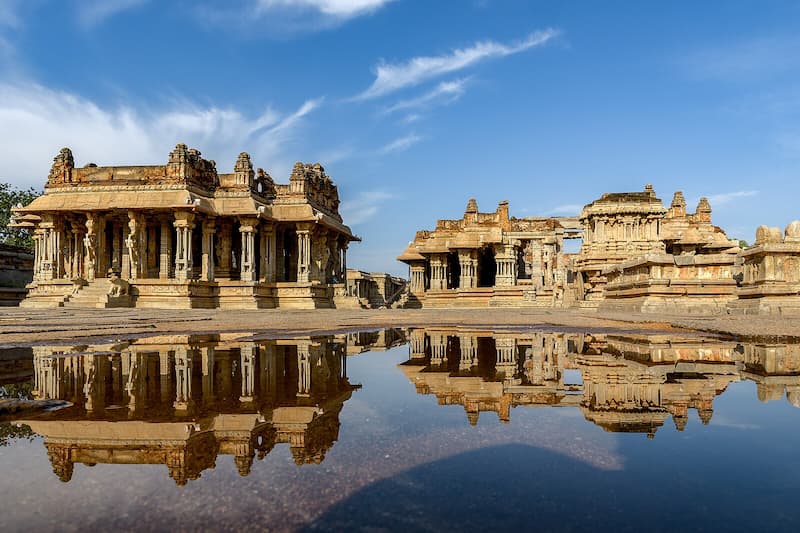
The Group of Monuments at Hampi, located in the east-central part of Karnataka, India, is one of the most evocative and physically vast archaeological sites in the world. Often described as the “World’s Largest Open-Air Museum,” it serves as a silent, stone-carved chronicle of the final great Hindu Kingdom of Vijayanagara.
Spread over 4,100 hectares, Hampi is a surreal landscape where thousands of boulders are strewn across rolling hills and the banks of the Tungabhadra River. Within this dramatic setting lie the ruins of the Vijayanagara Empire (14th to 16th centuries).
The site includes more than 1,600 surviving remains, ranging from majestic temples and royal palaces to massive stables, sophisticated water systems, and ancient market streets. The architecture is primarily Dravidian, characterized by high enclosure walls, massive gate-towers (Gopurams), and intricate carvings on hard granite that depict scenes from Indian epics.
Attraction
Hampi offers a unique blend of historical grandeur and adventurous exploration:
- The “Singing” Pillars: The Vittala Temple contains 56 “musical pillars” that produce distinct rhythmic notes when gently tapped. It also houses the iconic Stone Chariot, a masterpiece of craftsmanship that has become the symbol of Karnataka tourism.
- A Living Temple: Unlike many ruins, the Virupaksha Temple is a continuous center of worship. Its 50-meter high gopuram dominates the landscape, and visitors can still witness traditional Hindu rituals and receive a “blessing” from the temple elephant, Lakshmi.
- Bouldering Capital: Beyond history, Hampi is globally famous for rock climbing. Its unique geological formations attract enthusiasts from all over the world to “boulder” among the ruins.
- Vibrant River Life: Crossing the river in a Coracle (a traditional circular reed boat) to visit “Hippie Island” (Virupapura Gaddi) provides a bohemian contrast to the austere monuments on the south bank.

Heritage
UNESCO inscribed Hampi in 1986 under Criteria (i), (iii), and (iv):
- Masterpiece of Genius: The integration of a fortified city with exemplary temple architecture and a spectacular natural setting is considered a unique human achievement.
- Testimony to a Civilization: It is the most significant testimony to the Vijayanagara Empire, which was once one of the wealthiest and most powerful in the world, trading with Persia, Portugal, and China.
- Architectural Ensemble: The site represents a peak in the evolution of South Indian architecture and urban planning, showcasing advanced military, civil, and religious structures.
Gateway
While Hampi is a small village, the primary gateway for international and domestic travelers is Hubballi (Hubli).
- Commercial Airport: Hubballi Airport (HBX) is the nearest major commercial airport (160 km away), with frequent flights from Bangalore, Mumbai, and Hyderabad. (Note: The closer Jindal Vidyanagar Airport is sometimes used for private or regional charters).
- Lodging: Hubballi offers a wide range of business and luxury hotels. Most travelers, however, use Hubballi to land and then travel to the town of Hospet (13 km} from Hampi), which has specialized tourist hotels like Hotel Hampi International or luxury resorts like Evolve Back Kamalapura.
When
The ideal time to visit is during the winter (October to March).
- Weather: Temperatures are pleasant (16°C to 32°C), making it possible to walk through the expansive, shade-less ruins without the intense heat of the Indian sun.
- Festivals: The Hampi Utsav (usually in November) features cultural performances and light shows among the ruins, while the Purandara Festival in January/February celebrates classical music.

Consideration
- Sun Protection: The site is almost entirely open. Sunscreen, wide-brimmed hats, and umbrellas are essential for midday exploration.
- No ATMs in Hampi: There are virtually no ATMs in the historic village. You must withdraw sufficient cash in Hospet or Kamalapura before arriving.
- Cultural Sensitivity: Wear modest clothing that covers shoulders and knees, especially when entering “living” temples like Virupaksha. You will be required to remove your shoes at temple entrances.
- Mobility: The site is massive (26 sq. km). Renting a bicycle or a moped is the best way to see the various clusters, as walking between major monuments can be exhausting.

Resources
- UNESCO World Heritage – Hampi: The official dossier on the site’s history and conservation status.
- Incredible India – Hampi: The government tourism portal with high-quality photos and official guides.
- Hampi.in: A comprehensive, locally maintained “DIY” guide that details every single monument and legend.
- Karnataka Tourism Official Site: Best for checking the dates of festivals like Hampi Utsav.
- Agoda: A reliable platform to book everything from budget guesthouses to luxury heritage resorts near the ruins.
Featured Image
Vittala Temple (Basavaraj M, Wikipedia/CC BY-SA 4.0).
In The News
Advertisement


Comments:
7 responses to “Group of Monuments at Hampi”
-
Hemkuta Hill, the sunset point, offers lovely views of the surroundings. What was to be a touristic experience, turns into a soulful one–the open sky, unmarred by tall buildings; the simplicity, serenity and earthiness of the granite hill that feels like a cool balm to my bare feet as I walk towards Virupaksha temple; the quietude afforded due to well-dispersed tourists; and the sun’s warmth, accompanied by the November breeze, gradually melt away my baggage of stress, making me feel centered and free.
LikeLike
-
For a very special perspective on Hampi, rise early when it’s still dark and climb the 250 steps up Matanga Hill to watch the sun rise over the ancient temples, halls, monuments, and adjacent banana plantations and emerald rice paddies. Matanga Hill, which is looked after by a local priest and his family, is little visited and is especially peaceful at dawn. Those who climb to the top are rewarded with 360-degree views. Take a camera but don’t forget to simply watch without a lens to absorb the atmosphere.
LikeLike
-
I believe 2 days is enough to explore and relax in Hampi. However, Hampi is such an wonderful place that everyone will definitely feel like lingering for a while and I can bet on that. We were advised to stay on the river side. Our resort is brilliantly located next to the river on a hill.. The view is one of the best thing that we enjoyed.
LikeLike
-
Historians take special interest in the temple pillars that have intricate carvings. You will also hear of the musical pillars (they tend to resonate when tapped). The path that connects the ancient Hampi Bazaar to the Vittala Temple leads to the pleasant and thrilling Riverside Ruins. All along with path, you can see numerous shrines that are scattered along with the ruins of ancient structures.
LikeLike
-
Weather in Hampi does not allow visitors to explore much of the stone structures during the afternoon time. It gets very hot and thus, most of the attractions are best seen during early morning or late afternoon. Most of the temple complexes opens during sunrise and close at sunset. “Early to bed and early to rise” should be one’s main mantra while visiting Hampi.
LikeLike
-
Hampi is fantastic if you are into history, but its landscape is as compelling. The region is dominated by rust-coloured rocky outcrops, massive boulders, green fields and the serenely flowing Tungabhadra River. Surely, there could have been more practical reasons why Hampi was chosen as the capital of the Vijyanagara Empire, but we’re sure its beauty, especially at sunrise and sunset, would have played a part.
LikeLike
-
Within Hampi, cycles and bikes are available on rent; autorickshaws are also available to take you to the points of interest. However, nothing beats exploring on foot, at your own pace. With Hampi slowly gaining popularity, a lot of homestays, guest houses, and resorts are emerging. A few heritage houses even offer a traditional, close-to-nature experience in terms of stay as well as cuisine.
LikeLike

 All About World Heritage Sites (...and more)

Leave a comment