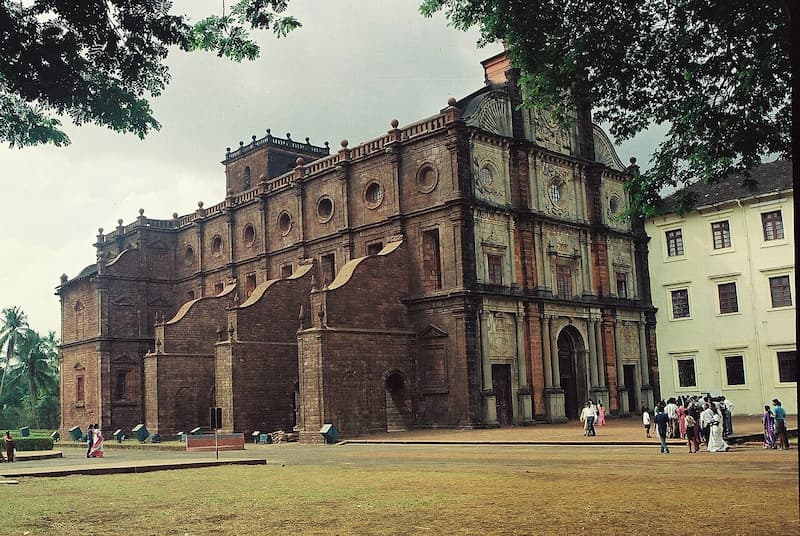
The Churches and Convents of Goa, located in Velha Goa (Old Goa), India, represent the former capital of the Portuguese Indies and serve as a remarkable testament to the spread of Christianity and European architectural styles in Asia.
The property is a serial site consisting of several major religious monuments built between the 16th and 18th centuries. Once known as the “Rome of the East,” Old Goa was a bustling metropolis that rivaled London and Lisbon in size and splendor before being abandoned due to plague in the 18th century.
Key monuments include:
- Basilica of Bom Jesus: A landmark of Baroque architecture, famous for its unplastered laterite exterior and for housing the silver casket of St. Francis Xavier.
- Sé Cathedral: Dedicated to St. Catherine of Alexandria, it is one of the largest churches in Asia. Its Tuscan exterior houses the “Golden Bell,” known for its rich tone.
- Church of St. Francis of Assisi: Features a unique blend of Manueline (Portuguese late Gothic), Mannerist, and Baroque styles, with an interior adorned with gilded carvings and frescoes.
- Church of St. Augustine (Ruins): Once a massive complex, now marked by a striking 46m high bell tower that remains standing amidst the ruins.
Attraction
- The Relics of St. Francis Xavier: Thousands of pilgrims and tourists visit the Basilica of Bom Jesus to pay respects to the miraculously preserved body of the Jesuit missionary.
- Indo-Portuguese Fusion: The site offers a unique visual history where European architectural forms were adapted by local Indian craftsmen, resulting in a distinct “Indo-Portuguese” aesthetic not found elsewhere.
- Historical Time Capsule: Unlike the modern, beach-focused parts of Goa, this area feels like a preserved piece of 16th-century Europe dropped into the tropical landscape of the Konkan coast.
- Religious Significance: It remains a living center of faith, especially during major feasts and the decennial exposition of the sacred relics.

Heritage
UNESCO inscribed the site in 1986 under three cultural criteria:
- Criterion (ii): The monuments were instrumental in disseminating Western art forms—specifically Manueline, Mannerist, and Baroque styles—throughout Asia wherever Catholic missions were established.
- Criterion (iv): The ensemble of churches and convents is an outstanding example of an architectural type that illustrates the significant work of European missionaries in the East.
- Criterion (vi): The site is directly and tangibly associated with the history of the evangelization of Asia, a movement of universal historical importance.
Gateway
The city of Panaji, the current capital of the state of Goa, serves as the primary gateway.
- Commercial Airport: Goa is served by two major airports. Dabolim Airport (GOI) is approximately 25km from Old Goa, and the newer Manohar International Airport (Mopa, GOX) is about 45km away. Both handle domestic and international flights.
- Lodging: Panaji and the nearby area of Velha Goa offer extensive lodging options, from high-end heritage hotels like The Postcard Velha to business hotels (Marriott, Vivanta) and local guesthouses.
When
- November to February: This is the peak season. The weather is dry and pleasant, with temperatures ranging from 20°C to 32°C, making it ideal for walking between the monuments.
- December 3rd: The Feast of St. Francis Xavier is the most significant event. While very crowded, it offers an unparalleled look at Goan religious culture and tradition.
- Monsoon (June to September): While the greenery is stunning, heavy rains can make sightseeing difficult, and some smaller chapels may have limited access.

Consideration
- Dress Modestly: These are active religious sites. Visitors are expected to cover their shoulders and knees. Sleeveless tops, shorts, and miniskirts may result in being denied entry.
- Hydration and Sun Protection: The tropical sun can be intense. Carry water, wear a hat, and use sunscreen, as there is significant walking between the different church complexes.
- Photography: While generally allowed, photography is often restricted or forbidden during active Mass services. Always check for signs before using a flash inside the basilicas.
- Transport: While you can walk between the main churches in Old Goa, hiring a pilot (local motorcycle taxi) or a private cab for the day is the most efficient way to see outlying sites like the Church of Our Lady of the Mount.
- Monkeys: Be cautious of the local macaque population near the ruins; they are accustomed to tourists and may try to grab food or loose items.

(Joegoauk Oldgoa, Flickr/CC BY-SA 2.0).
Resources
- UNESCO World Heritage Centre – Detailed maps and the official Statement of Significance.
- Incredible India: Goa – The official national tourism portal providing cultural context and visitor guides.
- Archdiocese of Goa and Daman – Information on Mass timings, feast dates, and religious protocols for the Basilica and Cathedral.
- Archaeological Survey of India (ASI) – Technical details on the preservation and history of the monuments.
- GetYourGuide: Old Goa Tours – A platform to book guided heritage walks and private history tours of the churches.
Featured Image
Basilica of Bom Jesus (VN Gupta, Wikimedia/CC BY-SA 4.0).
In The News
Advertisement


Comment:
One response to “Churches and Convents of Goa”
-
Goa is a really nice place and offers many places to visit as well. Do visit to have grat experiences.
LikeLike

 All About World Heritage Sites (...and more)
Leave a comment