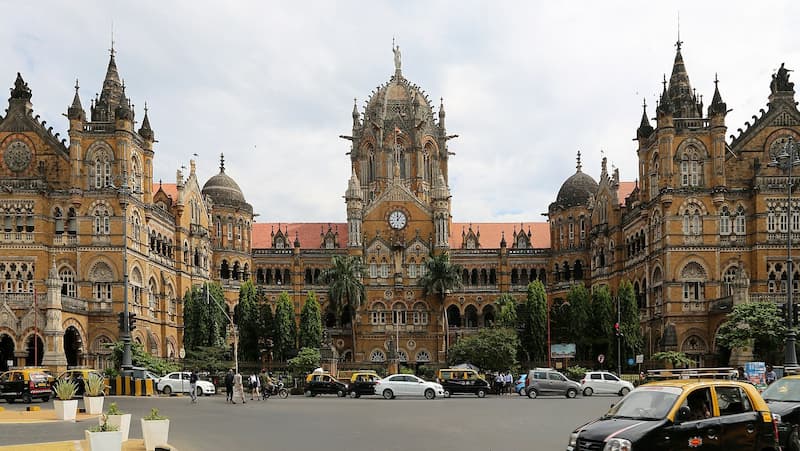
The Chhatrapati Shivaji Maharaj Terminus (CSMT), formerly known as Victoria Terminus (VT), is a breathtaking architectural marvel that stands as the crowning jewel of Mumbai’s skyline. It isn’t just a railway station; it is a symphony of stone, a witness to the birth of the Indian railway system, and the rhythmic heart of a city that never sleeps.
Designed by the British architect Frederick William Stevens, the terminus was completed in 1888 after ten years of construction. It is a stunning example of Victorian Gothic Revival architecture, but with a uniquely Indian soul.
The building is constructed from a blend of Indian sandstone and limestone, featuring Italian marble for its interior ornamentation. Its most striking feature is the high central dome, topped by a 4m (13ft) statue of a female figure representing “Progress.” The facade is a riot of detail: pointed arches, gargoyles, stone carvings of local flora and fauna, and stained-glass windows that filter the harsh Mumbai sun into a kaleidoscope of colors.
Attraction
Why do travelers from across the world flock to a functional train station?
- Architectural Grandeur: It is often cited as the finest example of Victorian Gothic architecture in the world outside of Europe. The fusion of European “Gothic” with Indian “Saracenic” styles creates a visual language that is entirely unique.
- The Living Museum: Unlike many heritage sites that are static, CSMT is a living, breathing entity. Over 3 million people pass through its gates daily. To stand on its platforms is to witness the sheer, kinetic energy of India.
- Cinematic Iconography: Fans of global cinema recognize it from the Oscar-winning Slumdog Millionaire (specifically the “Jai Ho” dance sequence) and countless Bollywood blockbusters.
- Night Illumination: Every evening, the building is bathed in a sophisticated LED light show, highlighting its spires and domes in a way that makes it look like a palace from a fairy tale.

Heritage
UNESCO inscribed the terminus in 2004, recognizing it for its Outstanding Universal Value.
- Interchange of Values (Criterion ii): The site represents a unique “collision” of two cultures. While the structural blueprint is British Gothic, the intricate stone carvings, tiles, and woodwork were the work of Indian craftsmen and students from the local J.J. School of Art.
- Masterpiece of an Era (Criterion iv): It is the ultimate example of a 19th-century railway terminus. At the time of its construction, it was the most advanced and expensive building in India, symbolizing the technological and economic power of the British Empire while inadvertently becoming a symbol of Indian national pride.
Gateway
The gateway to the site is the city of Mumbai itself.
- Commercial Airport: Chhatrapati Shivaji Maharaj International Airport (BOM) is the primary gateway, located approximately 20km from the station. It is one of the busiest and most modern airports in Asia.
- Lodging: Being a global financial hub, Mumbai offers everything from the legendary Taj Mahal Palace (a destination in itself) to boutique hotels in the “Colaba” district and business hotels in “Bandra.” For those wanting to stay near the site, the South Mumbai (Fort/Colaba) area is best.
When
- Peak Season (October to March): The weather is pleasant and dry, making it easier to walk around the exterior and admire the carvings without the sweltering humidity of summer.
- The “Magic Hour”: Visit at sunset. You get to see the transition from the golden glow of the sun on the yellow sandstone to the brilliant artificial lighting that turns the building into a neon-gothic masterpiece.
- Avoid the “Super-Peak” Rush: If you want to explore the interior, try to avoid the 8:30 AM to 10:30 AM and 5:30 PM to 8:30 PM windows, unless you want to experience the “Mumbai Crush” firsthand!

Consideration
- The Heritage Wing: Many tourists miss this, but there is a dedicated Heritage Museum inside the building that offers guided tours of the grand staircase, the dining hall, and the upper balconies. It usually requires a small fee and has specific afternoon hours.
- Photography Permits: While you can snap photos of the exterior freely, professional photography or tripod use inside the functional parts of the station may require prior permission from the Central Railway office.
- Safety & Scams: Like any major transit hub, be mindful of pickpockets. Ignore “unauthorized guides” who offer to take you to restricted areas for a fee.
- Walkability: The area around CSMT (the “Fort” district) is very walkable. Pair your visit with a walk to the Gateway of India or the Marine Drive promenade.

Resources
- UNESCO World Heritage Centre – The official justification, maps, and technical details of the site’s protected status.
- Central Railway (Official) – For information on the Heritage Museum and station history.
- Maharashtra Tourism (MTDC) – The official state tourism portal for broader travel planning in the region.
- Britannica: Chhatrapati Shivaji Terminus – A deep dive into the architectural history and the life of F.W. Stevens.
- Viator – A popular platform for booking professional “Heritage Walks” through South Mumbai that include detailed tours of CSMT.
Would you like me to find the specific opening hours for the Heritage Museum tour for your 2026 visit?
Featured Image
Chhatrapati Shivaji Terminus (PadFoot2008, Wikimedia/CC0 1.0).
In The News
Advertisement



Comment:
 All About World Heritage Sites (...and more)
Leave a comment