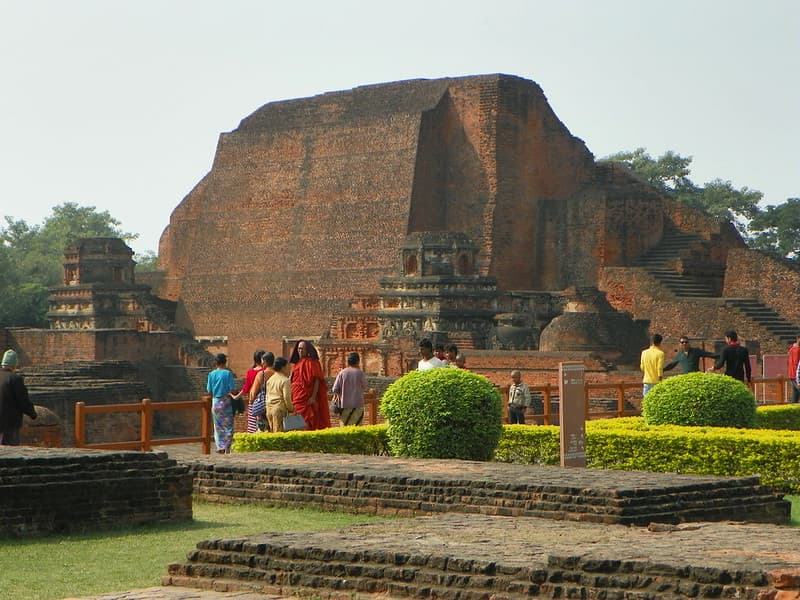
The Archaeological Site of Nalanda Mahavihara (Nalanda University) in Bihar, India, is one of the world’s most significant historical centers of learning. Established in the 5th century CE, this ancient monastic university served as a global epicenter for higher education, attracting scholars and students from as far away as China, Korea, Japan, and Southeast Asia. Today, the excavated ruins offer a glimpse into a sophisticated educational system that flourished for over 700 years before its destruction in the 12th century.
The excavated ruins at Ruins of Nalanda Mahavihara span a vast area, showcasing a sophisticated urban layout designed specifically for scholarly pursuits. The site is characterized by an impressive array of structures built primarily from red brick.
- Viharas (Monasteries): These are a series of monastic complexes arranged in rows, featuring small cells for monks surrounding a central courtyard, often with a shrine at the entrance.
- Chaityas (Temples): Several grand temple structures are interspersed among the monasteries. The most notable is Temple No. 3, a massive structure rebuilt several times, offering a commanding view of the entire complex.
- Stupas: The site contains numerous stupas dedicated to various Buddhist deities and teachers, adding to its spiritual significance.
Attraction
Travelers are drawn to Nalanda for its profound historical and spiritual aura. It offers a rare opportunity to walk through the physical remnants of one of the earliest residential universities in the world, fostering a deep connection with ancient intellectual history.
- Architecture: The sheer scale and systematic planning of the brick ruins are a marvel for architects and history enthusiasts.
- Cultural Connection: It remains a site of pilgrimage for Buddhists worldwide, representing a key location in the journey of knowledge and faith across Asia.

Heritage
Inscribed in 2016, the site is recognized for its exceptional universal value under Criteria (iv) and (vi):
- Criterion (iv): It is an outstanding example of a mahavihara—a comprehensive educational institution comprising both monasteries and temples, showcasing the architectural evolution of such centers in the Indian subcontinent.
- Criterion (vi): It is directly associated with the development of Buddhism as a religion and the evolution of monastic educational traditions, serving as a pivotal hub for the transmission of knowledge throughout Asia.
Gateway
- The City: Patna, the capital of Bihar, serves as the primary gateway to the Nalanda site, located approximately 90 kilometers away.
- Airport: Jay Prakash Narayan International Airport Click to open side panel for more information (IATA: PAT) in Patna connects the region to major Indian cities.
- Lodging: Patna offers comprehensive lodging options, ranging from luxury hotels to budget guesthouses.
When
- Best Overall: October to March offers the most pleasant temperatures for exploring the outdoor ruins, avoiding the intense heat of summer and the heavy monsoons.

Consideration
- Site Size: The ruins are sprawling; wear comfortable walking shoes and bring adequate water.
- Summer Heat: If visiting between April and June, prepare for extremely high temperatures with hats, sunscreen, and plenty of water.
- Local Transport: Hire a private taxi from Patna for a convenient day trip, or consider taking a train to the nearby Nalanda station, followed by local transport.

Resources
- UNESCO – Archaeological Site of Nalanda: The official archive for maps, conservation reports, and detailed history.
- Bihar Tourism – Nalanda: Official tourism portal with practical information on visiting hours and facilities.
- Archaeological Survey of India (ASI): Government body responsible for the maintenance and preservation of the site.
- Nalanda Digital Archives: An independent resource focusing on the history and excavation of the ruins.
- Viator – Nalanda Tours: For booking guided day trips from Patna, including transportation and an English-speaking guide.
Featured Image
Sariputra Temple, or Temple No 3 (Juggadery, Flickr/CC BY-SA 2.0).
In The News
Advertisement



Comment:
 All About World Heritage Sites (...and more)
Leave a comment