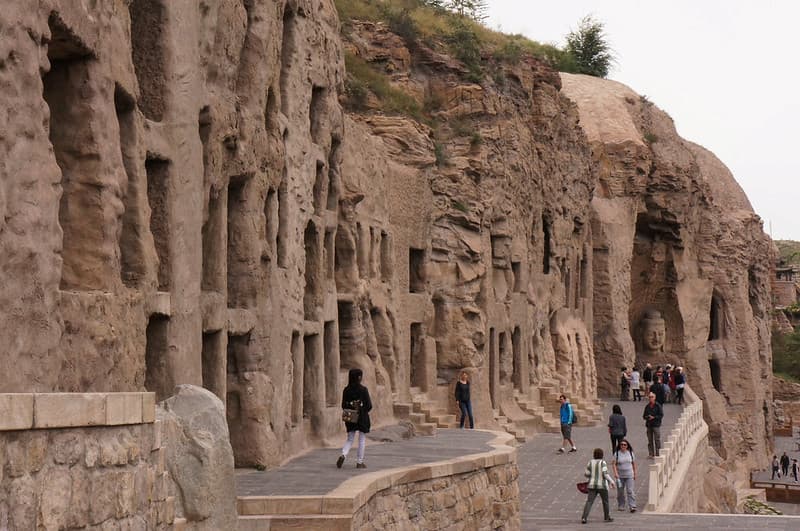
The Yungang Grottoes, located in the southern foothills of Wuzhou Mountain near Datong in Shanxi Province, are a monumental collection of early Buddhist cave art. They represent the first peak of Buddhist stone carving in China and are a testament to the religious and political fervor of the Northern Wei Dynasty (386–534 CE).
The site stretches for approximately 1 km along a sandstone cliff and comprises 252 caves and niches containing more than 51,000 statues. These carvings were created primarily between 460 and 494 CE under imperial patronage.
The grottoes are divided into three sections:
- Eastern Section (Caves 1–4): Mostly pagoda-style caves.
- Middle Section (Caves 5–13): The most elaborate, featuring twin caves and the “Five Caves of Tan Yao.” Cave 6 is particularly notable for its central pillar and 33 embossed panels depicting the life of Sakyamuni.
- Western Section (Caves 14–53): Predominantly smaller caves and niches carved after the capital moved to Luoyang.
The statues vary drastically in scale, from tiny 2cm figures to the massive 17m tall seated Buddha in Cave 5.
Attraction
The Yungang Grottoes are a magnet for international travelers due to their:
- Artistic Fusion: The site is a rare visual record of the Silk Road’s cultural exchange. You can see a blend of Indian Gandharan art, Central Asian motifs, and even Greek and Roman architectural influences (such as acanthus leaf patterns) synthesized with traditional Chinese aesthetics.
- Colossal Scale: The sheer number of statues and the massive scale of the larger Buddhas provide an awe-inspiring experience similar to the Bamiyan Buddhas or the Ajanta Caves.
- Vibrant Preservation: Unlike many ancient sites, several caves (notably Cave 5 and 6) still retain their original brilliant mineral pigments, offering a glimpse into the colorful world of the 5th century.

Heritage
UNESCO inscribed the Yungang Grottoes in 2001 under criteria (i), (ii), (iii), and (iv):
- Masterpiece of Human Genius: They represent a masterpiece of early Chinese Buddhist cave art.
- Cultural Exchange: They illustrate the successful fusion of South and Central Asian religious art with Chinese cultural traditions.
- Symbol of Faith: The site vividly demonstrates the power and endurance of Buddhist belief in China.
- Historical Impact: Yungang was the first major site where religious cave art developed a distinct Chinese character, which subsequently influenced Buddhist art across East Asia.
Gateway
The city of Datong serves as the perfect gateway.
- Transportation: The city is served by Datong Yungang Airport (DAT), which has commercial flights to major hubs like Beijing and Shanghai. It is also a major stop for high-speed rail, connecting to Beijing in about 2 hours.
- Lodging: Datong offers a wide range of accommodation, from the high-end Hilton Garden Inn to traditional courtyard stays like the Datong Yunzhong Traditional Courtyard within the city’s ancient walls.
When
- Peak Season (May to October): The weather is mild and dry. This is the best time for sightseeing, as Datong can be quite windy and dusty in early spring.
- Winter (December to February): It is brutally cold (often below -15°C), but the site is peaceful with very few tourists. The snow against the sandstone can be strikingly beautiful.
- Pro Tip: Avoid the first weeks of May and October (China’s National Holidays) as the crowds can be overwhelming.

Consideration
- Real-Name Ticketing: Tickets must be booked in advance via the official WeChat mini-program or website. You must carry your passport for entry.
- Climate Protection: The region is very dry. Bring lip balm, moisturizer, and a face mask for potential dust or wind.
- Photography Rules: Photography is allowed in most areas, but the use of flash is strictly prohibited inside the caves to prevent pigment degradation.
- Physicality: Exploring the full 1 km stretch involves significant walking. Wear comfortable shoes and bring water, though there are shuttle buses available at the entrance.

(Thebrainchamber1, Wikimedia/CC BY-SA 4.0).
Resources
- UNESCO World Heritage Centre – For the official historical dossier and map of the inscribed zone.
- Yungang Grottoes Research Academy – The official institutional site (Chinese/English) for deep-dives into conservation efforts and academic history.
- Chinese History Digest – An excellent English-language overview of the individual caves and their meanings.
- Trip.com – A robust platform for checking current ticket prices, traveler reviews, and booking nearby hotels in Datong.
- GetYourGuide – Useful for international travelers who prefer booking guided tours or entrance tickets in English with a flexible cancellation policy.
Featured Image
Yungang Grottoes (Tefl Search, Flickr/CC BY 2.0).
In The News
Advertisement


Comment:
 All About World Heritage Sites (...and more)
Leave a comment