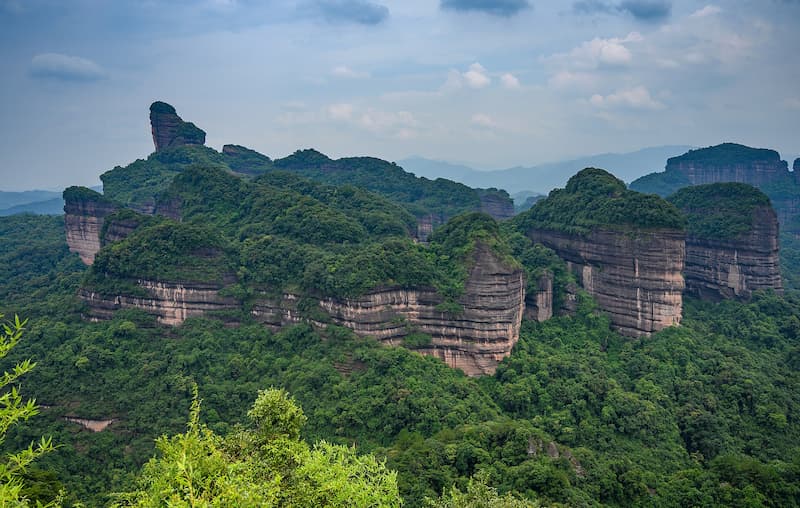
China Danxia is a spectacular serial World Heritage property comprising six component parts located across the sub-tropical zone of south-eastern China. These sites are Chishui (Guizhou), Taining (Fujian), Langshan (Hunan), Danxiashan (Guangdong), Longhushan (Jiangxi), and Jianglangshan (Zhejiang).
The term “Danxia” (meaning “rosy cloud”) refers to unique landscapes developed on continental red sedimentary beds. Over millions of years, these red sandstone and conglomerate layers have been shaped by internal tectonic forces (uplift) and external erosional forces (weathering and water). The result is a breathtaking array of vibrant red cliffs, massive mesas, peak clusters, deep ravines, and dramatic natural pillars. Unlike the “Rainbow Mountains” of Zhangye (a separate geological phenomenon in northern China), the China Danxia sites are characterized by their deep crimson hues and lush, evergreen sub-tropical forests that often cling to the cliff faces.
Attraction
The site draws tourists worldwide due to its extraordinary visual contrast. The “Red Stone Park” landscapes offer a stark, fiery contrast against the emerald-green sub-tropical canopies. Notable features that fascinate visitors include:
- Iconic Rock Formations: Bizarrely shaped rocks, such as the phallic Yangyuan Stone and the clitoral Yinyuan Hole in Danxiashan, which carry deep cultural and spiritual symbolism.
- “Landscapes on Water”: Many sites, like Taining and Longhushan, feature winding rivers and lakes that allow tourists to view the red cliffs from bamboo rafts, creating a serene, painterly experience.
- Biodiversity: The rugged terrain has served as a natural refuge for rare flora and fauna, including over 400 threatened or rare species, making it a “living laboratory” for nature lovers.

Heritage
China Danxia was inscribed as a UNESCO World Heritage site in 2010 under two natural criteria:
- Criterion (vii): It contains “superlative natural phenomena” and areas of “exceptional natural beauty.” The sheer scale of the red cliffs and the aesthetic harmony between the stone and the forest are considered globally unique.
- Criterion (viii): It represents major stages of Earth’s history. The six sites together display a complete evolutionary sequence of Danxia landforms—from “young” (high peaks and deep valleys) to “mature” (isolated pillars and mesas) to “old age” (eroded hills and plains).
Gateway
The ideal gateway to the namesake and most famous part of the property, Danxiashan, is Shaoguan in Guangdong Province.
- Transport: Shaoguan is served by the Shaoguan Danxia Airport (HSC), which handles commercial domestic flights. It is also a major hub for the high-speed rail network (Shaoguan Datai Station), connecting it to Guangzhou and Shenzhen in under an hour.
- Lodging: The city offers a wide range of overnight options, from luxury international brands like Ramada to boutique “homestays” (minshus) specifically designed for hikers and photographers near the park entrance.
When
The best time to visit is from September to early November (Autumn). During this period:
- Visuals: The weather is generally dry and the air is exceptionally clear, which makes the red colors of the sandstone appear more vivid, especially during sunrise and sunset.
- Comfort: The sweltering humidity of the sub-tropical summer has faded, and the rainy season (April–June) has ended, making the steep hiking trails safer and more pleasant to navigate.

Consideration
- Physicality: Exploring these sites involves significant climbing. While cable cars and boat tours are available, reaching the best viewing platforms requires sturdy footwear and a moderate level of fitness.
- Distance: Because “China Danxia” is a serial site, the six locations are hundreds of kilometers apart. You cannot see them all in one trip unless you have several weeks; most travelers choose one or two (like Danxiashan and Longhushan) to explore thoroughly.
- Fragility: The sandstone is relatively soft and prone to erosion. Strictly follow the boardwalks to avoid damaging the ancient landforms.
- Sun and Hydration: Despite the forest cover, the heat reflected off the red stone can be intense. Always carry water and sun protection.

Resources
- UNESCO World Heritage Centre – China Danxia: The official dossier and maps for the six serial sites.
- Trip.com – Danxiashan Guide: A comprehensive platform for booking Shaoguan hotels and flights directly.
- IUCN World Heritage Outlook: Technical conservation data and environmental reports on the site’s health.
- TravelChinaGuide – Danxiashan: Detailed practical logistics, including bus schedules and ticket prices.
- Geological Society of China: Deep-dive scientific articles on the specific “red bed” geological processes (mostly in Chinese, but often with English abstracts).
Featured Image
Danxiashan (Xiquinho Silva, Wikimedia/CC BY 2.0).
In The News
Advertisement



Comment:
 All About World Heritage Sites (...and more)


Leave a comment