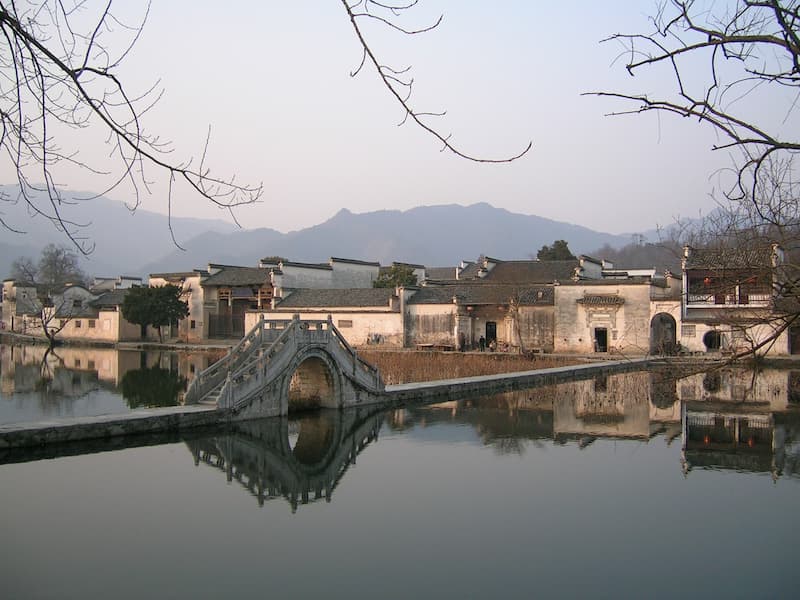
The Ancient Villages in Southern Anhui, specifically Xidi and Hongcun, are two of China’s most iconic and well-preserved examples of traditional non-urban settlements. Dating back to the 11th century, these villages offer a rare glimpse into the feudal era’s social and architectural structure, seemingly untouched by the rapid urbanization of the last century.
Located in Yi County, these villages are the quintessential representatives of Hui-style architecture.
- Hongcun: Known as the “Village in a Chinese Painting,” it is famous for its unique ox-shaped layout and ingenious hydraulic system. Water flows from the Leigang Hill through a network of canals (“the intestines”) into the Moon Pond (“the stomach”) and finally into South Lake (“the belly”).
- Xidi: Often called a “retreat away from the world,” Xidi is structured around three streams and is celebrated for its hundreds of Ming and Qing residences. It is home to the majestic Hu Wenguang Memorial Archway, a massive three-tier stone structure standing at the village entrance.
Attraction
- Cinematic Fame: Hongcun gained worldwide recognition as a primary filming location for the Oscar-winning film Crouching Tiger, Hidden Dragon. The iconic scene of Zhang Ziyi gliding across the water was filmed at South Lake.
- Living Museums: Unlike reconstructed “theme park” towns, these are living communities where residents still live in ancestral homes, wash vegetables in the canals, and gather in centuries-old halls.
- The “Three Carvings”: Art enthusiasts visit to see the peak of Huizhou craftsmanship: intricate carvings in brick, stone, and wood that decorate the windows, beams, and doorways of local residences.

Heritage
Inscribed in 2000, the villages meet Criteria (iii), (iv), and (v):
- Criterion (iii): They are graphic illustrations of a human settlement type created during a feudal period and based on a prosperous merchant trading economy.
- Criterion (iv): The buildings and street patterns reflect the socio-economic structure of a long-lived settled period in Chinese history.
- Criterion (v): They represent traditional non-urban settlements that have largely disappeared elsewhere, exceptionally preserving the harmony between man and nature through Feng Shui principles.
Gateway
- The City: Huangshan City (formerly known as Tunxi) is the logistical hub for the region.
- Airport: Huangshan Tunxi International Airport (TXN) serves major cities like Beijing, Shanghai, and Guangzhou.
- Lodging: The city offers high-end international stays like the Crowne Plaza Huangshan Taiping Lake or the Banyan Tree Huangshan (located just minutes from Hongcun). Tunxi’s “Old Street” area is also famous for boutique heritage guesthouses.
When
- Spring (Late March to April): The fields surrounding the villages explode with bright yellow rapeseed flowers, contrasting beautifully with the white-walled houses.
- Autumn (October to November): The “sun-drying” season (Shaiqiu), where villagers spread colorful peppers and corn on rooftops, and the surrounding maple trees turn deep red.
- Winter (January): For a quiet, misty atmosphere that looks like a classical ink-wash painting, though it can be quite cold.

Consideration
- Walking & Footwear: The villages are pedestrian-only with uneven stone-paved alleys. Wear comfortable, non-slip shoes.
- The “Double Ticket”: Entrance fees are approximately 104 RMB per village (though discounts frequently apply for students or during off-peak Wednesdays). Tickets are valid for three days but must be registered with your ID/Passport.
- Crowd Management: Hongcun is significantly more popular than Xidi. To enjoy the tranquility, explore the side alleys away from the main tour group routes or visit at dawn (before 7:00 AM).
- Proximity to Yellow Mountain: Most travelers combine these villages with a trip to Mount Huangshan. It is roughly a 1-hour drive between the mountain base and the villages.

(Yiyuan New Residence, Wikimedia/CC BY-SA 4.0).
Resources
- UNESCO World Heritage – Xidi and Hongcun: The official global dossier and history.
- Travel China Guide – Hongcun: Excellent for up-to-date bus schedules from Huangshan North Station.
- Anhui Travel Official Portal: For regional cultural event calendars and local Hui cuisine guides.
- World Heritage Travel – Anhui Villages: A deep dive into the architecture and photography tips.
- Trip.com – Hongcun Guesthouses: The primary platform for booking traditional courtyard homestays inside the ancient villages.
Featured Image
Hongcun (Happy Udo, Wikimedia/CC BY 2.5).
In The News
Advertisement



Advertisements
Advertisements
Advertisements
Advertisements
Comment:
Advertisements
 All About World Heritage Sites (...and more)

Leave a comment