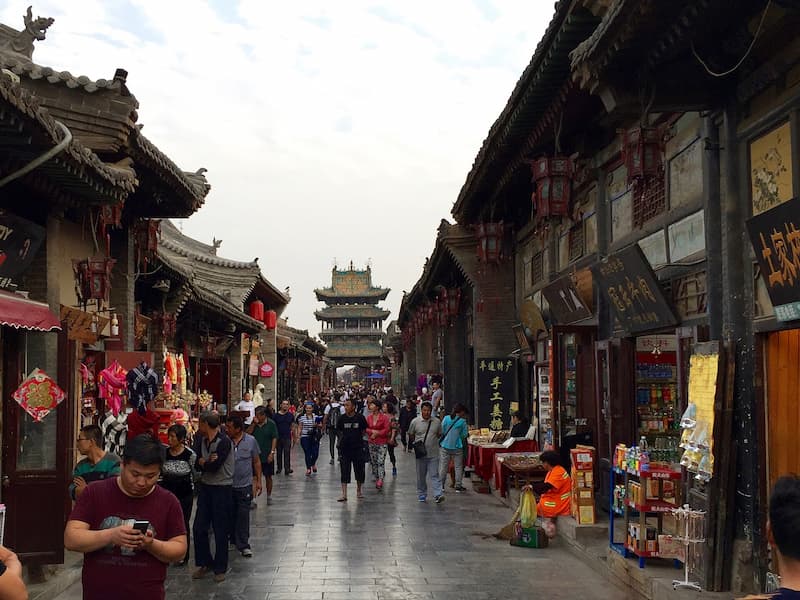
The Ancient City of Ping Yao is a magnificent relic of imperial China, standing as the best-preserved example of a traditional Han Chinese city. Located in Shanxi Province, it remains a “living city” where the daily lives of 20,000 residents unfold amidst architecture that has remained largely unchanged since the 14th century.
Attraction
Ping Yao is a time capsule that lures travelers with its undisturbed Ming and Qing dynasty atmosphere:
- The “Wall Street” of Ancient China: It was the financial capital of the Qing Empire. Visitors can explore the Rishengchang Draft Bank, the first modern bank in China, which once controlled half of the nation’s silver trade.
- Turtle City Layout: Viewed from above, the city walls resemble a turtle (a symbol of longevity). You can walk the 6-kilometer perimeter of the City Wall for a bird’s-eye view of the courtyard houses.
- Authentic Street Life: Unlike “museum towns,” Ping Yao is filled with local life. South Street (Ming-Qing Street) is a vibrant corridor of traditional medicine shops, tea houses, and paper-cutting workshops.

Heritage
Inscribed in 1997, the site is recognized under Criteria (ii), (iii), and (iv):
- Criterion (ii) & (iv): It is an exceptional example of Han Chinese urban planning, reflecting the evolution of architectural styles over five centuries.
- Criterion (iii): It stands as a historical witness to the economic prosperity and the birth of the Chinese banking system.
- The Complex: The listing includes the city itself plus the Shuanglin Temple (famous for 2,000 painted sculptures) and Zhenguo Temple (home to one of China’s oldest timber halls).
Gateway
- The City: Taiyuan is the provincial capital and the primary gateway.
- Airport: Taiyuan Wusu International Airport (TYN) connects to major hubs like Beijing, Shanghai, and Xi’an.
- Transit: From Taiyuan, a high-speed train reaches Pingyao Gucheng Station in just 30 minutes.
- Lodging: While Taiyuan has international chains like the Pullman Taiyuan, most travelers prefer staying inside Ping Yao in traditional courtyard guesthouses (e.g., Jing’s Residence) to experience the “Kang” (heated brick) beds.
When
- September to October: The most comfortable weather. Late September often hosts the International Photography Festival.
- January/February: For the Chinese New Year. The city is decorated with thousands of red lanterns, and traditional “Shehuo” folk performances take over the streets.
- Avoid: The first week of October (Golden Week), as crowds can be overwhelming.

Consideration
- The “Through Ticket”: Entry to the city streets is free, but you need a Pingyao Scenic Area Pass (approx. 125 RMB) to enter the 22 specific attractions like the Bank or the County Government Office. The pass is valid for 3 days.
- No Cars Allowed: The ancient city is pedestrian-only. Be prepared to walk several miles or hire an electric cart.
- Cash & Payments: While Alipay and WeChat Pay are dominant, some smaller stalls still prefer cash (CNY). Ensure your mobile payment apps are set up before arrival.
- Stairs: Climbing the City Wall and temple platforms involves steep, uneven stone steps. Wear sturdy walking shoes.

Resources
- UNESCO World Heritage – Ping Yao: The official global dossier and map of the protected zones.
- Travel China Guide – Pingyao: Excellent for up-to-date bus and high-speed train schedules.
- The China Guide – Pingyao Ancient City: Detailed descriptions of the “Must-See” museums and banks inside the walls.
- Visit Our China – Pingyao Guide: Helpful cultural insights into the Jin Merchant history.
- Trip.com – Pingyao Hotels & Flights: The primary platform for booking traditional courtyard stays and domestic China flights.
Featured Image
South Street, Ping Yao (Bairuilong, Wikimedia/CC BY-SA 4.0).
In The News
Advertisement



Advertisements
Advertisements
Advertisements
Comment:
Advertisements
 All About World Heritage Sites (...and more)


Leave a comment