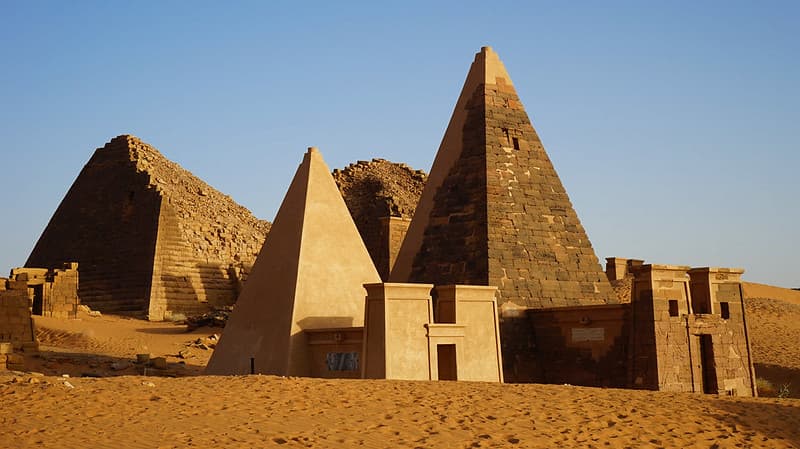
The Archaeological Sites of the Island of Meroe in Sudan constitute a semi-desert landscape between the Nile and Atbara rivers that served as the heartland of the Kingdom of Kush, a major power from the 8th century BCE to the 4th century CE. The property comprises three distinct components: the royal city of the Kushite kings at Meroe, the religious center of Naqa, and the temple complex of Musawwarat es-Sufra.
- Meroe (Royal City & Necropolises): This component includes the remains of palaces, temples, and domestic buildings, surrounded by extensive burial grounds containing hundreds of pyramids. These pyramids are smaller and steeper than Egyptian counterparts, featuring integrated offering chapels.
- Naqa: Located about 30 km south of Meroe, this site is renowned for its well-preserved temples, including the Temple of Amun and the Temple of Apedemak (the Lion Temple), which showcase a unique blend of Egyptian, Roman, and indigenous Meroitic artistic styles.
- Musawwarat es-Sufra: A massive temple complex situated in a shallow valley, featuring the expansive “Great Enclosure” with numerous temples and courtyards, as well as the Lion Temple.
Attraction
Travelers are drawn to Meroe for its unique blend of monumental history and stunning desert scenery.
- Unique Pyramids: The sheer concentration of dozens of steep, solitary pyramids rising from the desert sand creates a dramatic, photogenic landscape unmatched elsewhere in the world.
- Cultural Blend: The site offers a rare opportunity to explore a civilization that uniquely combined African traditions with Egyptian, Hellenistic, and Roman influences, evident in their art and architecture.
- Atmosphere: Due to the political situation and the location, the site is rarely crowded, providing a personal and quiet encounter with ancient history.

Heritage
Inscribed in 2011, the sites were listed under four criteria:
- Criterion (ii): They reflect the interchange of ideas and contact between Sub-Saharan Africa and the Mediterranean and Middle Eastern worlds along a major trade corridor over a very long period.
- Criterion (iii): They contribute an exceptional testimony to the wealth and power of the former Kushite state and its extensive contacts with African, Mediterranean, and Middle Eastern societies.
- Criterion (iv): The pyramids are outstanding examples of Kushite funerary monuments, illustrating the association with the well-preserved remains of the urban center of Meroe.
- Criterion (v): The major centers far from the Nile at Musawwarat and Naqa raise questions as to their viability in what is today an arid zone, offering possibilities for understanding interaction with the desert hinterland.
Gateway
- The City: Khartoum, the capital of Sudan, is the essential gateway for international visitors.
- Airport: Khartoum International Airport (IATA: KRT) handles international flights.
- Lodging: Khartoum offers numerous lodging options, from international chains to local hotels, suitable for overnight stays before traveling to the sites.
- Transit: The sites are roughly a 4-hour drive (approx. 200 km) north of Khartoum along a paved highway. A 4×4 vehicle is required to access the specific components off the main road.
When
- Winter (November to February): This is the ideal time. Daytime temperatures are pleasant (20°C–30°C), making it comfortable to explore the ruins.
- Avoid Summer (March to October): Temperatures can exceed 45°C, making outdoor sightseeing dangerous and uncomfortable.

Consideration
- Security Advisories: Foreign governments often advise against all travel to Sudan due to armed conflict, terrorism, and civil unrest. Visitors should check their home country’s official advisories and rely on specialized, local security providers.
- Logistics: The sites are remote and spread out; hiring a guide with a 4×4 vehicle in Khartoum is mandatory for a successful trip.
- No Facilities: There are minimal facilities on-site. Bring ample water, food, and sun protection.

Resources
- UNESCO – Island of Meroe: Official documentation and history.
- Sudan Archaeological Research Society: Academic research and reports on Meroitic discoveries.
- National Corporation of Antiquities and Museums (NCAM) – Sudan: Official body managing the heritage sites.
- British Museum – Sudan and Nubia: Contextual history and artifacts from the Kingdom of Kush.
- Viator: For booking guided trips from Khartoum that include transportation and required logistical support.
Featured Image
Pyramids of Meroe (Nina R, Flickr/CC BY 2.0).
In The News
Advertisement


Advertisements
Advertisements
Advertisements
Advertisements
Comment:
Advertisements
 All About World Heritage Sites (...and more)
Leave a comment