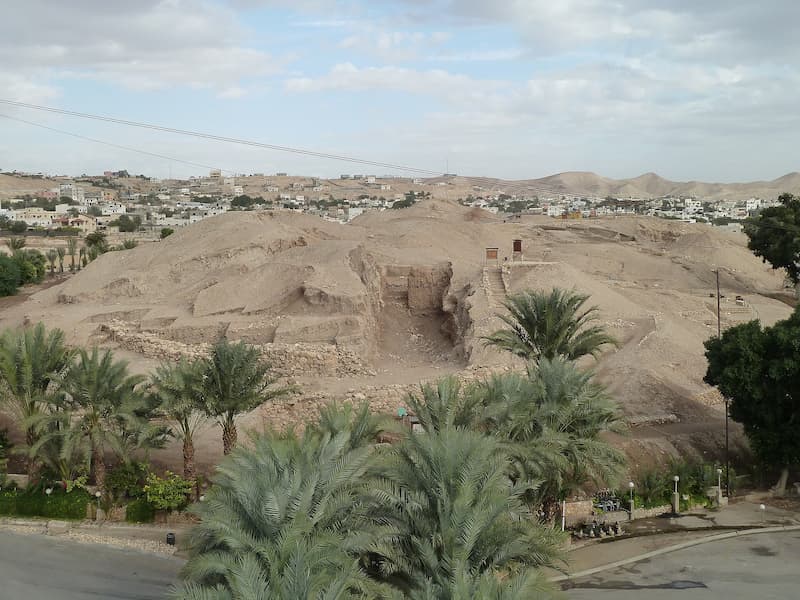
Ancient Jericho, also known as Tell es-Sultan, is widely considered the oldest fortified city in the world. Located in the State of Palestine, this archaeological mound (tell) preserves over 10,000 years of human history, marking the very moment humanity transitioned from wandering hunter-gatherers to settled farmers.
Tell es-Sultan is an oval-shaped mound rising approximately 21 meters above the Jordan Valley. It is situated in a lush oasis fed by the perennial ‘Ain es-Sultan (Elisha’s Spring). The site contains 29 distinct layers of occupation. Key architectural features include:
- The Jericho Tower: A massive stone structure built around 8000 BCE, standing 8.5 meters tall with an internal spiral staircase of 22 steps. It is one of the oldest man-made stone monuments on Earth.
- Pre-Pottery Neolithic Walls: Massive stone fortifications that predate the invention of pottery, demonstrating early communal labor and defense.
- Bronze Age Palaces: Remains of “Palace G,” which show early urban planning and sophisticated mud-brick construction.
Attraction
Jericho’s appeal lies in its “superlative” status:
- The Oldest & Lowest: It is the oldest continuously inhabited city on the planet and sits at the lowest point on Earth, roughly 258 meters below sea level.
- Biblical Resonance: Though archaeologists debate the specific timing of the “Walls of Jericho” mentioned in the Bible, the site remains a major pilgrimage stop for those exploring the Holy Land.
- Archaeological Drama: The deep, exposed trenches (notably those dug by Kathleen Kenyon in the 1950s) allow visitors to see the literal layers of time—from Neolithic flint tools to Canaanite pottery.

Heritage
Inscribed in 2023, the site meets Criteria (iii) and (iv):
- Criterion (iii): It is an exceptional testimony to the Neolithisation of the Fertile Crescent, representing the shift to sedentary communal living and new social organizations.
- Criterion (iv): It is an outstanding example of early urban culture, featuring monumental architecture (like the tower and ditch) that predates similar developments in Mesopotamia and Egypt.
Gateway
Since Palestine does not currently have its own functioning commercial airport, travelers must use neighboring hubs:
- Gateway 1: Amman, Jordan. Fly into Queen Alia International Airport (AMM). Travelers enter the West Bank via the King Hussein (Allenby) Bridge.
- Gateway 2: Tel Aviv. Fly into Ben Gurion Airport (TLV). It is roughly a 1.5-hour drive to Jericho, typically accessed via Jerusalem.
- Lodging: Modern Jericho offers excellent overnight stays such as the Oasis Hotel or the Jericho Resort Village.
When
- October to April: This is the peak season. Jericho has a tropical microclimate; while the rest of the region is cold, Jericho remains pleasantly mild (18–25°C).
- Avoid Summer (June–August): Temperatures regularly soar above 40°C (104°F), making the outdoor archaeological site punishingly hot.

Consideration
- Border Crossings: If arriving from Jordan, be prepared for significant wait times and security checks at the Allenby Bridge. Keep your passport and entry slips safe.
- Sun Protection: The site is almost entirely unsheltered. Bring a hat, high-SPF sunscreen, and plenty of water.
- Guide Services: To the untrained eye, the site can look like piles of mud and stone. Hiring a local guide or using an audio tour is essential to understand what you are seeing.
- Safety: While Jericho is generally peaceful and tourism-focused, check current travel advisories due to the evolving regional political situation.

Resources
- UNESCO World Heritage – Ancient Jericho: The official dossier on the site’s inscription and outstanding universal value.
- This Week in Palestine – Tell es-Sultan: A cultural and historical deep dive written by local experts.
- Lonely Planet – Jericho Guide: Practical travel tips and nearby attractions like Hisham’s Palace.
- The Madain Project – Tell es-Sultan: An excellent visual archive of the excavations and artifacts found on-site.
- Expedia – Palestine/Jericho Travel: Useful for booking international flights to Amman or Tel Aviv and coordinating regional car rentals.
Featured Image
Tell es-Sultan (Deror Avi, Wikimedia/CC BY-SA 3.0).
In The News
Advertisement


Comment:
 All About World Heritage Sites (...and more)
Leave a comment