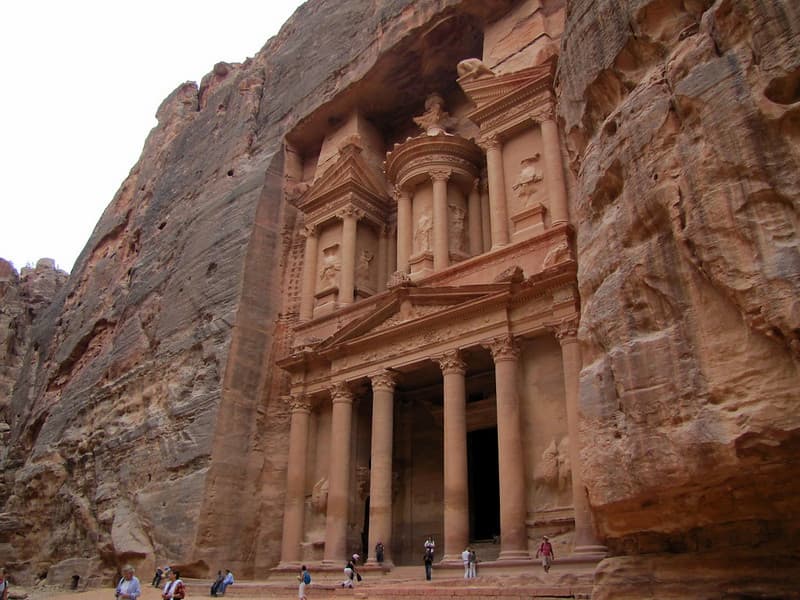
Petra, the “Rose City,” is an archaeological masterpiece carved into the red sandstone cliffs of southern Jordan. Once the thriving capital of the Nabataean Kingdom, it is a place where nature’s rugged beauty meets the peak of ancient human craftsmanship.
Petra is a vast “caravan-city” situated between the Red Sea and the Dead Sea. It is unique for being half-built and half-carved into the rock. The city is accessed through the Siq, a narrow, winding gorge over 1 km long, flanked by high cliffs. This path culminates in the sudden, breathtaking view of Al-Khazneh (The Treasury). Beyond the Treasury, the site opens into a wide valley filled with over 800 monuments, including the Royal Tombs, a massive Roman-style theater, and the colossal Ad-Deir (The Monastery), reached by climbing 800 rock-cut steps.
Attraction
Petra’s status as one of the New Seven Wonders of the World stems from its ethereal atmosphere and engineering brilliance:
- Rock-Cut Architecture: The sheer scale of facades carved directly into vertical cliffs is unparalleled.
- The “Rose City” Hue: The sandstone changes colors throughout the day, shifting from deep ochre to soft pink.
- Petra by Night: Seeing the Siq and Treasury illuminated by over 2,000 candles is a bucket-list experience.
- Advanced Engineering: Tourists can still see the sophisticated Nabataean water conduit systems that allowed this desert city to flourish.

Heritage
Petra was inscribed as a UNESCO World Heritage Site in 1985.
- Criterion (i), (iii), and (iv): It is recognized as a “unique artistic achievement” and an outstanding architectural ensemble. It serves as an exceptional testimony to the Nabataean civilization, which blended Eastern traditions with Hellenistic architecture. Its water management systems were a marvel of the ancient world, enabling life in an arid environment.
Gateway
While the town of Wadi Musa sits directly at Petra’s entrance and offers extensive lodging, it does not have an airport.
- Amman (AMM): Queen Alia International Airport is the primary gateway (3 hours away). Amman provides the most flight options and high-end lodging.
- Aqaba (AQJ): King Hussein International Airport is closer (2 hours away) and ideal for those combining Petra with the Red Sea.
- Lodging: Wadi Musa has everything from luxury stays like the Old Village Resort to authentic Bedouin-style camps.
When
- Spring (March to May) & Autumn (September to November): These are the optimal windows. Temperatures are mild (18°C to 28°C), perfect for the extensive walking required.
- Winter (December to February): Can be surprisingly cold and rainy; however, it offers the fewest crowds.
- Summer (June to August): Temperatures often exceed 40°C, making the shadeless hikes physically grueling.

Consideration
- The Jordan Pass: Purchase this online before arrival; it waives visa fees and includes Petra’s entry price, saving significant money.
- Physical Demand: A “standard” visit involves walking at least 10-15 km. Wear sturdy hiking boots.
- Hydration and Sun: There is very little shade. Bring a hat, high-SPF sunscreen, and plenty of water.
- Respectful Dress: While not strictly enforced for tourists, dressing modestly (shoulders and knees covered) is respectful of local Jordanian culture.

Resources
- Visit Petra (Official): The authoritative source for tickets, trails, and site history.
- UNESCO – Petra: For the technical background on its heritage designation.
- Jordan Pass Official: Essential for pre-purchasing your entry and visa bundle.
- Visit Jordan: The national tourism board’s site for broader travel logistics.
- Viator – Petra Tours: Useful for booking guided day trips from Amman or Aqaba with verified reviews.
Featured Image
Al-Khazneh, or The Treasury, Petra (David Berkowitz, Flickr/CC BY 2.0).
In The News
Advertisement


Comment:
11 responses to “Petra”
-
The most beautiful place. Here, it’s medicine. If you have problems, you forget them quickly.
LikeLike
-
Most people remember the site of the carved Treasury facade from ‘Indiana Jones and Last Crusade,’ but the UNESCO World Heritage Site is so much larger than just the one building. To get a different perspective of this iconic view, take the Al-Khubtha Trail just to the left of the royal tombs. You will find a rock staircase leading you over 600 steps to the top. An enterprising Bedouin has the best views from his tent, where you can buy tea or water for 1 dinar or simply relax and admire the view.”
You can see the main sights in a day, but everyone recommends at least two full days, if you want to cover it completely. One-day tickets are currently 50 Jordanian dinar or around $70. If you want a picture of yourself in front of the Treasury building without any people, get up at the crack of dawn to be one of the first in — then you can have Petra all to yourself before the busloads start showing up! Wear sturdy shoes, a hat and bring plenty of water, although you can buy water and other beverages for inflated prices all around the site. Modern bathrooms have, thankfully, been installed in several places to keep up with the growing number of tourists. Now is a great time to travel to Jordan — tourism has been down due to the Middle East conflicts, but Jordan is very safe and the people are very friendly. I never felt in danger.
LikeLike
-
Petra was much larger than I ever expected. I highly recommend going beyond the Treasury and really getting out there.
LikeLike
-
If you ever visit Jordan, please add Petra to your sightseeing list. All the images and video in the world can’t prepare you for your first view of the Treasury (Al Khazneh), which was built as a crypt and mausoleum at the beginning of the 1st century AD and also featured in the Indiana Jones movie ‘The Last Crusade’. The walk seemed to go on forever and then all of a sudden, there it was at the end of the siq. I was in absolute awe. It really is an incredible sight. The walk there wasn’t too bad, I was excited and intrigued, and it was on a downhill slope, but the walk back really did get me. I don’t know how far it is exactly, but it’s at least 1.4km from the visitor centre to the treasury. It was hot, humid, dusty and uphill – I was a mess! I was so pleased to get back to the top and drown myself in a freezing cold bottle of water. I wouldn’t advise anyone attempt the walk unless you are absolutely sure you can make it there and back. You can take a horseback ride or horse and cart, so don’t worry, you won’t miss out on anything, just please be prepared for the heat, humidity and a long trek.
We didn’t have time to explore everything that Petra boasts, but at least now I can say that I’ve seen some of the ‘Lost City’. It really was magical. Even the walk is unlike anything I’d ever seen or done before. I felt like I was in the middle of a movie set.LikeLike
-
Petra is one of those destinations that many people feel they know long before they ever arrive. It has served as the backdrop for countless films, television shows and books, and has even been named one of the New Seven Wonders of the World. But even knowing all of that I was unprepared for what I found when I visited the place. It was far larger, and grander, than I had ever imagined and it is one of those rare places that exceeds expectations.
LikeLike
-
The most wondrous thing about Petra is that it is actually REAL! It’s hard to accept that till you actually are there. I was in Jordan some years ago on business, and made it a condition of my coming that I spend a day there.
You know what I took the most pictures of? The ceilings of the chambers. There is such a vast array of color in the sedimentary layers, and when a chamber is carved these undulating layers present an abstract color pattern that is incredible to see.
LikeLike
-
It’s just gorgeous. I remember wandering around for hours one very hot day and feeling totally exhausted and wondering how I could make it out when I heard a soft voice saying “Miss, would you like an air conditioned taxi?” and I turned and saw a young boy with a donkey! It was perfect! Of course, he was waiting for me the next day but that was fine with me.
LikeLike
-
Away from the deep yawn of the gully that marks the main tourist route, an entire network of winding Bedouin back roads, narrow goat trails and worn rock-cut staircases wind across the russet-hued cliffs, gloriously empty of visitors; their stony paths leading to rarely-visited monuments and panoramic vistas. Even in one of the world’s most popular sights it is still possible to escape the crowds.
Most people who visit Petra begin at the Treasury (al-Khazneh), famed for its starring role as the home of the holy grail in the film Indiana Jones and the Last Crusade. Steer clear of the tourists craning their necks at the ornate 43m-high facade, and instead walk down the main tourist route and up the steps to the cliff ridge bearing the group of monuments known as the Royal Tombs. Just past the three-tiered ruin of the Palace Tomb, a staircase can be seen slicing into the rock. It is a knee-knocker of a climb from here to the top of Jebel al-Khubtha mountain, but worth it for the sweeping panoramas of jagged orange and dusky pink cliffs undulating out across the desert.
A walk across the summit plateau reveals a craggy ridge from where the Treasury can be seen a dizzying drop below. Looking down at the facade from this angle miniaturises it against the vast, raw amphitheatre of surrounding cliffs, and echoes of the ant-like cluster of visitors in front of the monument soar up into the air. The fact that there is rarely anyone else contemplating this view makes the scene even more surreal. Petra’s back roads do not just give a different perspective on the ruins. Following them allows you to better understand the site.
LikeLike
-
We are discovering that Petra is huge. It is spread over 100 square miles in the mountains and valleys of Ma’an Governate, about 150 miles south of the capital, Amman. Although you could easily spend a week hiking and exploring the site, we find that the main attractions are on an eighteen-mile route between the Siq and Ad-Dayr, the Monastery, near the top of the mountain. With the help of horses, mules, and donkeys, we are able to manage it all in one day.
LikeLike
-
Wherever you go in Petra, Bedouins will invite you to drink tea with them. After that, they’ll invite you to dine with them at their homes, in the village or in their caves. While you may be invited dozens of times a day — obviously more tea than you could possibly drink — do accept their invitations when possible. You’ll add a genuine dimension to your experience in Petra, one completely different from that of most tourists. Talk with the Bedouins. They’ll open their heart and tell you their life stories. Some of them have begun to return to their past lifestyle.
LikeLike
-
Although you could likely see a great deal of Petra in one day if you’re ambitious, I feel like two days is perfect. One day should be spent getting accustomed to the site with a guide and learning about the history. The second day should be spent hiking to some of the more remote sites like the monastery, experiencing mind-blowing views, and capturing great photos.
LikeLike

 All About World Heritage Sites (...and more)


Leave a comment