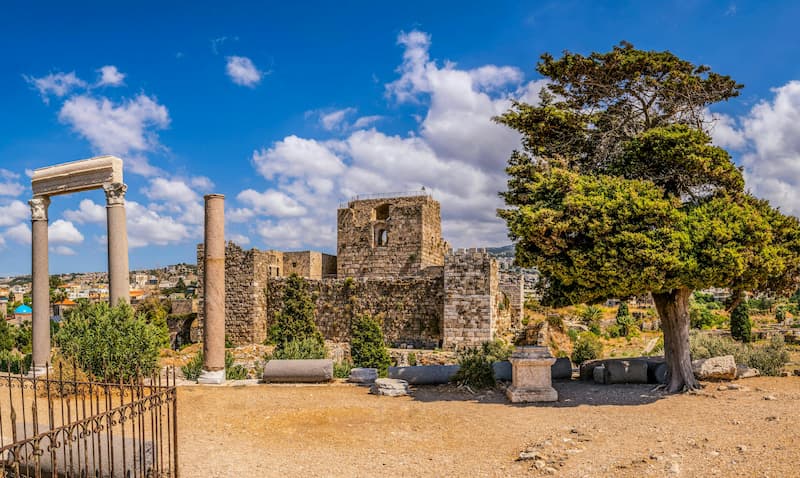
Perched on a sandstone cliff overlooking the Mediterranean, Byblos (also known as Jbeil) is one of the world’s oldest continuously inhabited cities, with a history spanning over 8,000 years. It serves as a living museum where the foundations of Western civilization were laid.
The archaeological site of Byblos is a physical “layer cake” of history. Within its medieval walls, you can find ruins stacked upon ruins:
- The Crusader Castle: A 12th-century limestone fortress that provides panoramic views of the entire site.
- Phoenician Temples: Including the Temple of the Obelisks, which dates back to the 2nd millennium BCE.
- The Royal Necropolis: Nine vertical shaft tombs of ancient kings, including the famous sarcophagus of King Ahiram.
- Roman Remains: A colonnaded street and a charming small theater that sits directly against the sea cliffs.
- Medieval Souks: Just outside the ruins, the cobblestone old town is filled with vaulted stone shops, cafes, and bougainvillea-shaded alleys.
Attraction
Byblos attracts visitors due to its rare combination of archaeological depth and vibrant seaside lifestyle:
- Biblical Roots: The city’s name is the root of the word “Bible,” referencing its ancient role as the primary exporter of papyrus (byblos) to Greece.
- The Harbor: One of the most picturesque in the Mediterranean, filled with traditional wooden fishing boats and surrounded by upscale seafood restaurants.
- Fossil Museum: A unique attraction showcasing prehistoric marine life found in the nearby Lebanese mountains.
- Modern Energy: It hosts the Byblos International Festival, an annual summer event featuring world-renowned artists performing in an ancient setting.

Heritage
Byblos was inscribed as a UNESCO World Heritage site in 1984 under several criteria:
- The Alphabet: It is directly associated with the invention and diffusion of the Phoenician alphabet, the ancestor of the modern Latin and Greek scripts.
- Urban Evolution: It bears exceptional testimony to the beginnings of the Phoenician civilization and the continuous urban life from the Neolithic period to the present.
- Trade Hub: It was a crucial link in the Mediterranean trade network, facilitating cultural exchange between Egypt, Mesopotamia, and the Aegean.
Gateway
Beirut, the capital of Lebanon, is the essential gateway for visiting Byblos.
- Airport: Beirut–Rafic Hariri International Airport (BEY) is the only commercial airport in the country.
- Lodging: Beirut offers thousands of lodging options, from the iconic Phoenicia Hotel to trendy boutique stays in Mar Mikhael or Hamra.
- Proximity: Byblos is only about 37 km (23 miles) north of Beirut. Travelers can reach it in 45–90 minutes depending on the notorious Lebanese traffic.
When
- Spring (April–June) and Autumn (September–November): These are the optimal times. The weather is mild (18°C to 26°C), and the archaeological site is pleasant to walk through without the summer humidity.
- Summer (July–August): Best for the Byblos International Festival and nightlife, though it is very hot and crowded.
- Winter (December–February): Cooler and rainier, but perfect for having the ruins nearly to yourself.

Consideration
- Cash Economy: Lebanon’s economy is highly cash-dependent. While some hotels and upscale restaurants take cards, keep plenty of US Dollars or Lebanese Pounds for entrance fees, taxis, and souk shopping.
- Traffic: The highway from Beirut to the north is frequently congested. Plan for extra travel time, especially during peak morning and evening hours.
- Footwear: The archaeological site is a mix of uneven stone, dirt paths, and steep castle stairs. Wear sturdy sneakers or hiking sandals.
- Safety: Always check current travel advisories. While Byblos is historically a very safe and tourist-friendly town, regional stability can fluctuate.

Resources
- UNESCO World Heritage – Byblos: For the official history and maps of the archaeological zones.
- Ministry of Tourism – Lebanon: The official government portal for tourism information and site hours.
- Living Lebanon: A comprehensive local guide for logistics, bus routes, and restaurant recommendations.
- Byblos International Festival: The official site for checking concert dates and ticket information for summer visitors.
- GetYourGuide – Byblos: A reliable platform for booking guided tours that often combine Byblos with the Jeita Grotto and Harissa.
Featured Image
The Crusader Castle, Byblos (Soly Moses, Pexels/Free To Use).
In The News
Advertisement

Comment:
 All About World Heritage Sites (...and more)
Leave a comment