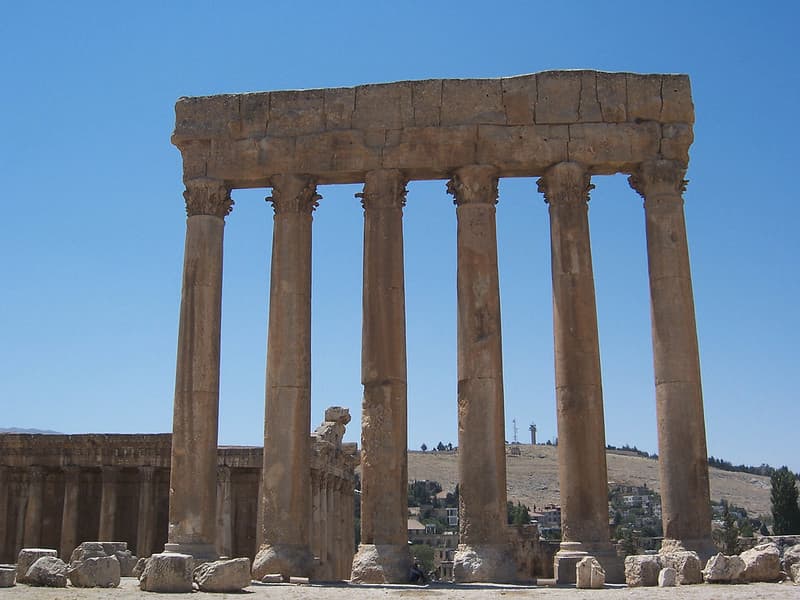
Baalbek, located in the fertile Beqaa Valley of Lebanon, is one of the most mysterious and awe-inspiring archaeological sites of the ancient world. Known as Heliopolis (“City of the Sun”) during the Hellenistic and Roman periods, it represents the pinnacle of Roman monumental architecture.
Baalbek is a massive temple complex built over several centuries. It was originally a Phoenician city dedicated to the god Baal, but under Roman rule, it was transformed into a premier religious sanctuary. The site is dominated by three main structures:
- The Temple of Jupiter: Once the largest temple in the Roman Empire, it is famous for its six remaining colossal Corinthian columns that tower 22 meters high.
- The Temple of Bacchus: Remarkably well-preserved, this temple is larger than the Parthenon in Athens and features exquisite stone carvings of lions, bulls, and geometric patterns.
- The Temple of Venus: A smaller, elegant circular temple known for its unique “horseshoe” layout.
The site is also home to the Trilithon—three of the largest stones ever used in construction, each weighing approximately 800 tons.
Attraction
Baalbek draws visitors from around the world due to its sheer scale and preservation.
- Engineering Marvels: Tourists are fascinated by the “Stone of the Pregnant Woman” in the nearby quarry, one of the largest monoliths ever quarried (1,000 tons), which remains a mystery as to how it was intended to be moved.
- Architectural Detail: Unlike many ruins that are mere foundations, the Temple of Bacchus is almost entirely intact, allowing visitors to walk through a space that feels much as it did 1,800 years ago.
- Cultural Fusion: The site beautifully blends Near Eastern (Semitic) traditions with Greco-Roman aesthetics.
- Baalbek International Festival: Held in the summer, this world-renowned festival hosts musical and theatrical performances among the illuminated ruins.

Heritage
Baalbek was inscribed as a World Heritage Site in 1984 based on its “outstanding universal value”:
- Criterion (i): It is a masterpiece of human creative genius, specifically for the artistic value of its decorative stonework and the technical prowess required to move such massive monoliths.
- Criterion (iv): It is an outstanding example of a Roman sanctuary at its peak, showcasing the power and wealth of the Roman Empire through the most impressive testimonies of imperial architecture.
Gateway
The primary gateway to Baalbek is Beirut, the capital of Lebanon.
- Airport: Beirut–Rafic Hariri International Airport (BEY) is the country’s only commercial airport, located approximately 85 km (about a 2-hour drive) from the site.
- Lodging: Beirut offers world-class accommodations, ranging from historic luxury like the Phoenicia Hotel to boutique stays in the Gemmayzeh district. Travelers often use Beirut as a base and take day trips to Baalbek.
When
The optimal months to visit are April to June (Spring) and September to November (Autumn).
- Weather: During these windows, temperatures are mild, ranging from 18°C to 25°C (64°F to 77°F).
- Aesthetics: In the spring, the Beqaa Valley is lush and green, often with snow still visible on the surrounding Lebanon Mountains, providing a stunning backdrop to the ruins.
- Note: Avoid the height of summer (July-August) when temperatures can exceed 35°C (95°F) with very little shade at the site.

Consideration
- Safety Advisories: Many governments maintain travel advisories for Lebanon due to regional instability. Always check your local embassy’s current status before traveling.
- Modesty: While Beirut is cosmopolitan, the Beqaa Valley is more traditional. It is respectful to dress modestly—covering shoulders and knees—when visiting the town of Baalbek.
- Transport: It is highly recommended to hire a private driver or join a reputable tour group from Beirut rather than using public transport, as it allows for more flexibility and security.
- GPS Disruption: Be aware that GPS signals can occasionally be jammed or inaccurate in border-adjacent regions like the Beqaa Valley; carry physical maps or pre-downloaded offline maps.

Resources
For more information, consult these resources:
- UNESCO World Heritage Centre – Baalbek – The official source for history, maps, and protection status.
- LebanonUntravelled – A local guide providing deep dives into the site’s mysteries and hidden corners.
- Britannica – Baalbeck – Excellent for a detailed historical and archaeological overview.
- Visit Lebanon Official Portal – Practical tourist information and national event calendars.
- Expedia – Baalbek Tours – A reliable platform for booking guided day-trips and finding lodging in Beirut or the Beqaa Valley.
Featured Image
Temple of Jupiter (ISAWNYU, Flickr/CC BY 2.0).
In The News
Advertisement



 All About World Heritage Sites (...and more)
