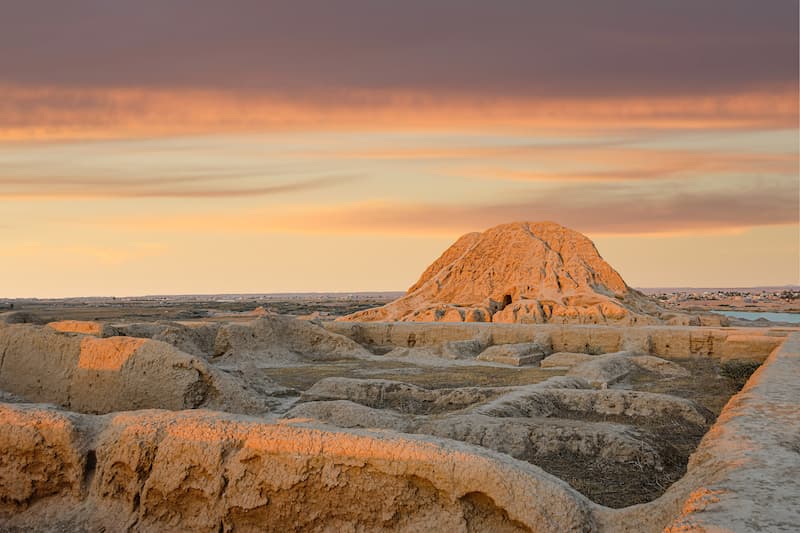
Located on the western bank of the Tigris River in the Saladin Governorate of northern Iraq, Ashur (Qal’at Sherqat) is one of the most significant archaeological sites in Mesopotamia. It served as the first capital of the Assyrian Empire and remains a profound symbol of the region’s ancient identity.
Ashur was founded in the 3rd millennium BC and functioned as the political and religious heart of the Assyrian state until the 9th century BC. Even after the political capital was moved to Nimrud and later Nineveh, Ashur remained the empire’s religious center. The site is characterized by its dramatic position on a limestone cliff overlooking the Tigris. Key archaeological features include:
- The Ziggurat of Ashur: A massive, stepped temple dedicated to the national god, Ashur.
- The Great Temple of Ashur: The most important religious structure in the city.
- Royal Palaces: The remains of the “Old Palace” where many Assyrian kings were crowned and buried.
- Fortifications: A complex system of double city walls and monumental gates like the Tabira Gate.
- Multi-Layered History: Excavations reveal superimposed layers of civilization ranging from the Sumerian and Akkadian periods to a revival during the Parthian era (1st–2nd centuries AD).
Attraction
Ashur draws travelers and scholars from around the world due to its status as the birthplace of the Assyrian civilization.
- Ancient Cradle: It offers a rare, tangible link to one of the world’s earliest territorial empires.
- Religious Significance: Unlike other Assyrian capitals, Ashur was the only “holy city,” where the god, the land, and the city all shared the same name.
- Architectural Evolution: It serves as a laboratory for the history of Mesopotamian architecture, showcasing the transition from mud-brick to stone and baked-brick monumental construction.

Heritage
Ashur (Qal’at Sherqat) was inscribed as a UNESCO World Heritage Site in 2003. It specifically meets two cultural criteria:
- Criterion (iii): The site is an exceptional testimony to the civilizations of the Sumerian, Akkadian, and Assyrian periods, and its role as the religious capital and burial place of kings is unique.
- Criterion (iv): The excavated remains provide an outstanding record of the evolution of building practices in the ancient Near East over nearly 2,500 years.
Note: The site is also on the List of World Heritage in Danger due to the potential impact of dam projects and the ongoing need for stabilization following years of regional conflict.
Gateway
The most practical gateway for international visitors is Erbil, the capital of the Kurdistan Region of Iraq.
- Airport: Erbil International Airport (IATA: EBL) is a modern hub with frequent connections to Europe and the Middle East.
- Lodging: Erbil offers a wide variety of high-end hotels (e.g., Rotana, Divan) and secure guesthouses.
- Transit: While Ashur is approximately 170 km (105 miles) from Erbil, visitors must cross between the Kurdistan Region and Federal Iraq, which requires coordinated security and specific travel permits.
When
- Spring (March–April): This is the ideal time; the weather is mild, and the surrounding plains are often green with wildflowers.
- Autumn (October–November): Another excellent window with cooler temperatures after the summer heat.
- Avoid Summer: June through September can see temperatures exceeding 45°C (113°F), making outdoor exploration dangerous.

(Mary Harrsch, Flickr/CC BY 2.0).
Consideration
- Security: Most Western governments currently have a “Do Not Travel” advisory for the Saladin Governorate. Independent travel is highly discouraged; visitors should use specialized tour operators with local security contacts.
- Visas: Iraq has introduced an e-Visa portal, but requirements vary by nationality. Ensure your paperwork covers travel to both Kurdistan and Federal Iraq if starting in Erbil.
- Cultural Etiquette: Dress modestly (shoulders and knees covered). Always ask for permission before photographing people or any government/military installations.
- Guided Tours: Because the site is vast and many ruins are in a state of decay, a professional archaeologist or historian guide is essential to interpret the landscape.

Resources
- UNESCO World Heritage Centre – Ashur: The primary source for the site’s official history and criteria.
- World History Encyclopedia – Ashur: A deep dive into the historical and mythological context of the city.
- Iraq Heritage: An NGO dedicated to the preservation and promotion of Iraqi archaeological sites.
- Visit Iraq e-Visa Portal: The official government site for checking visa eligibility and applications.
- GetYourGuide – Iraq Tours: (Affiliate Marketing) A platform to find and book vetted local guides and organized multi-day excursions.
Featured Image
The Ziggurat of Ashur (Fakhri Mahmood, Wikimedia/CC BY-SA 4.0).
In The News
Advertisement


Comment:
 All About World Heritage Sites (...and more)

#/media/File:Ziqqurat_Ashur_and_Ashur_city_walls.jpg)
Leave a comment