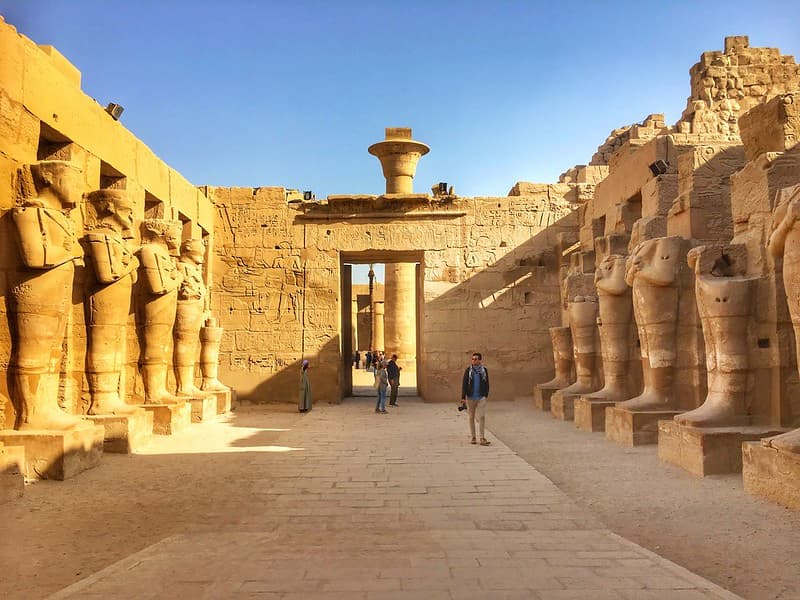
Ancient Thebes with its Necropolis is arguably the most significant archaeological site in the world, representing the peak of Egyptian civilization during the New Kingdom. Located in modern-day Luxor, it spans both banks of the Nile, where the “City of the Living” to the east meets the “City of the Dead” to the west.
Ancient Thebes was the capital of Egypt during the Middle and New Kingdoms (c. 2050–1070 BCE). The site is divided into two distinct zones:
- The East Bank: This was the center of life and religion. It features the Karnak Temple Complex, the largest religious building ever constructed, dedicated to the god Amun-Ra. Nearby lies Luxor Temple, which was connected to Karnak by the 3 km Avenue of Sphinxes.
- The West Bank (The Necropolis): Traditionally the land of the setting sun and the afterlife. It houses the Valley of the Kings, where over 60 royal tombs (including Tutankhamun’s) are carved into the limestone cliffs. It also includes the Valley of the Queens, the Valley of the Nobles, and monumental mortuary temples like the terraced Temple of Hatshepsut at Deir el-Bahari and the Colossi of Memnon.
Attraction
Ancient Thebes is often called the “world’s greatest open-air museum.” Its global appeal lies in:
- Grandeur of Scale: The Hypostyle Hall at Karnak, with its 134 massive columns, remains one of the most awe-inspiring architectural feats of antiquity.
- The Mystery of the Pharaohs: The Valley of the Kings offers a direct connection to famous figures like Ramses the Great and King Tutankhamun.
- Artistic Preservation: The vibrant colors and intricate hieroglyphs inside the tombs (particularly the Tomb of Nefertari and Seti I) look as though they were painted yesterday, despite being over 3,000 years old.
- Cultural Continuity: Seeing the ancient ruins integrated into the modern city of Luxor provides a unique historical depth.

Heritage
Ancient Thebes with its Necropolis was inscribed on the UNESCO World Heritage List in 1979.
- Criterion (i): It represents a unique artistic achievement, particularly in the architectural masterpieces of Karnak and the Mortuary Temple of Hatshepsut.
- Criterion (iii): It bears exceptional testimony to the New Kingdom civilization of Egypt.
- Criterion (vi): The site is directly associated with the history of the Pharaonic religion, the evolution of burial practices, and the development of Egyptian art.
Gateway
- Gateway City: Luxor is built directly on top of ancient Thebes. It is the undisputed hub for visiting the site.
- Commercial Airport: Luxor International Airport (LXR) serves domestic flights from Cairo (about 1 hour) and international charters from European cities.
- Lodging: Options are extensive, ranging from world-famous historic hotels like the Old Winter Palace to budget-friendly guesthouses on the West Bank.
When
- Peak Season (October to April): This is the best time to visit. Temperatures are mild (18°C to 30°C), making it comfortable to walk through the unshaded temple grounds.
- Shoulder Months (March and October): These offer a good balance of pleasant weather and slightly smaller crowds.
- Avoid Summer (June to August): Daytime temperatures regularly exceed 40°C (104°F), which can make outdoor sightseeing physically dangerous and exhausting.

Consideration
- Physical Demands: Visiting the West Bank involves significant walking and climbing steps into deep, often humid tombs. Wear comfortable shoes.
- Separate Tickets: A general entry ticket to the Valley of the Kings covers three tombs, but “premium” tombs like those of Tutankhamun, Seti I, and Nefertari require expensive, separate tickets.
- Photography Rules: Photography is generally allowed with a smartphone, but tripods and professional cameras often require a separate permit. Flash is strictly forbidden inside tombs to prevent pigment damage.
- Tipping (Baksheesh): Small tips are expected for almost any service, including tomb guards who might offer to show you a specific detail. Keep small bills (Egyptian Pounds) handy.
- Hydration: There is very little shade at the archaeological sites. Bring a hat, sunscreen, and carry plenty of water.

Resources
- UNESCO World Heritage Centre – Ancient Thebes: Official documentation regarding the site’s historical significance and preservation status.
- The Theban Mapping Project: An incredible scholarly resource with detailed maps and 3D models of every tomb in the Valley of the Kings.
- Rough Guides – Luxor and the Nile Valley: Practical, up-to-date travel logistics for independent travelers.
- Everything Everywhere – Ancient Thebes: A comprehensive guide by travel expert Gary Arndt, focused on the UNESCO perspective.
- Memphis Tours – Luxor Travel Guide: A major Egyptian tour operator providing detailed itineraries and the ability to book private guided tours.
Featured Image
Luxor Temple (Catherine Poh Huay Tan, Flickr/CC BY 2.0).
In The News
Advertisement

Advertisements
Advertisements
Advertisements
Advertisements
Comment:
 All About World Heritage Sites (...and more)


Leave a comment