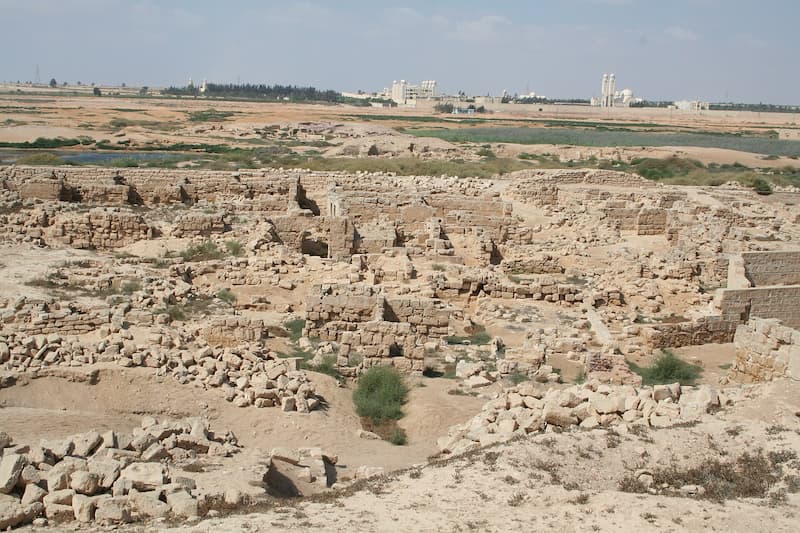
Located in the Western Desert, approximately 45 kilometers southwest of Alexandria, Abu Mena is a sacred archaeological site and one of Egypt’s most significant early Christian landmarks.
Abu Mena was a major Christian pilgrimage center during the Late Antique period (4th–7th centuries CE). It was built over the tomb of Saint Menas, an Egyptian soldier in the Roman army who was martyred for his faith in 296 CE.
- The Complex: At its peak, it was a vast holy city containing a grand basilica, a baptistery, several smaller churches, monasteries, and public buildings like baths and workshops.
- Architectural Features: The site is famous for its intricate marble work and the “Great Basilica,” which was designed to accommodate thousands of pilgrims.
- Current State: Today, much of the site consists of foundation ruins and low walls, though the layout of the streets and major religious buildings remains clearly visible.
Attraction
Abu Mena is a beacon for travelers interested in the roots of Christian Monasticism and Byzantine history.
- Religious Pilgrimage: It remains a site of deep spiritual importance to the Coptic Orthodox community. A modern monastery nearby continues the tradition of venerating Saint Menas.
- Early Christian Art: The site provides rare insight into the architecture and urban planning of a “pilgrimage city,” a concept that influenced later religious centers in Europe and the Middle East.

Heritage
Inscribed in 1979, Abu Mena was recognized under Criterion (iv) as an outstanding example of an early Christian architectural ensemble.
- Danger Listing: From 2001 to 2025, it was on the “List of World Heritage in Danger” due to a rising water table caused by local agricultural irrigation, which turned the soil into a swamp and threatened the structural integrity of the ruins.
- Current Status: Following an extensive restoration project involving advanced solar-powered drainage and conservation systems, UNESCO officially removed Abu Mena from the Danger List in July 2025.
Gateway
- City: Alexandria serves as the primary gateway.
- Airport: Borg El Arab International Airport (HBE) is the closest commercial airport, located just 20–30 minutes from the site.
- Lodging: Alexandria offers world-class hotels such as the Four Seasons Alexandria at San Stefano or the Steigenberger Cecil. Closer to the site, the Hilton Alexandria King’s Ranch provides luxury accommodation within a 15-minute drive of the ruins.
When
- Winter (November to March): This is the ideal time to visit the Egyptian desert. Daytime temperatures are mild (approx. 18^C to 22^C), making it comfortable to explore the sprawling outdoor ruins.
- Avoid: Mid-summer (July and August), when temperatures can soar and there is very little shade at the archaeological site.

Consideration
- Accessibility: The ruins are located a short distance from the modern monastery. You will likely need to walk over uneven, sandy ground; wear sturdy shoes.
- Modern vs. Ancient: Ensure your driver knows you want to see the archaeological site (Mantiqat Abu Mina al-Athariya), as many locals may assume you only want to visit the modern monastery.
- Photography: While photography is allowed, be respectful if visiting the modern monastery during prayer times.
- Hydration: Bring plenty of water and sun protection, as the site has virtually no tree cover.

Resources
- UNESCO World Heritage Centre – Abu Mena: The official portal detailing the site’s history and its recent removal from the Danger List.
- Egyptian Ministry of Tourism and Antiquities: Official government updates on site accessibility and conservation efforts.
- Coptic Orthodox Church – Monastery of St. Mina: Information on the modern religious complex and the life of the saint.
- Lonely Planet – Abu Mena Guide: Practical visitor reviews and transit advice for 2026 travelers.
- Expedia – Abu Mena Tours: Useful for booking day tours and hotels in nearby Alexandria or Borg El Arab.
Featured Image
Ruins of Abu Mena (Einsamer Schutze, Wikimedia/CC BY-SA 3.0).
In The News
Advertisement



Comment:
 All About World Heritage Sites (...and more)

Leave a comment