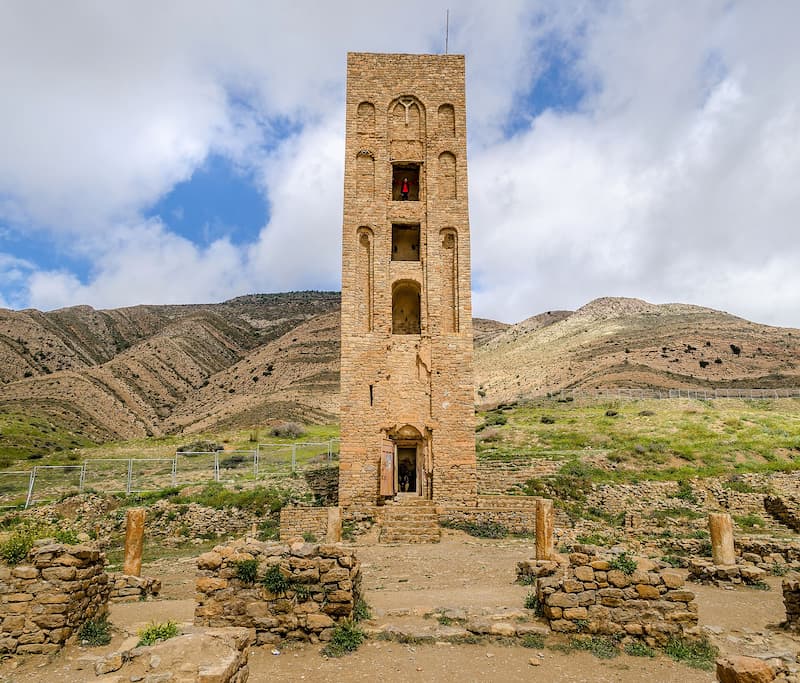
Perched in a breathtaking mountainous setting at an altitude of 1,418 meters, the Al Qal’a of Beni Hammad (the Kalâa of the Beni Hammad) is a stunning archaeological site in Algeria. Founded in 1007 by Hammad ibn Buluggin, it was the first capital of the Hammadid emirs and remains one of the most significant vestiges of medieval Islamic civilization in North Africa.
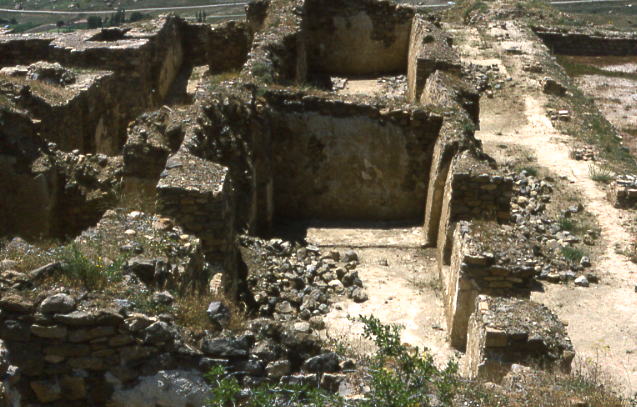
Located on the southern flank of the Djebel Maâdid, the site is a fortified palatial city. Although largely in ruins today, its scale is immense:
- The Great Mosque: One of the largest in Algeria, its prayer hall once featured 13 naves and 8 bays. Its 20-meter-tall minaret is remarkably well-preserved and heavily influenced the design of the Giralda in Seville.
- Palatial Complexes: The site houses several palaces, most notably the Dal al-Bahr (Palace of the Lake), named for its large rectangular pool where nautical displays were once staged.
- The Ramparts: A 7-kilometer line of fortifications originally encircled the city, weaving through the rugged mountain terrain to provide a natural and man-made defense.
Attraction
The Al Qal’a of Beni Hammad attracts travelers primarily for its monumental isolation and architectural purity.
- Authenticity: Unlike many medieval sites that were built over by subsequent dynasties, the Kalâa was abandoned in the 12th century. This provides a “time capsule” of early Islamic art and architecture.
- Stunning Landscapes: The dramatic mountainous backdrop offers a rugged, cinematic atmosphere that appeals to hikers and history buffs alike.
- History of Science and Art: It was once a vibrant center of intellectual life, and the site showcases early examples of intricate ceramic and marble work that defined the Maghreb style.

(Michel-Georges Bernard, Wikimedia/CC BY-SA 3.0).
Heritage
Inscribed in 1980, the site is recognized for its “Outstanding Universal Value” under Criterion (iii): It bears an exceptional testimony to a vanished civilization—the Hammadid dynasty.
The Al Qal’a provides an authentic image of a fortified Muslim city and is a unique reference point for the study of Islamic architecture, particularly in its transition toward the more decorative styles seen later in the Almohad and Nasrid (Alhambra) periods.
Gateway
- City: Sétif is the most convenient gateway city.
- Airport: Sétif Ain Arnat Airport (QSF) is a commercial airport with flights from Algiers and several European cities (primarily France).
- Lodging: Sétif is a major urban center with excellent lodging, including the Park Mall Hotel & Conference Center (Marriott) and the Hotel El-Hidhab. From Sétif, the site is approximately a 1.5 to 2-hour drive through the M’Sila province.
When
- Spring (March to May) and Autumn (September to November): These are the ideal windows. The weather is temperate, and the mountain wildflowers in the spring provide a beautiful contrast to the stone ruins.
- Winter: Can be very cold and snowy due to the high altitude.
- Summer: Often extremely hot, making the steep climbs within the site physically taxing.
(Michel-Georges Bernard, Wikimedia/CC BY-SA 3.0).
Consideration
- Physical Fitness: The site is vast and built on a slope. You will need to hike up and down rocky paths to see the different palaces and the mosque.
- Guided Tours: Signage is limited. Hiring a local guide from Sétif or M’Sila is essential to understanding the layout and history of the ruins.
- Security: While tourism in northern Algeria is generally safe, it is always wise to register your travel with your local embassy and use a recognized local tour operator for remote mountain sites.
- Provisions: There are very few facilities at the site itself. Bring your own water, snacks, and sun protection.

Resources
- UNESCO World Heritage Centre – Beni Hammad: The official portal for historical documentation and site maps.
- Algerian Ministry of Culture: (In Arabic/French) Updates on archaeological excavations and preservation efforts.
- Archnet – Al-Qal’a of Beni Hammad: A high-level academic resource for architectural drawings and photographic archives.
- Lonely Planet – Sétif & The Kalâa: Practical logistics for travelers navigating the Sétif and M’Sila regions.
- Tripadvisor – Al Qal’a of Beni Hammad: Useful for finding local drivers and booking guided excursions from nearby cities.
Featured Image
Minaret of the Great Mosque (R Hakka, Wikimedia/CC BY-SA 4.0).
In The News
Advertisement


Comment:
 All About World Heritage Sites (...and more)

.jpg)
_(cropped).jpg)
Leave a comment