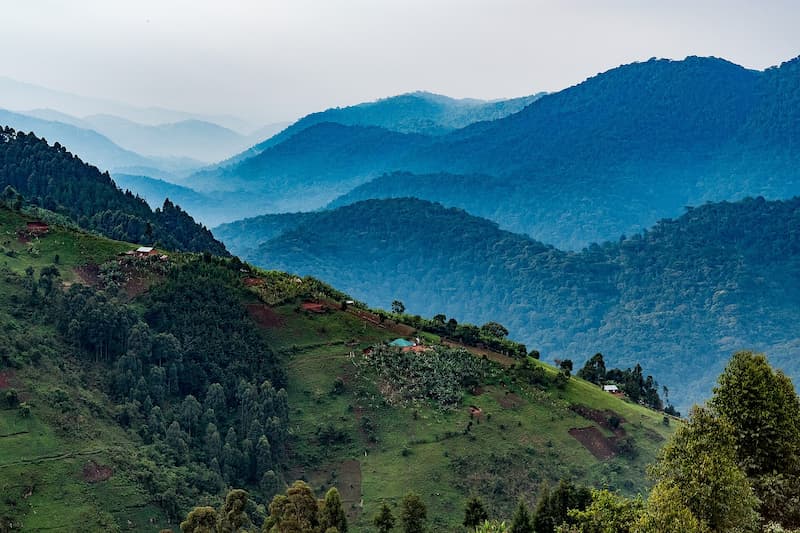
Located in the steep ridges of the Kigezi Highlands in southwestern Uganda, Bwindi Impenetrable National Park is an ancient, mist-covered rainforest that feels like a world frozen in time. Covering 331 square kilometers, it is one of the most biologically diverse regions on Earth, characterized by its incredibly dense “impenetrable” undergrowth of ferns, vines, and shrubs.
Bwindi is a true “Afromontane” forest, where lowland and montane vegetation meet. The park’s rugged terrain ranges from 1,160 to 2,607 meters in altitude, creating a dramatic landscape of deep valleys and jagged peaks. It is divided into four main administrative sectors for tourism: Buhoma (North), Ruhija (East), Rushaga, and Nkuringo (South). Each sector offers a distinct trekking experience, from the relatively gentler slopes of Buhoma to the famously steep and challenging ridges of Nkuringo.
Attraction
The primary magnet for tourists worldwide is the Mountain Gorilla.
- The Population: Bwindi is home to roughly 459 mountain gorillas—nearly half of the world’s remaining population.
- The Encounter: Unlike a traditional safari in a vehicle, gorilla trekking is a raw, physical adventure. Visitors hike through the thick jungle for hours to spend one “magical hour” observing a habituated gorilla family from just a few meters away.
- Other Primates: While gorillas are the stars, the park also hosts chimpanzees, L’Hoest’s monkeys, and black-and-white colobus monkeys.
- Birding: With over 350 species, including 23 Albertine Rift endemics (like the African Green Broadbill), it is considered the best birding destination in Africa.

Heritage
Inscribed in 1994, Bwindi meets UNESCO Criteria (vii) and (x):
- Superlative Natural Phenomena: The park is a remnant of a very large forest that once covered much of Western Uganda and neighboring countries, serving as a “Pleistocene refugium” (an area where species survived the last ice age).
- Exceptional Biodiversity: It contains more than 160 species of trees and 100 species of ferns. It is essentially an “ecological island” surrounded by one of the highest rural population densities in Africa, making its preservation critical for the survival of globally threatened species.
Gateway
To reach Bwindi within Uganda, Entebbe serves as the primary international gateway.
- Airport: Entebbe International Airport (EBB) is the main entry point for all international flights.
- Connecting Flights: From Entebbe, travelers typically take a domestic “bush flight” (approx. 1 hour) via carriers like Aerolink Uganda to the Kihihi Airstrip KHX (for Northern Bwindi) or Kisoro Airstrip KXO (for Southern Bwindi).
- Lodging: Entebbe offers excellent overnight options like The No.5 Boutique Hotel or Hotel Protea Marriott to recover from international travel before heading to the forest.
- Note: Many travelers also use Kigali (Rwanda) as a gateway because the 4-5 hour drive to Bwindi is shorter than the 9-10 hour drive from Entebbe/Kampala.
When
- The Dry Seasons (June to August and December to February): These are the best months for trekking. The trails are less slippery, and the skies are clearer, though short rain showers are possible year-round in a rainforest.
- The Rainy Seasons (March to May and October to November): These are “low seasons.” While trekking is harder due to mud, some luxury lodges offer significant discounts, and the forest is at its most lush and vibrant for photography.

Consideration
- Gorilla Permits: These are mandatory and cost $800 USD. They sell out months in advance, so booking at least 6–12 months ahead is critical.
- Physical Fitness: Trekking can last anywhere from 2 to 8 hours. You must be prepared to hike through thick vegetation and up steep, muddy slopes.
- Health: To protect the gorillas (who share 98% of human DNA), visitors with even a minor cold or flu are not permitted to trek. You must also have a Yellow Fever vaccination certificate to enter Uganda.
- Porter Services: At the park headquarters, you can hire a local porter for around $20. This is highly recommended—not only does it help you navigate the terrain, but it also provides a vital income to the local community.

Resources
- UNESCO – Bwindi Impenetrable National Park: The official technical dossier on the park’s heritage and biodiversity.
- Uganda Wildlife Authority (UWA): The official government body managing the park and permit issuance.
- Visit Uganda: The national tourism board’s guide to activities and logistics.
- Inside Bwindi: A comprehensive local guide focused on the different sectors and lodging.
- SafariBookings – Bwindi Tours: The best platform to compare hundreds of tour operators and read independent reviews for Bwindi safaris.
Featured Image
Nkuringo – South Sector (USAID, Wikimedia/Public Domain).
In The News
Advertisement

Comment:
 All About World Heritage Sites (...and more)
_(25422552517).jpg)
Leave a comment