The Town of Luang Prabang in the Lao People’s Democratic Republic is often described as the “jewel of the Mekong.” Inscribed as a UNESCO World Heritage site in 1995, it is a masterclass in the preservation of architectural harmony and cultural continuity.
Luang Prabang is situated in northern Laos, nestled on a narrow peninsula at the confluence of the mighty Mekong River and the Nam Khan River. Surrounded by lush, jagged green mountains, the town was the ancient royal capital of the Lane Xang Kingdom (“Kingdom of a Million Elephants”) from the 14th century until the mid-20th century.
The town is characterized by its unique “fusion” landscape. It features a dense concentration of over 30 gilded Buddhist temples (Vats), traditional Lao timber houses on stilts, and elegant French colonial brick buildings. The entire historic district is a living heritage site where the spiritual and the secular coexist in a quiet, unhurried atmosphere.
Attraction
Luang Prabang offers a rare, “slow-travel” experience that feels like stepping back into a bygone era:
- The Alms Giving Ceremony (Sai Bat): Every morning at dawn, hundreds of saffron-clad monks emerge from their temples to collect offerings of sticky rice from local devotees in a silent, meditative procession.
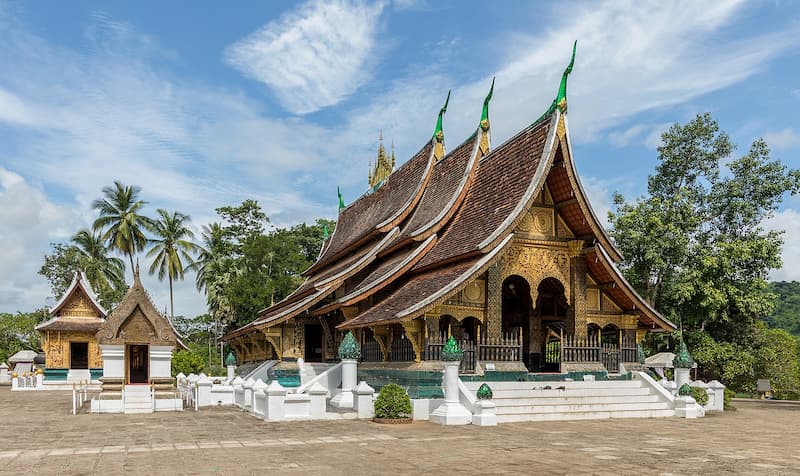
- Wat Xieng Thong: Known as the “Temple of the Golden City,” this 16th-century masterpiece features a stunning “Tree of Life” glass mosaic and sweeping roofs that represent the pinnacle of classical Lao architecture.
- Natural Wonders: Just a short drive away are the Kuang Si Falls, a multi-tiered turquoise waterfall with limestone pools perfect for swimming, and the Pak Ou Caves, which house thousands of miniature Buddha statues.
- Mount Phousi: A climb up the 300+ steps to the summit of this central hill provides 360-degree views of the town and the Mekong, especially popular for sunset.
- The Night Market: A daily open-air market where ethnic minority groups sell high-quality handicrafts, indigo-dyed textiles, and local street food in a remarkably calm, low-pressure environment.

Heritage
UNESCO recognizes Luang Prabang for its “Outstanding Universal Value,” primarily under Criterion (ii), (iv), and (v):
- Exceptional Fusion: It is the best-preserved example of the fusion of traditional Lao architecture and 19th-to-20th-century European colonial influences.
- Urban Integrity: The townscape reflects the harmonious overlap of a traditional Lao administrative center and a colonial grid plan.
- Cultural Continuity: Unlike many other heritage sites, Luang Prabang has maintained its religious and social functions. The temples remain active centers of learning and worship, and the traditional way of life continues alongside modern tourism.
Gateway
Luang Prabang itself is the primary gateway, as it is a fully functioning city with its own international facilities.
- Commercial Airport: Luang Prabang International Airport (LPQ) is located just 4 km from the town center. It serves direct flights from Bangkok, Hanoi, Singapore, and Vientiane.
- Lodging: As a world-class destination, Luang Prabang offers a vast range of accommodations. These include ultra-luxury boutique hotels housed in former royal residences (like Amantaka or Satri House), mid-range colonial villas, and budget-friendly guesthouses along the Nam Khan riverfront.
When
The ideal time to visit is during the dry season (November to March).
- Weather: The skies are clear, and the temperatures are pleasantly cool, especially in the mornings (15°C to 25°C).
- Festivals: Visiting in April is also popular for Pi Mai (Lao New Year), though it is the hottest month. October is another highlight for the Boun Suang Heua (Boat Racing Festival) and the spectacular Lai Heua Fai (Festival of Light Boats), where the town is illuminated by thousands of paper lanterns.

Consideration
- Respectful Dress Code: When visiting temples or observing the alms ceremony, your shoulders and knees must be covered. Carrying a sarong or light shawl is highly recommended.
- Alms Etiquette: If observing the morning alms, keep a respectful distance and do not use flash photography, as it is a sacred religious ritual, not a tourist performance.
- Health & Safety: Laos is generally safe, but be cautious of mosquito-borne diseases like dengue. Drink only bottled water and avoid ice from street stalls if you have a sensitive stomach.
- Currency: While major hotels accept credit cards, the economy is still largely cash-based (Lao Kip). Use ATMs in town to withdraw local currency for markets and small cafes.
- Visa Requirements: Most nationalities require a visa. You can obtain a Lao eVisa online in advance or a Visa on Arrival at the airport for a fee (usually around $35–$45 USD).

Resources
For more information on planning your visit, refer to these sites:
- UNESCO World Heritage Centre – Luang Prabang: The official technical description of the site’s heritage value.
- Official Tourism Luang Prabang: The local government-run guide for attractions, festivals, and transport.
- Lao e-Visa Official Portal: The safest and most official government site to apply for your travel visa.
- Travel Happy – Luang Prabang Guide: A comprehensive independent travel guide with detailed local logistics.
- Agoda : A leading booking platform for securing traditional boutique stays and heritage villas in the old town.
Featured Image
Wat Xieng Thong Temple (Basile Morin, Wikivoyage/CC BY-SA 4.0).
In The News
Advertisement
Comment:
11 responses to “Town of Luang Prabang”
-
I would go for an architecture tour! Look at those buildings! And the view from the top! And as always I would love some street food!
LikeLike
-
If you love nature, you should probably consider spending an entire day at the falls. After climbing to the top of the falls, there are trails that lead to the left (which is probably the better side to climb up anyway – then turn right to see the top of the falls or left to follow the paths). Wish we could have done it, but we were short on time. Travel well!
LikeLike
-
The thing that we fell in love with in LP and all over Laos was the textiles. The hemp fabrics including the traditional natural dyes are breathtaking. We also loved the LP library as a nice place to hang out & the French Institute there. Also we fell in love with the baguette ladies and their families, especially the kids that live under the counters, as they are a big box – sometimes complete with TV & bedding ;). So much more.
LikeLike
-
Luang Prabang is one of my favourite places in Asia. Laid back locals, cheap, great scenery, good architecture, a few really nice local sights… what more can you ask for. Perfect romantic getaway…
LikeLike
-
There are a variety of other things to do in and around Luang Prabang. Some of the ecotourism companies like Green Discovery offer quite a good experience, albeit at a hefty price for what people accustomed to living in China would think.
The elephant village is also worth a look. Tourists can enjoy the elephants guilt-free, since all of them have been rescued from the logging industry. Carrying tourists around, even fat ones, is much better than 700 kilogram logs, and the elephants are all well-fed and cared for.
Laos can be reached by Vientiane as well, and Vientiane is also worth a look. It’s the sleepiest, shortest (no skyscrapers that I could see) capital city that I’ve ever seen.
Laos is not as developed as Thailand or Vietnam, and the people are much more relaxed as well.
LikeLike
-
The magic of Luang Prabang is the combination of French colonial architecture sitting alongside buddhist temples.
LikeLike
-
Climb the stairs up Mount Phousi for a spectacular sunset view of the city and countryside. One of my favorite sights is Wat Xieng Thong temple lit up at dusk with the colorful market at its’ borders.
LikeLike
-
Starting at daybreak, devotees line the streets for the alms-giving ritual where they offer food to Buddhist monks in orange saffron robes. This ritual is the source of their only meal. As this is a sacred Buddhist tradition of Laos, observe the ritual from a distance and use non-flash photography when taking photos of the ceremony.
LikeLike
-
Every evening, the main Sisavangvong Road (which is the main road that runs through the historical peninsula of Luang Prabang) closes to motor vehicles, and a walking street market sets up.
At the market, find an abundance of all this Laos, especially souvenir type of things like baggy elephant print comfy pants, bracelets, and ethnic tribal shoulder bags. There’s so much available, and so many stalls you’ll be amazed – and plenty of vendors sell pretty much the same thing.
Even if not interested in shopping, the Luang Prabang night market is still a perfect place to take an evening stroll. Additionally, can always grab a fruit shake at the front of the market.
LikeLike
-
We loved Luang Prabang so much we ended up staying nearly 2 weeks! Our initial plan was a few days. We just loved the relaxed vibe, the friendly people and the beautiful views of the Mekong! However, as a result, we didn’t visit any more of Laos… however, we decided we’d just have to go back and explore more! But we’d definitely be going back to Luang Prabang!
LikeLike
-
The thing that we fell in love with in LP and all over Laos was the textiles. The hemp fabrics including the traditional natural dyes are breathtaking. We also loved the LP library as a nice place to hang out & the French Institute there.
LikeLike

 All About World Heritage Sites (...and more)


Leave a comment