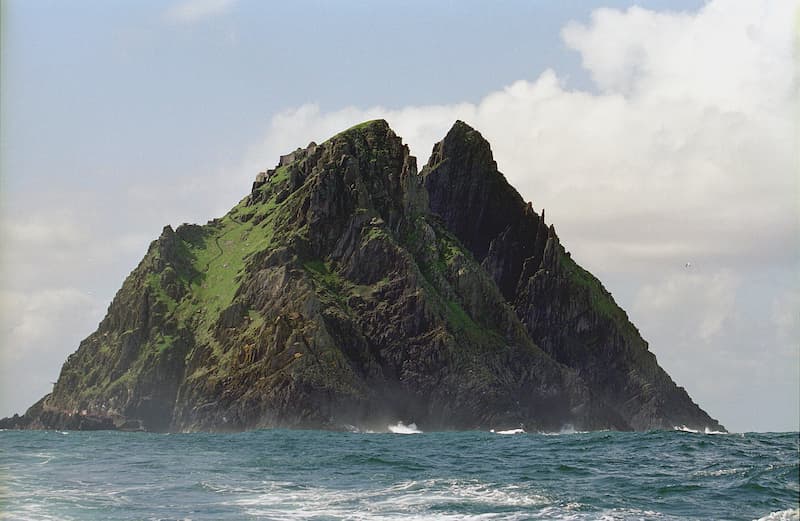
Sceilg Mhichíl, also known as Skellig Michael, is a sheer-sided, twin-peaked sandstone crag rising abruptly from the Atlantic Ocean, 12 kilometers off the coast of County Kerry, Ireland. It is home to one of the most remarkably preserved Early Medieval monastic settlements in Europe.
The site is defined by its dramatic “pyramidal” shape and its isolation. Between the 6th and 8th centuries, ascetic Christian monks founded a monastery on the island’s northern peak, roughly 180 meters above sea level. The settlement consists of six stone beehive huts (clocháns), two oratories, a small church, and a graveyard, all enclosed by dry-stone retaining walls. Access to the monastery requires a steep ascent of over 600 stone steps, carved into the cliffside by the monks themselves.
Attraction
Sceilg Mhichíl attracts visitors for its unique combination of history, nature, and pop culture:
- Medieval Heritage: It is a “living museum” of early Christian monastic life, showing how monks survived in extreme solitude and harsh oceanic conditions.
- Star Wars Connection: The island gained global fame as the filming location for “Ahch-To,” the remote Jedi retreat where Luke Skywalker lived in The Force Awakens and The Last Jedi.
- Extraordinary Wildlife: The islands are a sanctuary for seabirds. Little Skellig hosts one of the world’s largest gannet colonies, while Skellig Michael is famous for its thousands of nesting puffins.
- Spectacular Scenery: The jagged peaks and deep blue Atlantic waters offer some of the most dramatic coastal views in the world.

Heritage
Sceilg Mhichíl was inscribed as a UNESCO World Heritage Site in 1996 under two criteria:
- Criterion (iii): It illustrates the extremes of Christian monasticism, showing a unique example of an early religious settlement in a remote, oceanic environment.
- Criterion (iv): It is an outstanding example of dry-stone masonry, with its architectural ensemble remaining virtually intact due to its isolation.
Additionally, the Art of dry stone construction (the technique used to build the beehive huts) was inscribed on the UNESCO Representative List of the Intangible Cultural Heritage of Humanity in 2024.
Gateway
- Gateway Town: While Portmagee is the actual pier for boat departures, Killarney serves as the primary gateway for international tourists.
- Commercial Airport: Kerry Airport (KIR) is located in Farranfore, just 15 minutes from Killarney and about 1 hour and 15 minutes from Portmagee.
- Lodging: Killarney offers extensive lodging, from heritage hotels to modern guesthouses. Travelers often stay in Killarney and take a shuttle or rental car to Portmagee for their morning boat departure.
When
- Landing Season: Access is strictly limited to the season running from mid-May to the end of September.
- Puffin Watching: Visit between mid-May and July to see the puffins before they migrate back to the sea in August.
- Weather Note: Boats only sail in calm seas. Even in mid-summer, tours are frequently cancelled due to high swells or wind.

Consideration
- Physical Fitness: You must climb over 600 steep, uneven, and often slippery stone steps. There are no handrails. It is not suitable for those with limited mobility or a fear of heights.
- Advance Booking: Landing permits are limited to 180 people per day. Book your boat tour months in advance.
- Safety: The terrain is hazardous; accidents and fatalities have occurred. Always stay on the recognized paths and listen to the OPW guides on the summit.
- Supplies: There are no food, water, or toilet facilities on the island once you leave the landing pier. Bring a small backpack with water and a packed lunch.
- Age Restrictions: Most landing boat operators do not permit children under the age of 12 for safety reasons.

Resources
- UNESCO World Heritage Centre – Sceilg Mhichíl: The official archive for history and conservation data.
- Heritage Ireland (OPW): The official government site for visitor guides and safety information.
- SkelligMichael.com: A comprehensive planning resource including boat operator lists and local tips.
- Wild Atlantic Way – Skellig Michael: Focuses on the site’s place within the iconic coastal driving route.
- World Heritage Travel (Angie Kunze): A practical, first-person guide for travelers with accommodation and tour recommendations.
Featured Image
Sceilg Mhichil (Jerzy Strzelecki, Wikipedia/CC BY-SA 3.0).
In The News
Advertisement


Comment:
9 responses to “Sceilg Mhichíl”
-
There is nothing like it in the rest of the world.
LikeLike
-
It’s a relaxing place, it’s very special, it’s very spiritual.
LikeLike
-
I’ve not been to Skelling Michael but I have seen some photos and it looks like a really interesting and picturesque place to visit. The rounded domes of those dry wall-style buildings are fascinating!
LikeLike
-
It was fantastic, the monastery, the wildlife, everything. And we even saw dolphins on the way back.
LikeLike
-
The Bass Rock [in Scotland’s Firth of Forth] is a mere lump in comparison: both the Skelligs are pinnacled, crocketed, spired, arched, caverned, minaretted; and these gothic extravagances are not curiosities of the islands: they are the islands: there is nothing else. I tell you the thing does not belong to any world that you and I have lived and worked in. It is part of our dream world.
LikeLike
-
This was my favorite adventure in Ireland. You take a small boat out and the ride is intense, definitely not for those who get seasick easily. When you get to the island you walk up steep stairs filled with puffins to the top where a monastery awaits. I feel so lucky that I got to experience this.
LikeLike
-
At first, Skellig Michael appeared as a minuscule bump on the horizon. It gradually grew and by the time we were alongside the quay it loomed above us, a jagged, sheer-walled monolith of black-gray rock, crusty orange lichen and bright green grasses exploding upward out of the sea. I craned my neck but could not see the summit.
Once you hop onto land, there is a path to the stairs. My fellow passengers and I navigated them at our own pace, and eventually our clutch of wanderers thinned, allowing for solitary exploration. I took my time, focusing on the steps rather than the view to reduce vertigo. I wasn’t the only sufferer. On one particularly exposed run of stairs, I come upon a strapping man in his 20s descending in a seated position one step at a time. I feared that I would have to borrow his technique on the way back down.
As I stood amid the monastic ruins, I realized that for all the isolation and deprivation endured by Skellig Michael’s monks, they must also have felt the seductive power of the island’s raw, elemental beauty: a vermilion sunset; the delicate, perfectly ovoid shell of a seabird egg; a diaphanous curtain of approaching rain. For these men whose lives were stripped of all nonessentials, distilled to a purity I cannot imagine, everything on this crag must have sung of their god’s magnificent creation.
After an hour, I picked my way back down the stairs and to the quay with far less terror than expected. We were a quieter group on the return trip, until we encountered dolphins, an entire pod that cruised alongside us and leapt out of the water in high arcs.
After disembarking at Derrynane Harbour, during the hourlong drive back to the house where I was staying, I couldn’t shake the sense that I’d just awakened from a dream. One populated with ancient monks and dolphins and a swirling ocean mist that lingered long after my trip across the turbulent sea.
LikeLike
-
Visitors need to be in good condition to mount the 600 steps — no railings! — to the top. And, of course, what goes up must come down. We brought our trusty hiking poles, and they helped with both the ascent and descent.
LikeLike
-
When you are going to land on Skellig Michael you should have your hands free to climb out of the boat. If you need to go to the toilet go on the boat, because there is no public toilet on the island. You have not so much time on the Island, about 2.5 hours. When you are on the Island do not rush. There are people on the island anyway and you will not miss one thing. I recommend going up to the Monastery first. Do not stay too long on the other places at the beginning. If you see a puffin it will not be the last. Plan the most for the way back. You will see the scenery better from above on the way down. On the way up you are also faster out of breath and the groups on the stairs are bigger.
LikeLike

 All About World Heritage Sites (...and more)


.jpg)
Leave a comment