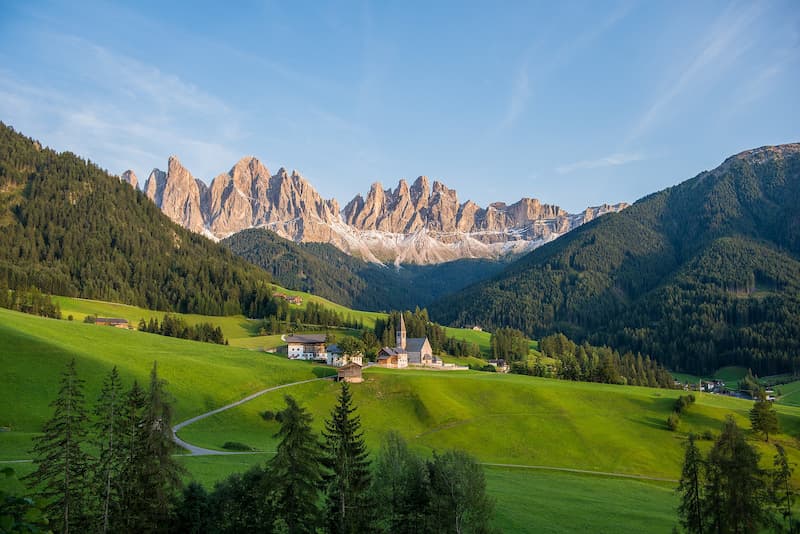
The Dolomites (Dolomiti) are a spectacular mountain range in the northern Italian Alps, characterized by pale, jagged limestone peaks that rise vertically above lush green meadows. Covering five Italian provinces, they are widely considered one of the most beautiful alpine landscapes on Earth.
The Dolomites consist of 18 major peaks rising over 3,000 meters. Unlike the typical granite peaks of the central Alps, these “Pale Mountains” are composed of dolomitic limestone, which reacts to light with a phenomenon called Enrosadira—where the peaks turn brilliant shades of pink and red at sunrise and sunset. The landscape is a mix of sheer vertical walls, deep narrow valleys, and sprawling plateaus like the Alpe di Siusi, the largest high-altitude alpine meadow in Europe.
Attraction
The region is a year-round magnet for outdoor enthusiasts and luxury travelers:
- Adventure Sports: In summer, the area is a world-class destination for hiking, rock climbing, and mountain biking. In winter, it hosts Dolomiti Superski, the world’s largest ski circuit with over 1,200 km of slopes.
- The Via Ferrata: These “iron paths”—climbing routes equipped with fixed cables and ladders—allow non-professional climbers to reach dramatic summits safely.
- The Lakes: Stunning turquoise lakes like Lago di Braies and Lago di Carezza offer some of the most photographed scenery in Europe.
- Cultural Fusion: The region blends Italian, Austrian, and Ladin (a local Rhaeto-Romance language) cultures, visible in the unique alpine architecture and gourmet mountain cuisine.

Heritage
Inscribed in 2009, the Dolomites are a Natural UNESCO World Heritage site recognized under two criteria:
- Criterion (vii): They possess “exceptional natural beauty.” The contrast between vertical sculptural forms and horizontal ledges, combined with the variety of colors and dynamic light, creates an archetype of mountain scenery.
- Criterion (viii): They are a globally significant geological site. The range offers a clear “fossilized” record of life in the Triassic period (250 million years ago), showcasing the evolution of coral platforms and ancient marine life.
Gateway
Depending on whether you want to visit the Western or Eastern Dolomites, there are two primary gateways:
- Bolzano (Bozen): The capital of South Tyrol serves as the central hub. While it has a regional airport (Bolzano Airport – BZO), it is most commonly reached by a 2-hour train from Verona or Munich.
- Venice: Venice Marco Polo Airport (VCE) is the major international hub for those heading to the Eastern Dolomites and Cortina d’Ampezzo. It is approximately a 2.5-hour drive from the mountains.
- Lodging: Both cities offer extensive hotels, but for an immersive stay, towns like Ortisei, Cortina, and San Candido provide high-end resorts and traditional Alpine chalets.
When
- Summer (Late June to Early September): Peak season for hiking. By mid-June, the snow has usually melted from high-altitude trails.
- Winter (December to March): Peak season for skiing and Christmas markets.
- Shoulder Season (September to October): Perhaps the best time for photography. The air is crisp, the crowds have thinned, and the larch trees turn a brilliant golden yellow.
- Note: Many cable cars and rifugios (mountain huts) close during the transition months of May and November.

Consideration
- Mountain Safety: Weather changes instantly. Always carry a waterproof shell and check the local Meteomont forecast daily.
- Transport: While buses are excellent, a rental car is highly recommended for reaching the most scenic passes (like Sella or Gardena) at sunrise or sunset.
- Booking Rifugios: If you plan to do a multi-day trek like the Alta Via 1, you must book your mountain hut stays 6–12 months in advance.
- Language: Road signs are often trilingual (Italian, German, and Ladin). Don’t be confused if a town has three different names!

Resources
- Dolomiti UNESCO Foundation: The official body managing the heritage site, with deep dives into geology and conservation.
- South Tyrol Official Tourism: Excellent resource for the Western Dolomites, including Bolzano and Val Gardena.
- Veneto Tourism – The Dolomites: Guides for the Eastern Dolomites and the Belluno province.
- Dolomiti Superski: The essential portal for winter sports, lift passes, and snow reports.
- TourRadar – Dolomites Tours: A platform to compare and book guided multi-day hiking or skiing tours.
Featured Image
Village of St Magdalena (Bohringer Friedrich, Wikipedia/CC BY-SA 3.0 AT).
In The News
Advertisement


Comments:
9 responses to “The Dolomites”
-
When people come to ride or hike, they like to come for a week. You need a minimum of three days to really get a feel. They like to go up to Tre Cima di Lavaredo, Mount Civetta, Mount Marmolada and Pale di San Martino, which are spectacular mountains with cliffs. The “four passes” – Gardena, Campolongo, Pordoi and Sella – are beautiful. Another highlight of the area is the Penta group near Lake Garda.
The tallest mountain is just over 3,000 meters (9,843 feet); the passes are about 2,000 meters (6,582 feet).
There’s something for all levels here, novice to expert.
There are overnight camping huts throughout the system: You’re never more than 2 1 / 2hours of walking from some kind of support system. You can stay in a hut in the mountains or stay in villages or town.
You don’t, as a rule of thumb, want to hike in the higher elevations after 3 p.m. That’s often when you get thunder storms off the Adriatic Sea.
-
While Cortina is definitely a draw for the adventurous, there is plenty to do if you prefer more gentle activity. The town itself feels more Austrian than Italian, with carved wooden balconies and baskets of geraniums. Designer brands are wedged between the outdoor-wear shops, and in the evenings well-groomed locals and visitors sip Aperol spritzers. My spacious room at the Hotel Franceschi looked out over mountain peaks and was a five-minute walk from Pasticceria Alvera, brilliant for morning croissants or afternoon cake.
There are easy walks or drives to surrounding villages and lakes, and I’d recommended lunch or dinner at Il Brite de Larieto, a working farm and restaurant two kilometres out of town. Everything on the menu is made here, from ham and cheese to fennel-seed bread and traditional dumplings.
The region’s mountain refuges are also reachable without hiking for miles as lots of them have cable cars which take you close by.
I stayed the night in family-run Rifugio Averau, with good home-cooked food and comfy dorms, where a dramatic midnight thunderstorm ricocheted around the mountains.
-
Along with the language and culture, the landscape creates a feeling of being in another world. On our first day, we catch the cable car up to the Alpe di Siusi, and find scenery I have rarely seen the like of. The green rolling hills and meadows of summer flowers contrast with the spiky and dramatic grey of the mountains: it’s a cross between Sound of Music country and Middle-earth.
-
In 2006 I hiked from rifugio Fodara to Sebastiano, with a rest day in Cortina, and it was one of the best hikes I’ve ever done. Spectacular scenery, wonderful refuges, and no crowds. The rocks have a pink-orange warmth that looks great against the blue skies and green of the trees.
-
To make your time in the mountains truly special, why not stop for a bite or even stay overnight in one of the many refugios – charming traditional mountain huts that are scattered among the region. Each has it’s own unique characteristics, some famous for their food, others for their warm hospitality. Seeing the sun set in the Dolomites, and rise again in the morning will be a truly magical experience.
-
For the Italians the area of Alta Badia and the whole region (called Trentino) is the winter time tourist magnet for skiers, but it is also the place to be in summer when you don’t want to go to crowded beaches – the whole area is fantastically equipped for toursists and there are aeven special family hotels where the small children are well catered for., allowing the parents to have quality toime together. All in all one of the best areas to holiday in.
-
Standing among these incredible peaks almost does not feel like reality. It felt as though I was standing in a fairy tale. I wanted to capture that feeling and emotion in the photographs. Weather was a bit tough during the trip. There was a lot of rain and cloud cover. I spent a good amount of time waiting for clearings in the storms to create the images and time lapses. These moments would often only last a few minutes. I love the feeling of being out in nature, traveling and seeing new places. Hiking around and waiting for the right moments to capture the scenes.
-
There’s no doubt that walking is the best way to explore the Dolomites. Trentino offers a range of hiking options. You can choose the Brenta Dolomites and eastern Trentino, the wild Lagorai chain and the Fassa and Fiemme Dolomites through two huge circuits undertaken in stages. The two networks of well-maintained footpaths (part of an amazing 5,000km of signposted footpaths in Trentino) pass by no less than 143 mountain huts, and there is a small army of mountain guides ready to provide all the support you need over the more challenging glaciers and crevasses. Our route of choice is the Palaronda Trek, which has a five-stage “hard” circuit and a four-stage “soft” circuit, both of which start and finish in San Martino di Castrozza, a charming town at 1,450 metres above sea level, in the heart of the Paneveggio woods in Pale di San Martino Nature Park.
-
The best way to see the largest alpine meadow in Europe is by taking the ultra-modern cable car connecting Ortisei with the 2,000 meter high Alpe di Siusi. In just a few minutes, you will find yourself surrounded by the breath-taking scenery of Gruppo del Sella, Gruppo del Sassolungo, Catinaccio, and the Sciliar. Relax and take in the views of yellow flowers that blanket the green meadows, or go for a hike through this magical wonderland.


Leave a Reply to VernonCancel reply