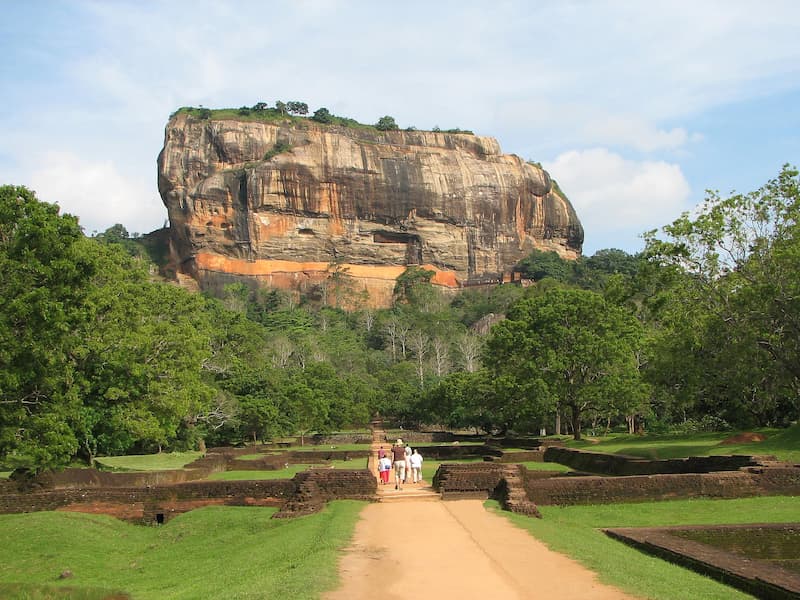
The Ancient City of Sigiriya, a UNESCO World Heritage site since 1982, is Sri Lanka’s most iconic landmark. Often called the “Eighth Wonder of the World,” this 5th-century stronghold is a dramatic combination of a royal palace and a formidable fortress, perched atop a massive 200-meter-high granite column that rises abruptly from the central plains.
Built by King Kasyapa (477–495 AD), Sigiriya is an architectural marvel of ancient urban planning.
- The Summit Palace: The flat top of the rock once held a magnificent seven-story palace, complete with paved courtyards, stone-cut cisterns for rainwater, and terraced gardens.
- The Lion Gate: Halfway up the ascent, visitors pass through the “Lion Gate,” where two enormous carved stone paws are all that remain of a colossal lion statue that once guarded the final staircase.
- The Mirror Wall and Frescoes: A sheltered gallery on the rock face features the world-famous Sigiriya Frescoes—exquisite paintings of celestial nymphs (Apsaras). Adjacent is the “Mirror Wall,” a highly polished brick wall covered in graffiti and poems dating from the 7th to 14th centuries.
- The Gardens: At the base lies one of the oldest landscaped gardens in the world, featuring a symmetrical network of Water Gardens, Boulder Gardens, and Terraced Gardens that still utilize a sophisticated underground hydraulic system.
Attraction
Sigiriya attracts travelers worldwide for its “Sky Palace” mystery and sheer scale:
- Engineering Prodigy: Tourists are amazed by the hydraulic technology that still feeds working fountains 1,600 years later.
- Classical Realism: The frescoes are considered the finest examples of classical Sri Lankan art, showing a level of realism and color that has survived the elements for centuries.
- Breathtaking Panoramas: The 1,200-step climb rewards visitors with a 360-degree view of the surrounding emerald jungles and distant mountains.

Heritage
UNESCO recognizes Sigiriya under Criteria (ii), (iii), and (iv):
- Criterion (ii) & (iii): It is a unique witness to the civilization of Ceylon and one of the best-preserved examples of ancient urban planning in South Asia.
- Criterion (iv): The site represents an exceptional artistic and architectural ensemble, blending human imagination with the natural landscape in a way that influenced Buddhist architecture for centuries.
Gateway
While the nearest major city is Dambulla, most travelers use Sigiriya Village as their base.
- Commercial Airport: Sigiriya Airport (GIU) serves domestic flights. However, most international visitors fly into Bandaranaike International Airport (CMB) in Colombo and take a 4-hour drive.
- Lodging: Options range from the luxurious Jetwing Vil Uyana, which offers dwellings over wetlands, to the eco-friendly Aliya Resort & Spa.
When
- Best Months: January to April offers the driest weather for the steep climb.
- Best Time of Day: Arrive at the gates by 7:00 AM. This allows you to avoid the sweltering midday heat (often reaching 32°C) and the largest tourist crowds. Late afternoon (around 3:30 PM) is also ideal for catching the sunset from the summit.

Consideration
- Physical Effort: The climb consists of 1,200 steps. It is steep and can be nerve-wracking for those afraid of heights, particularly the final metal staircases.
- Safety (Wasps & Monkeys): Large hornet nests are occasionally active on the rock face; signs advise visitors to remain quiet in these zones. Do not feed the macaques, as they can be aggressive.
- Dress Code: As a sacred site, you should dress modestly (shoulders and knees covered).
- Photography: Photography of the frescoes is strictly prohibited to protect the pigments from flash damage.
- Fees: The entry fee for foreign tourists is approximately $36 USD.

7. Recommended Resources
- UNESCO World Heritage – Sigiriya: The official global dossier for historical and scientific details.
- SigiriyaFortress.com: A comprehensive local guide for ticket prices and visiting hours.
- Central Cultural Fund Sri Lanka: The government body overseeing the preservation and management of the site.
- SriLanka.travel – Sigiriya: The official national tourism board’s portal.
- Viator – Sigiriya Tours: Use this to book guided tours from Colombo or Kandy that include transport and expert local historians.


Comments:
6 responses to “Ancient City of Sigiriya”
-
It was worth the effort to climb up – the view from the top is stupendous – on one side the king’s pleasure gardens stretch away to the jungle fringes, on the other side is the Sigiriya tank (a man-made lake) which once supplied the fortress and palace with its water.
-
Theories do not differ on when this massive 1,214-foot rock is best scaled. I learned the hard way, arriving at about, oh, 1pm or so, when the central Sri Lankan sun was at its suffocating peak. The mostly shade-less climb up was one of the most draining activities I’ve ever done; the long walk from the parking lot to the rock was almost just as oppressive.
Lesson learned: unless you’re curious to find out what it’s probably like inside a microwave on full blast, start your day trip from Kandy at Sigiriya before moving onto the Dambulla cave temple, not the other way around.
-
We arrive at Sigirya just as the afternoon eases into evening. The climb to the top takes a couple of hours and two steely knees. Halfway up the rock, up a windy stairway, one comes across a rocky shelter, home to the “Maidens of the Clouds” or 21 unidentified female figures, “comparable to the most beautiful creations of Ajanta,” according to a Unesco description. As one adjusts to the cool shade of the cave, enthusiastic guides hustle up to one, whispering, “Three nipples, three nipples” and point to the obvious offender — a beautiful doe-eyed nymphet. We then make our way to the top of the 150-m rock face (the height of a 50-storey building, roughly). Here is where the true majesty of Sigiriya can be witnessed. Legend goes that King Kassapa I (477-95) came to power after killing his father, but condemned that he would never be allowed into heaven, decided to build his palace atop the hill, from where he could command a view of endless woods, landscaped gardens and elephants dipping in the river. Even with groups of triumphant visitors making it to the summit, the top still affords a moment for reflection and peace.
-
A five-hour drive from Colombo, my guide parks his car in a shade for me to take “a nice picture” of Sigiriya fort. The Unesco heritage site is his pride like most Sri Lankans, who feel it deserves to be named the world’s eighth wonder. From here, Sigiriya looks like a one-kilo mound of mossy weather-beaten rock, hemmed in by a vast expanse of green. It has more than a thousand steps from the ground to the bare top, which I plan to climb. Somewhere up there, there are priceless fresco paintings, a lion carved out of rock and a passage through the lion’s mouth itself.
Steep steps carved in rock take you up for some distance. After about 700 steps, when you reach the fresco paintings and the lion’s paws, is the moment of big decision — whether to trust the rickety iron staircase and climb to the top. A raging, bellowing wind is trying to blow the climbers away — the few bravehearts who have decided to finish the last lap. A couple of steps from the top, I feel my wobbly feet would cave in any moment. And that’s when “Whoa, you’re almost there!” beamed a middle-aged American from above. Phew! The top is just a cluster of waist-high chambers but it’s a sight worth stressing my jangly nerves for. Who knew barren could be so beautiful.
-
On the day we visited The Rock, we joined the long line of tourists inching their way up the steel stairway to reach The Rock’s summit. Mid-way to the top, on the west wall’s rock depression, were frescoes of apsaras or celestial nymphs rendered in radiant colors and drawn in stylized, linear manner.
Further up a base is a massive rock sculpture of a lion, its paws wide apart and its wide-open mouth serving as an entrance. This mouth has a stairwell further up the summit of the Rock, that serves as entry point to the “city palace.” At the summit, we wandered around the gardens and ruins of this former palace. Taking in fresh air 200 meters above a lovely, verdant plain, we felt ourselves relaxing completely, our consciousness wrapped momentarily in the sublime beauty of the landscape.
Suddenly, we found ourselves landing back to earth with a thud—a monkey had quickly and effortlessly swiped our bag of two bananas! Lesson learned: Never leave bananas dangling when passing through monkey territory. -
During a recent three-week tour of Sri Lanka, I visited Sigiriya. While not planning to ascend the 1200 steps to the summit of Sigiriya like my fellow travelers, I did plan to climb at least to the level of the extant cave frescoes. Depicting exotic women, sometimes referred to as “The Maidens of the Clouds,” the frescoes at one time covered much of the western face of Sigiriya. Today only a small portion remain, located in a cave said to be about half way up the rock. The climb to the cave, for me, was a challenge; I was not prepared for the narrow steps and steep paths leading to the final circular metal staircase that finally leads to the best preserved cave paintings. But I am so happy I did the climb. The paintings are beautiful. It is a miracle they have survived.

Leave a Reply to JillCancel reply