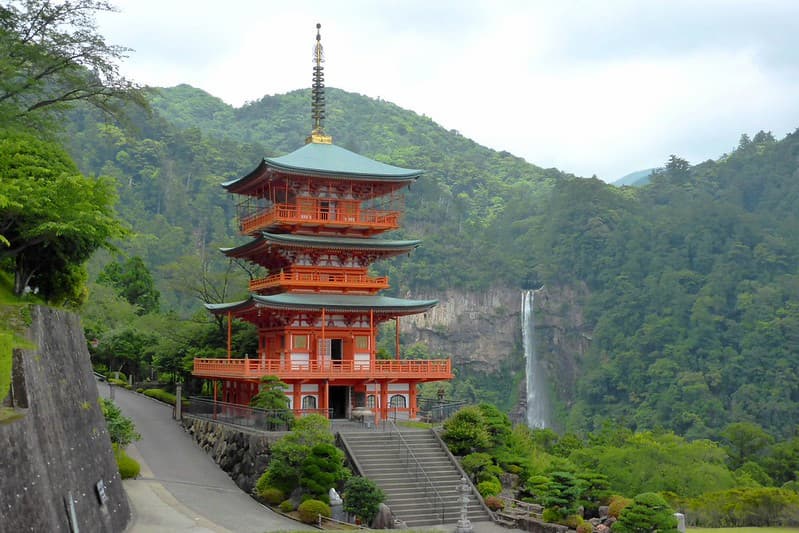
The Sacred Sites and Pilgrimage Routes in the Kii Mountain Range is a sprawling cultural landscape in Japan’s Kii Peninsula, spanning Wakayama, Nara, and Mie prefectures. It is one of the world’s most significant spiritual regions, where ancient trails weave through primeval forests to connect three distinct sacred areas.
The site consists of three sacred destinations linked by over 307 km of pilgrimage routes known collectively as the Kumano Kodo.
- Kumano Sanzan: The three Grand Shrines (Kumano Hongu Taisha, Kumano Hayatama Taisha, and Kumano Nachi Taisha) nestled in the southeastern mountains.
- Koyasan: A monastic mountaintop city founded in the 9th century as the center of Shingon Esoteric Buddhism.
- Yoshino and Omine: The northernmost area, famous for its thousands of cherry trees and as the headquarters for Shugendo, a religion of mountain asceticism.
Attraction
Kii Mountain Range is not just for historians; it offers a profound “slow travel” experience:
- Spiritual Immersion: Travelers can walk the same moss-covered stone paths used by emperors and commoners for over 1,200 years.
- Nachi Falls: One of Japan’s tallest waterfalls (133 m), providing a stunning backdrop to the vermilion Seiganto-ji Pagoda.
- Shukubo (Temple Lodgings): In Koyasan, visitors can stay overnight in active Buddhist temples, eat shojin ryori (vegetarian monk cuisine), and participate in morning fire ceremonies.
- Onsen Culture: The route is dotted with ancient hot spring villages like Yunomine Onsen, home to the world’s only UNESCO-listed thermal bath.

Heritage
Inscribed in 2004, UNESCO designated this site as a “living cultural landscape” for its outstanding universal value:
- Religious Fusion: It represents a unique, persistent fusion between Shintoism (nature worship) and Buddhism (introduced from the mainland).
- Exceptional Testimony: The site bears witness to over 1,200 years of mountain worship, where the mountains themselves are considered deities.
- Architectural Influence: The shrines and temples developed unique architectural styles that profoundly influenced religious building designs throughout Japan.
Gateway
While several towns provide access, the primary gateway for international visitors is Tanabe City (Kii-Tanabe).
- Commercial Airport: Most travelers fly into Kansai International Airport (KIX) in Osaka, which is a 2.5-hour train ride from Tanabe. Alternatively, Nanki-Shirahama Airport (SHM) offers direct domestic flights from Tokyo, followed by a short bus ride.
- Lodging: Tanabe offers a variety of “minshuku” (guesthouses) and business hotels. It serves as the base for the Nakahechi Route, the most popular trail for first-time pilgrims.
When
- Spring (March to May): Ideal for cherry blossoms, especially in Mount Yoshino, and mild hiking temperatures (13°C to 18°C).
- Autumn (October to November): The most popular time for photographers due to the vibrant red and gold maple foliage and crisp air.
- Winter (December to February): Quiet and serene, though snow is common in the higher passes of Koyasan.
- Avoid: The peak rainy season in June and the intense humidity/typhoon risk of August and September.

Consideration
- Advanced Booking: Accommodations in small mountain villages are extremely limited and often sell out 6–12 months in advance.
- Physical Preparation: This is a rugged trek. The paths involve thousands of steep, uneven stone steps that can be very slippery when wet.
- Etiquette: Pilgrimage routes are sacred. Do not eat while walking, refrain from loud conversation, and follow strict onsen etiquette (bathing naked and washing before entering).
- Cash is King: While Japan is modernizing, most mountain guesthouses and local buses only accept Yen cash.

Resources
- Tanabe City Kumano Tourism Bureau: The gold-standard official site for booking guesthouses, luggage shuttles, and getting detailed maps.
- UNESCO World Heritage – Kii Mountains: Official documentation regarding the site’s heritage value and conservation.
- Visit Wakayama Official Guide: The prefectural board’s guide to the larger region, including coastal views and cultural events.
- Kumano Kodo Iseji Navigator: Specialized information for the eastern Iseji route connecting the Ise Grand Shrine to Kumano.
- Agoda.com: A reliable platform for securing overnight stays in gateway cities like Tanabe, Shingu, or Shirahama.
Featured Image
Seiganto-ji Pagoda, with Nachi Falls at the background (Tetsushiro Terada, Flickr/CC BY 2.0).
In The News
Advertisement


11 responses to “Sacred Sites and Pilgrimage Routes in the Kii Mountain Range”
-
Our guide joins us one morning as we rise early to accompany the monks for a guided meditation session, and to witness the sacred Goma fire ritual at the Koyasan temple. The hypnotic chanting of the monks washes over us as we are given instruction in how to calm the mind while letting go of its ceaseless chatter.
Later, we take the 2km path to Kobo Daishi’s mausoleum. Surrounded by innumerable graves and shrines amid the centuries-old cedar trees, we watch the daily ritual of offering food to Kobo Daishi, who is believed to be in a state of eternal meditation that began 1,200 years ago. It was the first of many such powerful experiences as we followed the trail deeper into the mountains. Time and again, we ritually asked for blessings at wayside shrines on mountain pathways leading to sacred waterfalls or emerged into sunlit plateaus overlooking the surrounding mountains.
At the main temples, we were never quite sure we had mastered the rituals of purification (washing the hands, clapping twice to waken the gods, bowing, ringing the sanctuary bell), but no one seemed to mind. In Japan, strict doctrine is less important than a respect for spiritual traditions, whatever form they may take.
Other highlights on the trail included Oyunohara, where we blinked in disbelief at the Torii gate leading to the sacred shrine. Standing nearly 35 metres tall and more than 40 metres wide, it is the largest in the world. Fifteen minutes away, at the geological thermal wonder on the Oto River, hot spring water comes bubbling to a crystal-clear surface.
-
It’s not like Kyoto or Nara — it’s a little off the beaten path. The routes lead to inspiring natural sacred sites, and along the way visitors can find isolated hot springs, delicious cuisine and authentic accommodations.
-
My final two days of trekking to Nachi Taisha would take me through some of The Kumano Kodo pilgrimage’s most beautiful scenery, via mossy stone paths winding through bamboo and cedar forests and statues of dragons, monks and emperors, and giant cedar trees with hollowed out roots for offerings to be left.
-
In Koyasan, among the many pagodas, museums, and temples are little restaurants and souvenir shops. But what you really come to Koyasan to see is Okunoin, the largest cemetery in Japan and the site of the mausoleum of Kobo Daishi (or Kukai), the founder of Shingon Buddhism. Walking along the cobblestone path in the middle of the thick ancient forest can only be described as otherworldly—more peaceful than eerie. The space is filled with thousands of Jizo statues, moss-covered torii gates, and memorials that have been constructed for royalty and monks alike. Most impressive is Torodo Hall, filled with roughly 10,000 eternally lit lamps.
Before I leave for Kyoto, I take in my surroundings once more and it dawns on me: This enchanting, marvelous place is so quiet and peaceful that even the birds know not to chirp and disturb the spellbinding site. It’s hard to deny the overwhelming sense of serenity and the magic that is Koyasan.
-
We started our adventure by taking the train from Kyoto to Tanabe. Near the train station there is an excellent tourist information office where they will answer any of your questions (in perfect English) and have many maps and brochures on the Kumano Kodo. We stopped here to have lunch before catching a local bus to our pilgrimage starting point, Takajiri.
Our four-and-a-half-day pilgrimage took us 70km along the Nakahechi route, through remote mountain paths and forests, past innumerable oji shrines and, most importantly, to two of the Kumano grand shrines – Hongu Taisha and Nachi Taisha.
The pilgrimage does test your fitness and endurance, with many long, lung-cleansing inclines followed by steep and slippery, joint-jolting declines. The scenery throughout the whole trail is breathtaking – from pristine mountain vistas, to misty wooded forests, to bamboo groves and lush river valleys.
We stayed in five quaint little villages along the Nakahechi route, where our hosts were always welcoming and very helpful, even if they didn’t speak much English. Our dinner each evening was a gastronomical delight, each meal cooked freshly by our hosts and consisting of pickles, noodle soups, fried fish, tempura seafood and vegetables, sashimi and sticky rice. We washed down all this wonderful food with delicious local sake.
Each guesthouse had a lovely traditional communal Japanese onsen for bathing. An onsen is a hot spring bath, which the Japanese believe to have healing properties. Whether it does or not, soaking in a lovely hot bath is the perfect end to a tough day of hiking and a great remedy for aching muscles.
Each night we stayed in tatami mat rooms and pulled our futon mattresses out of the closet to convert our living room to a bedroom. We would leave the window open to enjoy the cool mountain breeze throughout the night, and slept the wonderful deep sleep of those who have earned it.
Our pilgrimage came to an end at the grand shine of Nachi Taisha, in a lovely little tourist town called Nachi-san and which is also home to the sacred Nachi-taki waterfall. Here we had a communal dinner with other pilgrims and shared stories of our experiences on the Kumano Kodo. We all agreed; it had been a tough but highly rewarding experience.
-
Koyasan is a classic exemplar of a picturesque hill town – winding roads, cedar trees and nippy weather – but this one comes with a twist. It is a Buddhist pilgrimage town and monastic center.
Founded over 1200 years ago by the great monk Kobo Daishi, Koyasan is the center of the Japanese Shingon sect of esoteric Buddhism and as such, the town is dotted with temple complexes and monastic retreat lodgings known as shukubo. We visit the Danjo Garan, the biggest religious complex in town, with its eye-catching, vermillion-colored Konpon Daito or Great Pagoda. Then there is the Okunoin, a cemetery and sacred area where the founder Kobo Daishi is buried. The main path is lined on both sides by towering, centuries-old cedar trees amidst over 200,000 gravestones and memorials of devotees who longed to be buried close to the great monk. We take a late lunch of Shojin Ryori or Buddhist vegetarian cuisine which Koyasan is known for, before finally capping our exploration with an homage to the mausoleum of Tokugawa Ieyayasu, that illustrious founder of the Tokugawa shogunate which ruled Japan for 268 years from 1603 until the Meiji Restoration in 1868.
Koyasan was tranquil, lovely and spriritual, as any holy mountain can be. Kobo Daishi couldn’t have chosen a better spot. And we did just as well by visiting Koyasan to cap off our passage to Japan’s Kansai region.
-
I knew I was going to have to climb 538 stairs to get to Kamikura Shrine in Wakayama, Japan. What I didn’t know was that those steps — leading to the lofty highlight of my Kumano Kodo pilgrimage — would be on a 70-degree incline. Already exhausted from hiking Kumano Kodo’s ancient trails in the Kii Mountains — the route starts about an hour by train from Osaka — the only things pushing me upward were the encouraging smiles from a grandpa, a girl wearing a long maxi-dress and salarymen in stiff shirts and dress pants who walked past me as if they were taking a stroll to the grocery store. So, was that uphill torture worth it? Of course — what great hike isn’t? Anyway, the rest of the trail was relatively easy to get through — the biggest obstacle was all the stops for photos. And there is good reason for that. The views and little stops along the way make this one of the best (and possibly most overlooked) treks on the planet, a glorious march — or in my case, occasional scramble, that includes hot springs retreats, delicious local food and rich cultural insight into a relatively unexplored part of Japan. When I say unexplored, I mean for international travelers. Though the pilgrimage has been in operation for more than 1,000 years it remains quite off the map for most visitors to Japan who consider Kyoto or Osaka a far enough detour from the main access point of Tokyo. And this is a good thing — because it means a richer, more peaceful experience for those that make it to Wakayama prefecture and the Kumano Kodo. And for those that think Japan is expensive, food and accommodation prices are better than reasonable.
-
Our 4.5 day pilgrimage took us 70km along the Nakahechi route, through remote mountain paths and forests, past innumerable oji shrines and, most importantly, to two of the Kumano grand shrines – Hongu Taisha and Nachi Taisha. The pilgrimage does test your fitness and endurance, with many long, lung-cleansing inclines followed by steep and slippery, joint-jolting declines. The scenery throughout the whole trail is breathtaking – from pristine mountain vistas, to misty wooded forests, to bamboo groves and lush river valleys. We stayed in five quaint little villages along the route, where our hosts were always welcoming and very helpful, even if they didn’t speak much English. Our dinner was a gastronomical delight, each meal cooked freshly by our hosts and consisting of pickles, noodle soups, fried fish, tempura seafood and vegetables, sashimi and sticky rice. We washed down all this wonderful food with delicious local sake. Each guesthouse had a lovely traditional communal Japanese onsen for bathing. An onsen is a hot spring bath, which the Japanese believe to have healing properties. Whether it does or not, soaking in a lovely hot bath is the perfect end to a tough day of hiking and a great remedy for aching muscles. Each night we stayed in tatami mat rooms and pulled our futon mattresses out of the closet to convert our living room to a bedroom. We would leave the window open to enjoy the cool mountain breeze throughout the night, and slept the wonderful deep sleep of those who have earned it. Our pilgrimage came to an end at the grand shine of Nachi Taisha, in a lovely little tourist town called Nachi-san and which is also home to the sacred Nachi-taki waterfall. Here we had a communal dinner with other pilgrims and shared stories of our experiences on the Kumano Kodo. We all agreed; it had been a tough but highly rewarding experience.
-
Kudoyama as a whole is well worth visiting, especially in Autumn. I often pick up several bags of kaki (persimmon) while I am there, either to take back home, or to eat as I follow the trail up to Koyasan.
-
The Magose Pass is arguably the most photogenic of the hiking trails along the network of pilgrimage paths. Around five kilometers, it’s a fairly easy hike but honestly, you’ll be too in awe of the stunning scenery to notice the time.
-
Besides gleaning deepening insights into Japanese culture, I enjoyed the physical and mental components of the trip as well as the mystical-like spirituality of the region. I felt like I was ten years old again! You receive a treasure map at the start of the trip and as you traverse up mountain trails and through tiny Japanese villages, you are treated to astounding sites including Shinto shrines, abandoned teahouses, Torii gates, and monuments to poets. The pièce de résistance is definitely Seiganto-ji Temple, seated next to Kumano Nachi Taisha Grand Shrine and Nachi Falls, which looks like long hair streaming down. Mesmerizing! Also thrown into the mix were daily onsen experiences soaking away the aches from the trail, beautiful food, and the Japanese tea ceremony. I love the fact that the host is pouring a cup of tea from their heart.


Leave a Reply