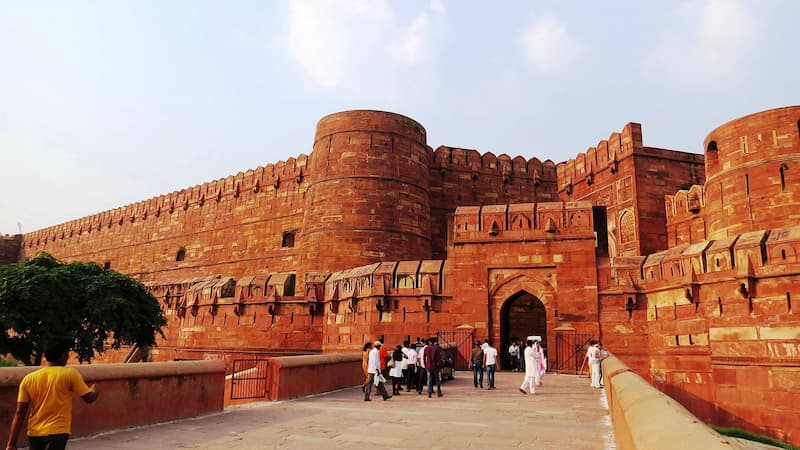
Located on the banks of the Yamuna River, Agra Fort is a majestic 16th-century fortress that served as the primary residence of the Mughal Emperors until the capital shifted to Delhi in 1638. Often overshadowed by its neighbor, the Taj Mahal, this sprawling complex is an architectural marvel in its own right, functioning as a “walled city” that preserves the legacy of India’s most powerful dynasty.
Agra Fort is a massive crescent-shaped citadel constructed primarily of red sandstone. Enclosed by double walls that rise over 20 meters high and stretch for 2.5 kilometers, it features four grand gates, though tourists today enter through the Amar Singh Gate.
Inside, the fort is a dense collection of “fairy-tale” palaces, mosques, and audience halls. Highlights include:
- Jahangiri Mahal: A grand red sandstone palace blending Hindu and Islamic motifs.
- Khas Mahal: A serene white marble palace overlooking the river.
- Diwan-i-Aam & Diwan-i-Khas: Ornate halls for public and private imperial audiences.
- Musamman Burj: An octagonal marble tower where Emperor Shah Jahan was imprisoned by his son, Aurangzeb, and spent his final years gazing at the Taj Mahal.
Attraction
Agra Fort attracts visitors worldwide because it offers a physical timeline of the Mughal Empire. While the Taj Mahal represents the pinnacle of romantic architecture, Agra Fort represents the empire’s military strength and administrative grandeur. Tourists come to see the transition from the rugged red sandstone structures of Emperor Akbar to the refined white marble artistry of Shah Jahan. The site also provides one of the most iconic viewpoints of the Taj Mahal from across the river.

Heritage
Inscribed in 1983, Agra Fort is a UNESCO World Heritage Site under Criterion (iii): It bears a unique testimony to the Mughal civilization, which at its peak represented a fusion of Persian, Timurid, and Indian artistic traditions.
The site is recognized as a masterpiece of design that influenced military and palace architecture across the Indian subcontinent for centuries.
Gateway
- City: Agra is the direct gateway.
- Airport: Agra Airport (AGR), also known as Kheria Airport, is a domestic hub. For international travelers, Indira Gandhi International Airport (DEL) in Delhi (approx. 210 km away) is the most common arrival point, followed by a 2–3 hour train or car journey.
- Lodging: Agra offers a high density of overnight options, from luxury hotels with Taj-views like The Oberoi Amarvilas and ITC Mughal to budget-friendly guesthouses in the Taj Ganj area.
When
- Months: October to March is the ideal window. The weather is cool and pleasant (8^C to 25^C), making it comfortable to explore the vast outdoor grounds.
- Daily Timing: Visit at sunrise or late afternoon (golden hour). Not only are the crowds thinner, but the low sun illuminates the red sandstone in a spectacular deep crimson.

Consideration
- Footwear: You will be walking on stone and gravel for several hours; wear comfortable, sturdy shoes.
- Guides: Licensed guides are available at the entrance. Ensure they have official ID, or consider using the AudioCompass app for a self-guided experience.
- Security: Like the Taj Mahal, the fort has strict security. Avoid carrying large bags, food, or electronics like tablets and tripods, as these may be restricted.
- Connectivity: Many heritage sites in India require online ticket booking through the Archaeological Survey of India (ASI) portal to avoid long queues at physical windows.

Resources
- Official Agra District Portal: The government source for official history and visiting hours.
- Archaeological Survey of India (ASI): The authority responsible for the site’s preservation; includes high-resolution maps and research.
- UNESCO World Heritage Centre: Detailed documentation on why the site holds universal value.
- Incredible India – Agra Fort: The national tourism board’s visual guide and traveler experience page.
- Viator – Agra Fort Tours: A reliable platform for booking skip-the-line tickets and private historian-led tours.
Featured Image
Amar Singh Gate, the entrance to Agra Fort (G Kaustav, Wikimedia/CC BY-SA 3.0).
In The News
Advertisement


Comments:
2 responses to “Agra Fort”
-
Is this…is this…could it be more beautiful than the Taj Mahal?
-
How interesting it was to read about Agra Fort! Finding out about the magnificent fortress’s rich history and architectural wonders is truly amazing. The clever arrangement and detailed patterns perfectly capture the opulence of the Mughal Empire. After reading this post, I’m eager to visit Agra Fort and take in its breathtaking atmosphere. I appreciate you sharing this thoughtful article.


Leave a Reply to Rohit bloggerCancel reply