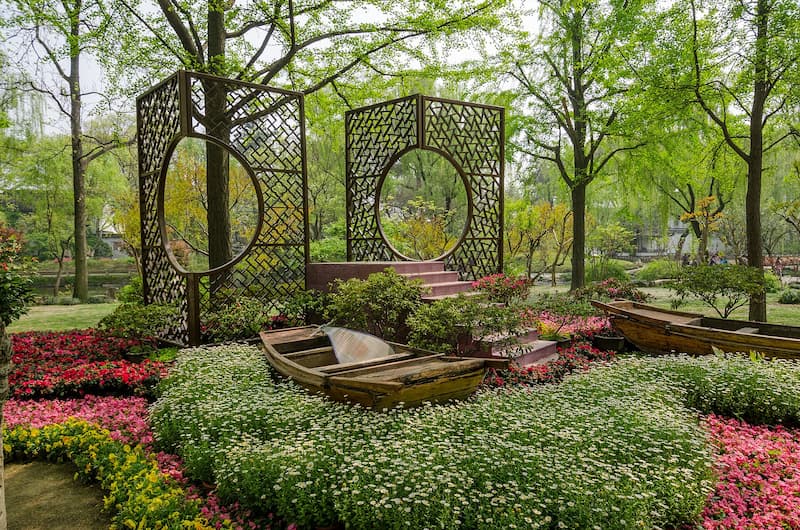
The Classical Gardens of Suzhou, located in Jiangsu Province, China, are considered the “pinnacle of Chinese garden design.” These gardens are not merely parks but meticulously crafted scholarly retreats that date back to the 6th century BCE, reaching their artistic zenith during the Ming and Qing dynasties (14th–20th centuries).
The site comprises nine representative gardens, with the Humble Administrator’s Garden (Zhuozhengyuan) being the largest and most famous. These gardens are designed as “microcosms of the natural world,” condensing mountains, forests, and rivers into a confined urban space.
- Key Elements: They feature winding pathways, limestone rockeries (often from Lake Tai), serene ponds, and elegant pavilions.
- The “Labyrinth” Effect: The layouts are purposefully non-linear, using techniques like “framed scenery” (kuangjing) where windows and doorways act as picture frames for the landscape.
- Major Gardens: Besides the Humble Administrator’s, other notable gardens include the Lingering Garden, the Master-of-the-Nets Garden (famous for its night opera), and the Lion Grove Garden, known for its complex rockery maze.
Attraction
Suzhou’s gardens attract millions of global visitors because they offer a rare, immersive experience of ancient Chinese high culture.
- “Venice of the East”: The gardens are integrated into a city of canals and stone bridges, providing a romantic, “old-world” atmosphere.
- Philosophical Depth: They are seen as a physical manifestation of Daoist and Confucian ideals—harmony between humans and nature.
- Artistic Perfection: Every detail, from the patterns of the pebble floors to the calligraphy on the pavilions, is an intentional work of art.
- Cultural Programs: Many gardens host traditional Kunqu opera performances and tea ceremonies, allowing tourists to engage with intangible heritage.

Heritage
The gardens were inscribed as a UNESCO World Heritage Site in 1997 (with extensions in 2000).
- Criteria (i), (ii), (iii), (iv), (v): They are recognized as masterpieces of human creative genius that represent the evolution of Chinese landscape design over 2,000 years.
- The site reflects an outstanding interchange of human values, where the garden served as a center for poetry, art, and intellectual discourse for the Chinese elite.
Gateway
- City: While Suzhou is the destination, Shanghai serves as the primary international gateway.
- Airports:Shanghai Hongqiao (SHA) and Shanghai Pudong (PVG).
- Note: From Hongqiao, a high-speed train takes only 30 minutes to reach Suzhou.
- Lodging: Suzhou itself has an abundance of lodging, ranging from world-class luxury hotels (like the Park Hyatt Suzhou or W Suzhou) to traditional courtyard guesthouses inside the historic canal districts.
When
- Spring (April to May): The gardens are in full bloom with wisteria, peonies, and cherry blossoms. The weather is mild and misty, enhancing the “ink painting” aesthetic.
- Autumn (September to October): The weather is crisp, and the osmanthus trees fill the air with fragrance. This is also the best time for the local delicacy, hairy crab.
- Avoid: The first week of May and October (Chinese National Holidays), as the gardens become extremely crowded.

Consideration
- Online Reservations: In 2026, almost all major gardens (especially the Humble Administrator’s) require pre-booked tickets via official apps (like Suzhou Tourism) or travel platforms. Walk-in tickets are rarely available during peak seasons.
- Walking Distance: While the gardens look small on maps, the winding paths and steps require significant walking. Wear comfortable footwear.
- Early Starts: To experience the tranquility for which these gardens are famous, arrive exactly when they open (usually 7:30 AM). By 10:00 AM, tour groups typically fill the narrow corridors.
- Language: While signage is bilingual, having a translation app is helpful for reading the poetic couplets inscribed on the buildings.

Resources
- UNESCO World Heritage – Suzhou: The official source for historical documentation and site maps.
- Travel to Suzhou – Official Site: The city’s official tourism portal with the latest 2026 event schedules.
- China Highlights – Suzhou Guide: Deep dives into individual gardens and logistical tips.
- The China Guide: Expert cultural context and specific advice on navigating the canal districts.
- GetYourGuide – Suzhou Tours: A reliable platform for booking private day trips from Shanghai, English-speaking guides, and night-tour tickets for the Master-of-the-Nets Garden.
Featured Image
Humble Administrator’s Garden (Xiquinho Silva, Wikimedia/CC BY 2.0).
In The News
Advertisement


Comments:
5 responses to “Classical Gardens of Suzhou”
-
Suzhou offers more than just canals and “diverse” foods. The Garden of the Humble Administrator dates back over 500 years to the early Ming dynasty and is considered one of China’s four great gardens. A leisurely stroll through this lush, sub-tropical garden can easily take two hours. There are also numerous scenic lakes nearby for recreational activities, and locals speak particularly highly of Jinji lake.
-
These are not Western-style gardens. You will see strangely shaped rocks, disordered landscapes, well-tended bushes and artificial hills. This is the Chinese way of finding the perfect balance between the human world and nature.
-
The garden is very, very Chinese. It is small but pretty. Living here must be good for the soul.
-
Walking in the Humble Administrator’s Garden is like taking a stroll through a painting. And the painting changes as the weather and season varies.
-
In The Humble Administrator’s Garden, there’s a wonderful illusion of being surrounded by nature rather than design, even though the place is meticulously planned. While walking around the garden whose different parts are connected by winding pathways, bridges, passages and pagodas, I realised how brilliantly the area had been designed. One part links to the other and as you walk over a zigzag bridge or through a circular doorway, the vistas around you and awaiting you are constantly changing. The garden never feels boring. There’s a stunning variety of flora and fauna that will thrill the naturalist and the garden has been planned in a way that, despite the intensive landscaping, nature doesn’t seem restrained. There’s the illusion of the wild without the hassle or discomfort – thorns, undergrowth, and so on – of the real wild.


.jpg)
Leave a Reply to LouCancel reply