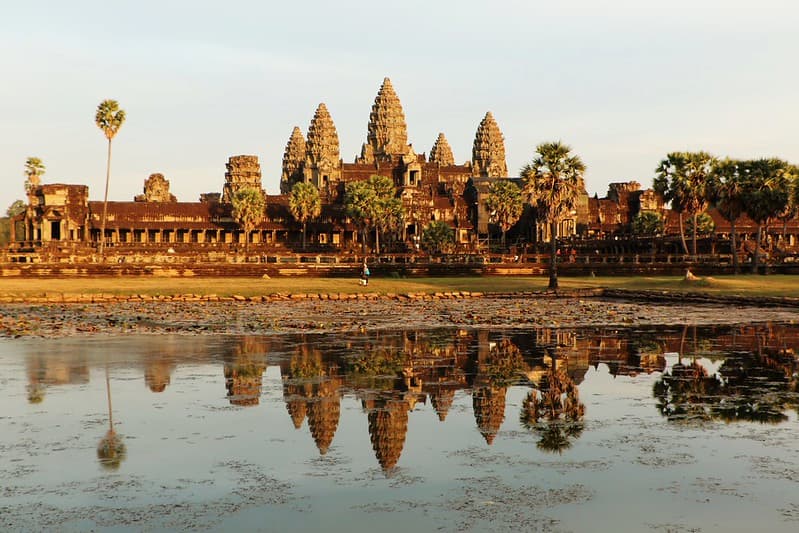
The Angkor Archaeological Park in Cambodia is one of the most significant archaeological sites in Southeast Asia and arguably the world’s most impressive collection of pre-industrial urbanism and religious architecture.
Stretching over roughly 400 square kilometers, Angkor was the heart of the powerful Khmer Empire from the 9th to the 15th centuries. It is not just a single temple but an entire ancient city complex.
- Angkor Wat: The “crown jewel,” it is the largest religious monument in the world. Originally a Hindu temple dedicated to Vishnu, it later became a Buddhist site. It is famous for its five lotus-like towers and extensive bas-reliefs depicting Hindu epics.
- Bayon Temple: Located at the center of the walled city of Angkor Thom, it is known for its “face towers”—massive, enigmatic stone faces smiling down from 54 Gothic towers.
- Ta Prohm: Often called the “Tomb Raider Temple,” it has been left largely as it was found, with giant silk-cotton trees and strangler figs growing out of the stone ruins.
- Hydraulic Mastery: The site is also a testament to ancient engineering, featuring massive man-made reservoirs (Barays) and intricate canal systems that once supported a population of nearly a million people.
Attraction
Angkor attracts millions annually for its spiritual weight and photographic grandeur:
- Sunrise at the Lily Pond: Watching the sun rise behind the three central towers of Angkor Wat, perfectly reflected in the northern lily pond, is a “bucket list” experience for many.
- Architectural Wonder: The sheer scale of the stone-carving craftsmanship—miles of intricate “Apsara” (celestial dancers) and battle scenes—is unparalleled.
- Cinematic Allure: Its jungle-entwined ruins offer an adventurous, “lost world” atmosphere that has been popularized by Hollywood films and travel documentaries.

Heritage
Inscribed in 1992, Angkor is protected under Criteria (i), (ii), (iii), and (iv):
- Criterion (i): It represents the entire range of Khmer art and includes indisputable artistic masterpieces.
- Criterion (ii): Khmer art developed here had a profound influence over much of Southeast Asia.
- Criterion (iii): It is the primary remaining testimony to the Khmer Empire, a civilization that once dominated the region.
- Criterion (iv): It showcases the unique evolution of Khmer architecture, which merged Indian influences with local traditions to create a distinct oriental style.
Gateway
- The City: Siem Reap is the vibrant gateway town located just 6 km from the park.
- Airport: Siem Reap–Angkor International Airport (SAI), opened in late 2023, is the primary commercial hub. It is located about 45 km from the city center and can handle large international aircraft.
- Lodging: Siem Reap offers everything from luxury 5-star resorts like the Park Hyatt Siem Reap to boutique stays and budget hostels.
When
- Peak Season (November to February): The weather is dry and relatively “cool” (25–30°C). This is the best time for photography but also the most crowded.
- Shoulder Season (June to October): The rainy season. While humid, the temples look spectacular against the lush green moss and jungle, and the moats are full of water.
- Equinox (March 21 & Sept 22): The sun aligns perfectly with the central tower of Angkor Wat during sunrise.

Consideration
- Dress Code: It is a sacred site. Shoulders and knees must be covered. Scarves are often rejected at the entrance to the uppermost levels; it is better to wear a T-shirt and light trousers.
- The Angkor Pass: You must buy a pass (1-day for $37, 3-day for $62, or 7-day for $72). Purchase it the afternoon before your first full day to catch the sunset for free.
- Transportation: The site is too vast to walk. Rent a Tuk-Tuk for the day (15–25) or hire an official guide for deeper historical context.
- Physicality: Exploring requires significant walking and climbing steep, uneven stone stairs. Wear sturdy walking shoes.

Resources
- UNESCO World Heritage – Angkor: The official global source for maps, conservation reports, and history.
- Visit Angkor: A passionate independent blog covering temple stories and local culture.
- APSARA Authority: The official Cambodian government body that manages and protects the park.
- The Common Wanderer – Angkor Guide: A highly visual, modern guide to the “Small” and “Grand” circuits.
- Travel Happy – Angkor Guide: A practical guide that includes links for airport transfers and hotel bookings.
Featured Image
Angkor Wat (Juan Antonio Segal, Flickr/CC BY 2.0).
In The News
Advertisement

Comment:
5 responses to “Angkor”
-
Siem Reap, a beautiful and quiet location, is truly one of Asia’s gems.
LikeLike
-
This is the Khmer nation’s pride, because Angkor is not only part of the prosperous heritage of Cambodia, but it has also become the heart and soul of the nation,
LikeLike
-
Siem Reap is one of those places I will keep going back to, there are SO many incredible temples and places to visit! The food is out of this world as well.
LikeLike
-
With more than 2 million visitors a year, Angkor Wat is one of the most famous tourist sites in the world. So it comes as no surprise that it is rush hour at 5 am in Siem Reap, the closest city, with buses and tuk-tuks filled with visitors streaming out of town towards the park. Standing amid a crowd on the moat in front of the temple, with cameras clicking and flashlights flickering, I fear that this might be another overrated sunrise experience. But when the sky above the stone spires of the temple complex slowly turns pink and then mauve, it is a truly magical sight not to be missed. The temple of Ta Prohm, commonly known as the “Tomb Raider” temple because its location was used as part of the movie set of the same name, is also high on my must-see list. Some impressive root formations of large trees winding their way over walls, towers, courtyards, and maze-like corridors remind us of the incredible power of the jungle.
LikeLike
-
To start the day well, the Cambodian sunrise is a must-see. Check the weather so not to wake up too early to a cloudy day. If you’re lucky, cotton candy rose and blue make the sky reflected on a lake look like a painting.
After watching the beautiful sunrise, head to the interior of the Angkor Wat temple which gives you an idea of the masterminds behind the ancient kingdom. Besides these mindblowing insights, the building style of the five symmetrical towers inspire awe. Don’t forget to climb to the top of the central tower for a view of the entire plateau. Remember to keep knees and shoulders covered to visit the temples.
LikeLike

 All About World Heritage Sites
Leave a reply to Tanya Cancel reply