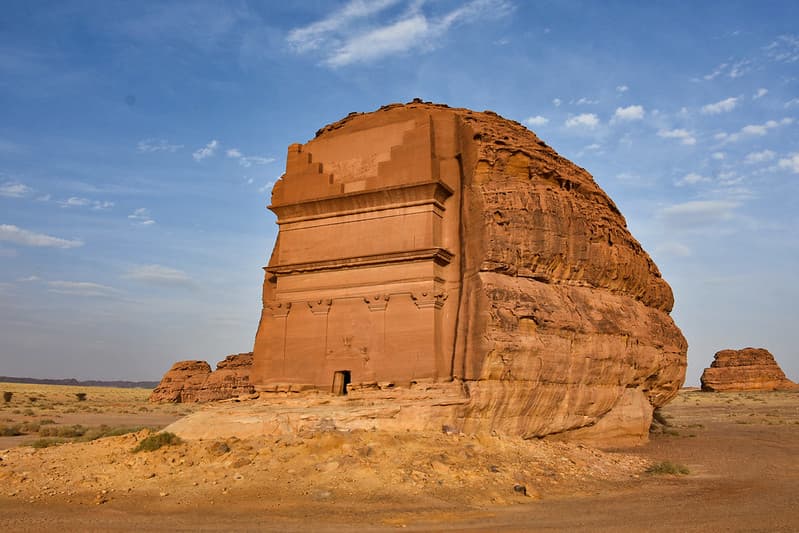
Hegra Archaeological Site (al-Hijr / Madā’in Ṣāliḥ) is Saudi Arabia’s premier historical landmark, offering a silent, monumental window into the Nabataean Kingdom’s southern reaches.
Hegra is the largest conserved site of the Nabataean civilization south of Petra in Jordan. Spanning over 1,600 hectares, it is an “open-air museum” featuring 111 monumental tombs dating from the 1st century BCE to the 1st century CE. These tombs are meticulously carved into monolithic sandstone outcrops that rise abruptly from the desert floor. Unlike Petra, which is a hidden city reached through a narrow canyon, Hegra is characterized by its isolation and the sheer visibility of its facades against the stark, golden dunes of the AlUla desert.
Key features include:
- Qasr al-Farid (The Lonely Castle): A massive, four-story unfinished tomb carved from a single, isolated rock. It is the site’s most iconic image.
- Jabal Ithlib: A religious area featuring a large natural slit in the rock (The Siq) leading to a “Diwan” or meeting hall used for sacred banquets.
- The Hejaz Railway: Remains of the early 20th-century Ottoman railway that once connected Damascus to Medina.
Attraction
Hegra has recently emerged as a “bucket-list” destination due to its mystery and preservation:
- The “Other Petra”: It offers the same architectural brilliance as Petra but with significantly fewer crowds and a more pristine, untouched atmosphere.
- Archaeological Depth: Recent excavations have revealed “Hinat,” a reconstructed face of a Nabataean woman based on remains found in a tomb, bringing a human element to the ancient stones.
- Star-Gazing and Landscapes: The surrounding AlUla region features surreal rock formations like Elephant Rock and the mirror-clad Maraya Concert Hall, which reflects the desert landscape.

Heritage
Hegra was the first site in Saudi Arabia to be inscribed on the UNESCO World Heritage List in 2008.
- Criterion (ii): The site demonstrates a significant exchange of human values, blending architectural styles from the Assyrian, Egyptian, Phoenician, and Hellenistic worlds with Nabataean ingenuity.
- Criterion (iii): It is a unique and exceptional testimony to the Nabataean civilization, which thrived on the incense trade route but left few written records.
Gateway
- Gateway Town: AlUla is the primary hub for the site, located about 22 km away.
- Commercial Airport: AlUla International Airport (ULH), also known as Prince Abdul Majeed bin Abdulaziz International Airport, receives direct flights from Riyadh, Jeddah, and international hubs like Dubai and Doha.
- Lodging: AlUla offers world-class luxury, including the Banyan Tree AlUla, Habitas, and The Chedi Hegra, alongside more accessible “Airstream” glamping and boutique hotels in the Old Town.
When
- Winter Season (October to March): This is the “golden window.” Temperatures range from 10°C to 28°C. This period coincides with the Winter at Tantora festival, featuring high-end concerts and cultural events.
- Golden Hour: Aim for sunrise or sunset tours. The sandstone glows a deep orange-red, and the shadows accentuate the intricate carvings on the tomb facades.
- Summer (May to September): Best avoided. Temperatures often exceed 40°C (104°F), and many outdoor activities are restricted during the heat of the day.

Consideration
- Mandatory Guided Tours: You cannot drive your own vehicle into the archaeological zones. Visitors must book official tours (by luxury coach or vintage Land Rover) through the Experience AlUla platform.
- Booking in Advance: Slots are capacity-managed to protect the site; it is highly recommended to book your Hegra tour weeks in advance, especially during winter.
- Visas: Most international tourists can obtain an e-Visa for Saudi Arabia, but ensure your passport is valid for at least six months.
- Etiquette: While Saudi Arabia has modernized rapidly, modest dress (shoulders and knees covered) is still expected. Alcohol is strictly prohibited.
- Physicality: Exploring Hegra involves walking on sand and uneven ground. While many sites are visible from the vehicle, the most immersive experience requires short treks.
_(8136618664).jpg)
Resources
- UNESCO World Heritage – Hegra: Detailed historical data and official conservation criteria.
- Experience AlUla: The official government tourism portal for booking tours, hotels, and events.
- The Royal Commission for AlUla (RCU): Insights into the long-term sustainable development and archaeological missions at the site.
- Lonely Planet – Saudi Arabia: Practical travel tips, budget advice, and regional context.
- Viator – Hegra and AlUla Tours: A platform to book comprehensive day trips or private photography tours of the region.
Featured Image
Qasr al-Farid, or The Lonely Castle, (Richard Mortel, Flickr/CC BY 2.0).
In The News
Advertisement


Comments:
6 responses to “Hegra Archaeological Site (al-Hijr / Madā’in Ṣāliḥ)”
-
This is exceptional. I never would have guessed there were places so beautiful in Saudi Arabia. I could just spend days exploring this place. I would tell all my friends back home to visit.
-
Spectacular… wonderful… breathtaking,
-
We got to explore this region that dates back thousands of generations of the Nabataeans. It is a very beautiful, spiritual place that many people don’t know about.
-
We didn’t expect it to be this magnificent. We keep hearing stories from people but this is way more than we thought it would be. It’s amazing, it’s beautiful. So much history, so much going on.
-
I learned firsthand that is a place of awe-inspiring beauty, a landscape of cliffs and canyons featuring ancient petroglyphs and rock art. It feels like another planet. There’s no light pollution, so you can see pretty much every single star in the sky. There is no traffic, so the air is fresh, there are no skyscrapers, so your views are totally unobstructed. The mushroom and elephant shaped rock formations also add to that out worldly notion.
-
While in AlUla, there is also an opportunity to visit its old town, where the community lived in close proximity, as well as the infinitely Instagrammable Elephant Rock, so called because of its uneven archway, resembling an elephant’s trunk. Natural wonders are plentiful, with the quiet region allowing for stunning stargazing, with views of the Milky Way uninterrupted by light pollution.

Leave a Reply to VirginieCancel reply