 Netherlands
N52 21 54 E4 53 16
Date of Inscription: 2010
Criteria: (i)(ii)(iv)
Property : 198.2 ha
Buffer zone: 481.7 ha
Ref: 1349
News Links/Travelogues:
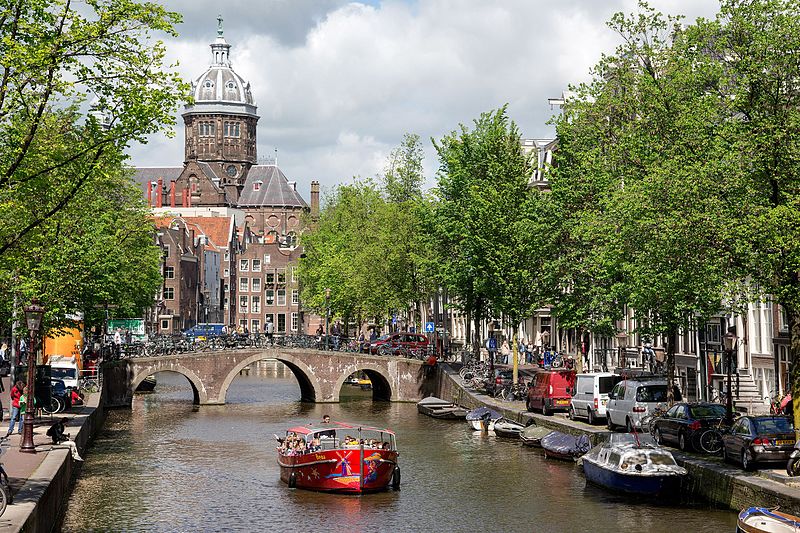
The historic urban ensemble of the canal district of Amsterdam was a project for a new ‘port city’ built at the end of the 16th and beginning of the 17th centuries. It comprises a network of canals to the west and south of the historic old town and the medieval port that encircled the old town and was accompanied by the repositioning inland of the city’s fortified boundaries, the Singelgracht. This was a long-term programme that involved extending the city by draining the swampland, using a system of canals in concentric arcs and filling in the intermediate spaces. These spaces allowed the development of a homogeneous urban ensemble including gabled houses and numerous monuments. This urban extension was the largest and most homogeneous of its time. It was a model of large-scale town planning, and served as a reference throughout the world until the 19th century.

The Amsterdam Canal District illustrates exemplary hydraulic and urban planning on a large scale through the entirely artificial creation of a large-scale port city. The gabled facades are characteristic of this middle-class environment, and the dwellings bear witness both to the city’s enrichment through maritime trade and the development of a humanist and tolerant culture linked to the Calvinist Reformation. In the 17th and 18th centuries, Amsterdam was seen as the realization of the ideal city that was used as a reference urban model for numerous projects for new cities around the world.
Criterion (i): The Amsterdam Canal District is the design at the end of the 16th century and the construction in the 17th century of a new and entirely artificial ‘port city.’ It is a masterpiece of hydraulic engineering, town planning, and a rational programme of construction and bourgeois architecture. It is a unique and innovative, large-scale but homogeneous urban ensemble.
Criterion (ii): The Amsterdam Canal District bears witness to an exchange of considerable influences over almost two centuries, in terms not only of civil engineering, town planning, and architecture, but also of a series of technical, maritime, and cultural fields. In the 17th century Amsterdam was a crucial centre for international commercial trade and intellectual exchange, for the formation and the dissemination of humanist thought; it was the capital of the world-economy in its day.
Criterion (iv): The Amsterdam Canal District represents an outstanding example of a built urban ensemble that required and illustrates expertise in hydraulics, civil engineering, town planning, construction and architectural knowhow. In the 17th century, it established the model for the entirely artificial ‘port city’ as well as the type of Dutch single dwelling with its variety of façades and gables. The city is testimony, at the highest level, to a significant period in the history of the modern world.
Suggested Bases:
Amsterdam is the Netherlands’ capital and financial, cultural and creative centre with more than 850,000 inhabitants. Amsterdam is known for the canals that criss-cross the city, its impressive architecture and more than 1,500 bridges. The city has a heritage dating back to the Dutch Golden Age in the 17th century as well as a diverse art scene and a bustling nightlife. Settled as a small fishing village in the late 12th century, Amsterdam became one of the most important trading centres in the world during the Dutch Golden Age of the 17th century. The city’s small medieval centre rapidly expanded as the Jordaan and the Canal District were constructed; the latter’s cultural significance was acknowledged when it became a UNESCO World Heritage Site in 2010. In the 19th and 20th centuries, the city expanded in all directions, with many new neighbourhoods and suburbs designed in modernist styles. Amsterdam is not the seat of the government, which is in The Hague [read more].
Rotterdam is a city in the province of South Holland in the west of the Netherlands. The city is the second largest in the country with a population of approximately 640,000 inhabitants in the municipality and about 2.3 million inhabitants in the shared metropolitan area of The Hague and Rotterdam MRDH. Rotterdam is a vibrant, multicultural city; it is known for its university (Erasmus), cutting-edge architecture, lively cultural life, industrial riverside setting, its maritime heritage and colourful summer events. The municipality stretches all the way to the North Sea with gigantic areas like Europoort and Maasvlakte 1&2. All belong to the Port of Rotterdam. Starting as a dam constructed in 1270 on the Rotte River, Rotterdam has grown into a major international commercial centre. The port of Rotterdam is Europe’s busiest port by cargo tonnage, and was the world’s busiest from 1962 until it was surpassed by Shanghai in 2004. Rotterdam’s commercial and strategic importance is based on its location near the mouth of the Nieuwe Maas (New Meuse), a channel in the delta formed by the Rhine and Meuse on the North Sea [read more].
The Hague is a city in the province of South Holland in the Netherlands. It is the seat of the Dutch parliament and government, and the residence of King Willem-Alexander. It is not the capital city, which is Amsterdam. The municipality (which is the city) has more than 525,000 inhabitants, it is the third largest city of the Netherlands. Since January 1, 2015 The Hague and its suburbs are part of the Rotterdam-The Hague Metropolitan Region. The Hague lies on the North Sea and is home to Scheveningen, the most popular seaside resort of the Netherlands. Also the smaller resort of Kijkduin is part of the city. Internationally, The Hague is often known as the “judicial capital of the world” due to the many international courts that are located in the city. Among these are the International Court of Justice, the International Criminal Tribunal for the former Yugoslavia and, since 2004, the International Criminal Court [read more].
 All About World Heritage Sites

