
 Portugal
Northern region
N41 8 30 W8 37 0
Date of Inscription: 1996
Criteria: (iv)
Ref: 755
News/Travelogue:
The city of Oporto, built along the hillsides overlooking the mouth of the Douro river, is an outstanding urban landscape with a 2,000-year history. Its continuous growth, linked to the sea (the Romans gave it the name Portus, or port), can be seen in the many and varied monuments, from the cathedral with its Romanesque choir, to the neoclassical Stock Exchange and the typically Portuguese Manueline-style Church of Santa Clara.
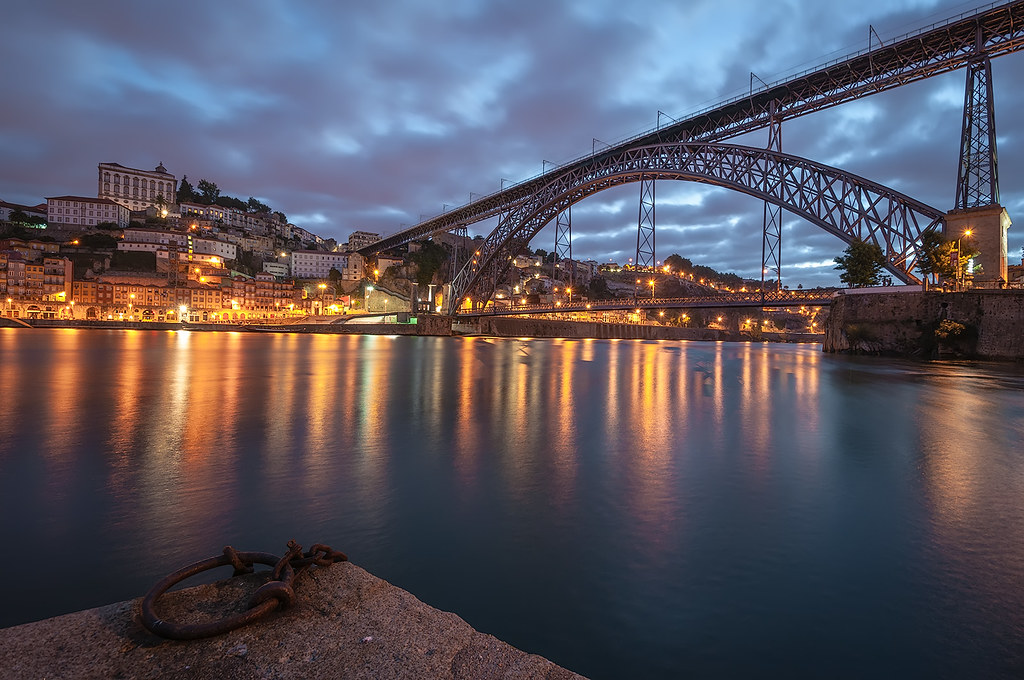
The Historic Centre of Oporto, Luiz I Bridge and Monastery of Serra do Pilar, built along the hills overlooking the mouth of the Douro River in northern Portugal, is an outstanding urban landscape with a 2,000-year history. The Romans gave it the name Portus, or port, in the 1st century BC. Military, commercial, agricultural, and demographic interests came together in this place. Its continuous growth linked to the sea can be seen in its many and varied monuments, from the cathedral with its Romanesque choir to the neoclassical Stock Exchange and the typically Portuguese Manueline-style Church of Santa Clara. The urban fabric of the Historic Centre of Oporto and its many historic buildings bear remarkable testimony to the development over the past thousand years of a European city that looks outward to the sea for its cultural and commercial links.
Archaeological excavations have revealed human occupation at the mouth of the Douro River since the 8th century BC, when there was a Phoenician trading settlement there. By the 5th century the town had become a very important administrative and trading centre. In the succeeding centuries it was subjected to attacks and pillage by successive groups, including Swabians, Visigoths, Normans, and Moors. By the early 11th century, however, it was firmly established as part of the Castilian realm. Expansion came in the 14th century with the construction of massive stone town walls to protect its two urban nuclei: the original medieval town and the hitherto extramural harbour area. The Historic Centre of Oporto is located within the line of these Fernandine walls (named after Dom Fernando, in whose reign they were completed in 1376), together with some smaller areas that retain their medieval characteristics. This area conserves to a large extent Oporto’s medieval town plan and urban fabric, along with some later monumental insertions as well as the two remaining sections of the Fernandine walls.
In this area are many important ecclesiastical buildings such as the cathedral – whose Romanesque core dates to the 12th century – and fine churches in various styles. The historic centre also has a number of outstanding public buildings, including the São João theatre (1796-1798; 1911-1918) and the former prison “Cadeia da Relação” (1765-1796). Among the important later structures are Palácio da Bolsa (1842-1910) and São Bento railway station (1900-1916). This rich and varied architecture eloquently expresses the cultural values of succeeding periods – Romanesque, Gothic, Renaissance, Baroque, neoclassical, and modern. The active social and institutional tissue of the town ensures its survival as a living historic centre. This property also includes Luíz I Bridge and Monastery of Serra do Pilar.
Criterion (iv): The Historic Centre of Oporto, Luiz I Bridge and Monastery of Serra do Pilar with its urban fabric and its many historic buildings bears remarkable testimony to the development over the past thousand years of a European city that looks outward to the sea for its cultural and commercial links.
Suggested Bases:
Porto is Portugal’s second largest city and the capital of the Northern region. Porto is a busy industrial and commercial centre. The city itself isn’t very populous (about 300,000 inhabitants), but the Porto metropolitan area (Greater Porto) has some 2,500,000 inhabitants in a 50km radius, with cities like Gaia, Matosinhos, Maia, and Gondomar. The city was built along the hills overlooking the Douro river estuary, and its historical center was awarded World Heritage status by UNESCO in 1996. It has been continuously inhabited since at least the 4th Century, when the Romans referred to it as Portus Calle Porto has a semi-Mediterranean climate, although it’s strongly affected by the Atlantic ocean, which makes it cooler than other cities with this climate. However, temperatures can rise as high as 40ºC in August during occasional heat waves. [read more]
Vila Nova De Gaia is a city in Oporto (Porto) district of Northern Portugal. It is home of cellars of port wine, several shopping centers and some of the best beaches. Perhaps the most famous tourist attraction in Gaia are the Port Wine Cellars, warehouses where the famous Port wine is stored. The Cellars are placed in Ribeira de Gaia, an area of the city located in the bank of River Douro opposite Porto. Ribeira de Gaia has also some typical and international restaurants, particularly in Cais de Gaia. Even if you are not in visiting the cellars, you should visit Ribeira the Gaia in order to get some amazing views of Porto. Small Nature Reserve for the Protection of Birds, (Begin at the base of the Dom Luis I bridge and head down river about 5.3 km. The journey is easy but not particularly interesting). [read more]
Braga is a city in the Cávado Valley of Northern Portugal. It is the fifth largest city in Portugal after Lisbon, Porto, Amadora and Vila Nova de Gaia. It is an ancient and modern city and one of the most important Archdiocese. Braga has a university is called the Universidade do Minho, and it is around 30 years old. It has a medium size campus area with lots of bars and cheap restaurants around it. There are lots of places to visit in Braga. The historic city center, with the cathedral and other churches, museums and traditional shops. The cathedral is almost 1000 years old, and while in there you can have a guided tour to its treasure. You can also visit the beautiful Braga Municipal Stadium, used for the 2004 European Football Championships held in Portugal. [read more]
 All About World Heritage Sites