 United Kingdom of Great Britain and Northern Ireland
Mainland Orkney, Scotland
Multiple locations
N58 59 45.8 W3 11 19.2
Date of Inscription: 1999
Minor boundary modification inscribed year: 2015
Criteria: (i)(ii)(iii)(iv)
Property : 15 ha
Buffer zone: 6,258 ha
Ref: 514bis
News Links/Travelogues:
The group of Neolithic monuments on Orkney consists of a large chambered tomb (Maes Howe), two ceremonial stone circles (the Stones of Stenness and the Ring of Brodgar) and a settlement (Skara Brae), together with a number of unexcavated burial, ceremonial and settlement sites. The group constitutes a major prehistoric cultural landscape which gives a graphic depiction of life in this remote archipelago in the far north of Scotland some 5,000 years ago.

The Orkney Islands lie 15km north of the coast of Scotland. The monuments are in two areas, some 6.6 km apart on the island of Mainland, the largest in the archipelago.
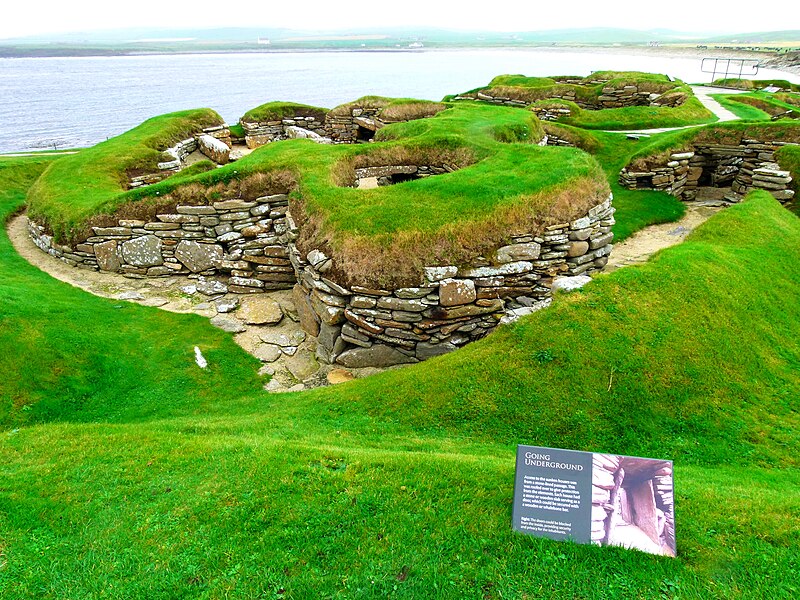
The group of monuments that make up the Heart of Neolithic Orkney consists of a remarkably well-preserved settlement, a large chambered tomb, and two stone circles with surrounding henges, together with a number of associated burial and ceremonial sites. The group constitutes a major relict cultural landscape graphically depicting life five thousand years ago in this remote archipelago.
The four monuments that make up the Heart of Neolithic Orkney are unquestionably among the most important Neolithic sites in Western Europe. These are the Ring of Brodgar, Stones of Stenness, Maeshowe and Skara Brae. They provide exceptional evidence of the material and spiritual standards as well as the beliefs and social structures of this dynamic period of prehistory.
The four main monuments, consisting of the four substantial surviving standing stones of the elliptical Stones of Stenness and the surrounding ditch and bank of the henge, the thirty-six surviving stones of the circular Ring of Brodgar with the thirteen Neolithic and Bronze Age mounds that are found around it and the stone setting known as the Comet Stone, the large stone chambered tomb of Maeshowe, whose passage points close to midwinter sunset, and the sophisticated settlement of Skara Brae with its stone built houses connected by narrow roofed passages, together with the Barnhouse Stone and the Watch Stone, serve as a paradigm of the megalithic culture of north-western Europe that is unparalleled.
The property is characteristic of the farming culture prevalent from before 4000 BC in northwest Europe. It provides exceptional evidence of, and demonstrates with exceptional completeness, the domestic, ceremonial, and burial practices of a now vanished 5000-year-old culture and illustrates the material standards, social structures and ways of life of this dynamic period of prehistory, which gave rise to Avebury and Stonehenge (England), Bend of the Boyne (Ireland) and Carnac (France).
The monuments on the Brodgar and Stenness peninsulas were deliberately situated within a vast topographic bowl formed by a series of visually interconnected ridgelines stretching from Hoy to Greeny Hill and back. They are also visually linked to other contemporary and later monuments around the lochs. They thus form a fundamental part of a wider, highly complex archaeological landscape, which stretches over much of Orkney. The current, open and comparatively undeveloped landscape around the monuments allows an understanding of the apparently formal connections between the monuments and their natural settings. The wealth of contemporary burial and occupation sites in the buffer zone constitute an exceptional relict cultural landscape that supports the value of the main sites.
Criterion (i): The major monuments of the Stones of Stenness, the Ring of Brodgar, the chambered tomb of Maeshowe, and the settlement of Skara Brae display the highest sophistication in architectural accomplishment; they are technologically ingenious and monumental masterpieces.
Criterion (ii): The Heart of Neolithic Orkney exhibits an important interchange of human values during the development of the architecture of major ceremonial complexes in the British Isles, Ireland and northwest Europe.
Criterion (iii): Through the combination of ceremonial, funerary and domestic sites, the Heart of Neolithic Orkney bears a unique testimony to a cultural tradition that flourished between about 3000 BC and 2000 BC. The state of preservation of Skara Brae is unparalleled amongst Neolithic settlement sites in northern Europe.
Criterion (iv): The Heart of Neolithic Orkney is an outstanding example of an architectural ensemble and archaeological landscape that illustrate a significant stage of human history when the first large ceremonial monuments were built.
Suggested Bases:
Kirkwall is the largest town and capital of the Orkney Islands in Scotland, and is some 40 mi (64 km) north of mainland Britain. Kirkwall has two faces, depending on where you have just come from. If arriving from a large city such as Edinburgh or Glasgow, it is a small, quiet town, with a gentle pace of life. On the other hand, if you arrive from a more remote area, such as the outer islands of Orkney, Kirkwall seems like a buzzing metropolitan centre with shops, cafes, bars, traffic and areas of housing and industry sprawling south, east and west from its busy harbour. The presence of cruise ships in Kirkwall can make a substantial difference to the town. Arrival of a 4000-person cruise ship over summer can cause queues to attractions and a jostle for space in the tea-rooms. If you can, time your visit to not be on a… [read more].
Thurso is a small town in Caithness on the north coast of the Scottish Highlands. The name probably refers to the deity Thor, and this area was Norse until the 13th C. The present town was laid out on a grid pattern in the 19th C when the railway arrived; its population boomed in the 1950s when Dounreay nuclear power plant was established 9 miles west. It’s long been a fishing port, and its harbour at Scrabster is a route to the Orkney Islands: many visitors are just passing through to catch a ferry. The main reasons to stay here are for sea-sports especially surfing, and to explore the rugged scenic coastline. Walk onto Holborn Head, the peninsula just north of Scrabster, for great sea views. The “Clett Rock” just below the north edge is a sea-stack swirling with birds. Dunnet Head is seen to the east and cloud-wreathed Hoy to… [read more].
Inverness is a city in the Scottish Highlands, situated where the River Ness flows out into the Moray Firth. It’s the only town of any size in the Highlands, and is the region’s commercial and administrative centre. It’s an agreeable Victorian town that has no stand-out tourist attractions of its own, but has good transport and choice of lodging and eating places. So it’s a good base for exploring nearby Loch Ness, Black Isle, Culloden, Spey valley and Cairngorm National Park. See Inverness Castle. A great defensive position it’s not: castles on this site have been serially destroyed, most recently in 1746 when its Jacobite occupiers wrecked the medieval bastion to prevent its use by government forces. The elegant pink sandstone edifice that now stands here was built in 1847. It houses the Sheriff Court, and the only parts accessible to visitors are the surrounding gardens, and the viewpoint from the… [read more].
 All About World Heritage Sites

